Why did they go to the Wuwei Heavy Ion Center for medical treatment?
Why did they go to the Wuwei Heavy Ion Center for medical treatment?
Reason
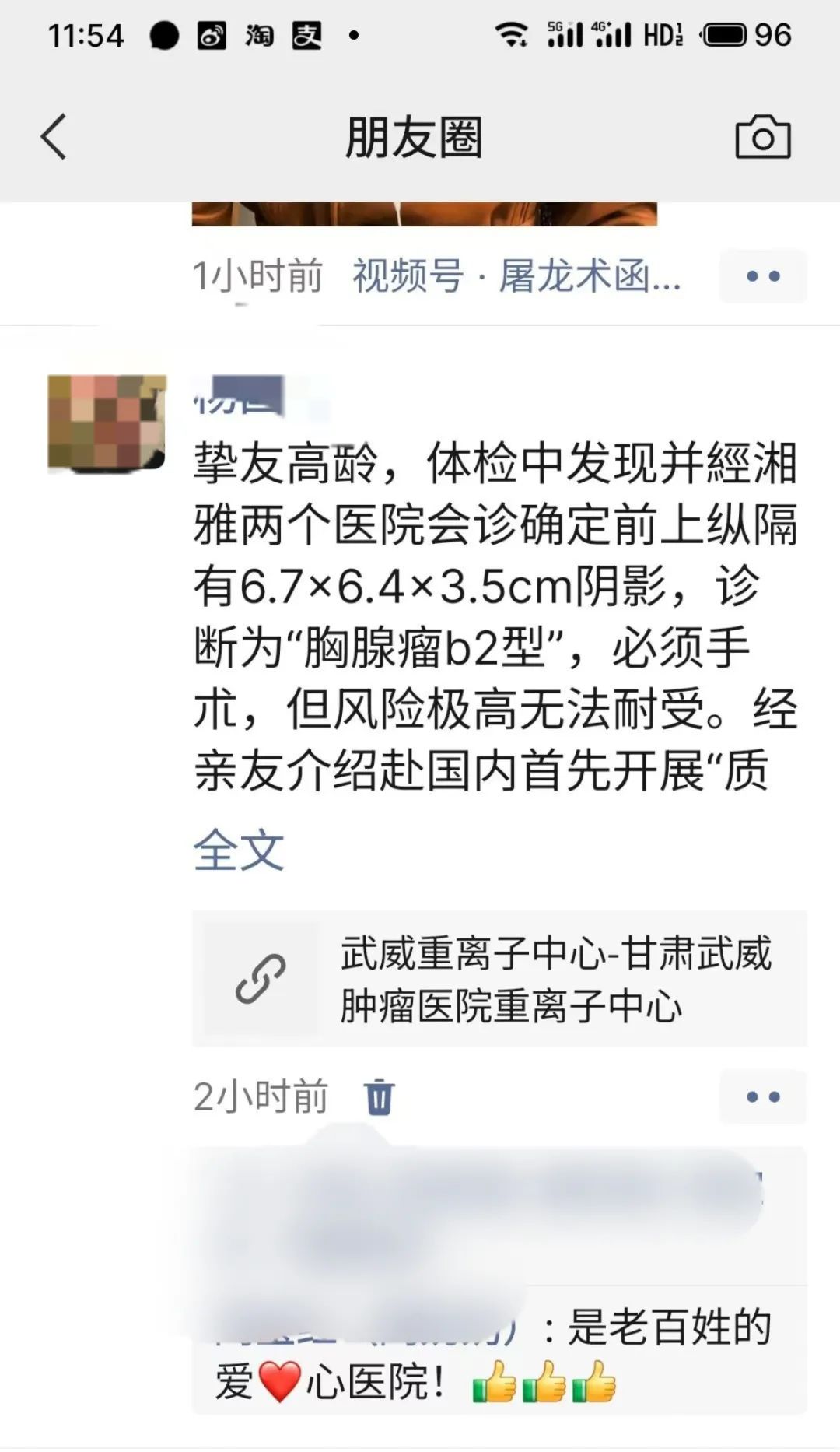
A close friend was found to have a "shadow" in the mediastinum during a physical examination, preliminarily diagnosed as either a thymoma or a teratoma. The family was frantic with worry and immediately sought medical attention at two of Hunan's top universities' hospitals. They registered for "PhD-level consultations," "expert consultations," and "special-needs consultations," all of which concluded that the tumor was a B2-type thymoma, measuring 6.7 x 6.5 cm. They were told surgery was mandatory. At the same time, they were informed that for a patient nearing eighty years old, the surgical risks were extremely high—the operation could become the final straw that breaks the camel's back. Even if the patient survived the surgery, the chest incision might not heal properly. They suggested going to a cancer hospital for "radiotherapy" or taking traditional Chinese medicine. The entire family felt as if they had fallen into an abyss.
In their despair, a relative recommended the Gansu Wuwei Heavy Ion Center and Shanghai Proton and Heavy Ion Center. Two lung cancer patients from their workplace, who were inoperable, had undergone "heavy ion" therapy in Wuwei and achieved clinical cures with remarkable results. A glimmer of hope appeared in the darkness.
Initial Introduction to the Wuwei Heavy Ion Center
The Wuwei Heavy Ion Center is scientifically supported by the Institute of Modern Physics under the Chinese Academy of Sciences, with operational management entrusted to Wuwei Cancer Hospital. Covering a site area of 2,865 mu (approximately 191 hectares), it is China's first medical institution to utilize domestically developed heavy ion therapy for cancer treatment, filling a critical domestic gap in this field. Since its inauguration in 2020, the center has accumulated clinical experience with over 1,000 cases. Heavy ions refer to charged particles with an atomic number greater than 2. Among them, carbon ions stand out as particularly suitable for tumor therapy. This treatment technology is internationally recognized by the medical community as one of the most optimal approaches for cancer treatment. It can be widely applied to various solid tumors where surrounding normal tissues can tolerable radiation sensitivity, as well as to cases that are resistant to conventional chemotherapy, difficult to control, and/or ineligible for surgical intervention.
Online consultation
Someone had previously contacted the Shanghai "heavy ion" hospital, paying a 298-yuan online registration fee for a three-minute consultation, only to be told to bring all medical records and join the waiting list in Shanghai. Time was of the essence—every second counted. After ruling out Shanghai, they immediately reached out online to the Gansu Wuwei Heavy Ion Center. The hospital's service hotline staff were warm and professional. Deputy Director Chen Dongji, a leading expert on the project, personally conducted the online consultation. After reviewing the enhanced CT scans from Xiangya Hospital electronically, he promptly confirmed that the center could provide non-surgical treatment and welcomed them to come for treatment.
What was particularly heartwarming was that the online consultation at this hospital was completely free—no "registration fee," no "consultation fee," and no need for prior appointment.
Bed Arrangement via Interdepartmental Borrowing
Their son, a dutiful young man, drove 1,700 kilometers to reach the Gansu Wuwei Heavy Ion Center. By the time they arrived, it was already past working hours. Deputy Director Chen Dongji and Associate Director Chen Weizuo were still waiting for them. Since no regular beds were available, they arranged for a temporary bed by borrowing one from a neighboring department. Considering they had traveled such a long distance, the hospital even provided two extra beds for caregivers.
A Powerful Tool for Differential Diagnosis
The patient was admitted on Friday. In addition to routine tests, a thorough discussion was organized by Director Chen and Associate Director Chen. The Contrast-enhanced CT scan revealed calcifications within the tumor mass—a feature not typical of thymoma but possible in teratomas, though chronic lymphadenitis could not be ruled out. The central part of the mass showed faint contrast enhancement, raising the possibility of two separate lesions. To clarify the diagnosis, it was decided to perform an emergency PET-CT scan on Saturday morning. The results showed two soft tissue masses: the right one measured 31.6×17.7×25.7 mm, while the left was slightly smaller. There was mild FDG uptake, and the previously observed pleural effusion had completely resolved. This differed from the enhanced CT findings at Xiangya Hospital. A thoracic surgery consultation was immediately requested. Director Lu, fresh off the operating table, made the effort to visit the patient in person. The consultation concluded that a biopsy was needed to confirm the diagnosis. Director Lu provided the patient with a detailed explanation, placing special emphasis on psychological support—an approach that directly helped alleviate the patient’s anxiety and encouraged cooperation. He then personally performed the puncture procedure to collect specimens for pathological examination.
The CT-guided biopsy went smoothly, with Dr. Sun Dongdong, winner of Gansu Province’s First Prize in CT Diagnosis, operating the machine. During the procedure, it was observed that the left mass had a regression significantly compared to earlier scans—a sign consistent with inflammatory changes, which was an encouraging indicator.
Pathology Diagnosis Report
Five days later, the pathology report with accompanying images was issued, diagnosing the condition as "Type A thymoma." The patient's family had consulted a prestigious medical university in a highly developed province, which highly commended the CT-guided biopsy procedure and the comprehensive pathology report with image documentation, stating that it represented an advanced domestic standard of medical practice.
Given the diagnosis of Type A thymoma—which allows for observation—the patient and their family opted to postpone heavy ion therapy and continue monitoring instead. The hospital fully respected this decision. As a gesture of support, they provided the patient with a complimentary DVD containing all the color-printed PET-CT materials and electronic files for future follow-up observations.
During the hospital observation period, the patient received no medication whatsoever, nor were any unnecessary additional examinations conducted.
Visible Results
Among the patients admitted alongside my close friend was a man from Sichuan diagnosed with central lung cancer, who was deemed inoperable and came to Wuwei seeking treatment. Immediately upon admission, he began "heavy ion" therapy. After just three sessions of irradiation, he remarkably progressed from being wheelchair-bound to walking independently—a strikingly evident therapeutic effect.
Other questions
Gansu Wuwei Academy of Medical and Science is not only a specialized cancer treatment center but also a Grade III Class A hospital, featuring a comprehensive range of departments and an assembly of top-tier experts, including internationally and nationally renowned specialists who contribute to its heavy ion therapy program for malignant tumors.
The hospital provides dedicated online consultation services, with experienced physicians leading the sessions free of charge. Should hospitalization be required, the medical team actively facilitates bed arrangements. The quality of care is exceptional, with attentive and professional service from medical, nursing, pharmacy, technical, and support staff across all departments.
Patients are typically allowed one caregiver, while those from other provinces or with special medical needs may be permitted two caregivers, with accommodations provided in the form of beds or sofa beds. The ward facilities are well-equipped and comfortable.
The hospital operates multiple scheduled shuttle bus services to the city center, addressing the daily needs of patients and their families. Nearby residential areas also offer rental housing options.
The hospital boasts a pleasant environment with spacious grounds. Smart electric shuttles circulate between departments for convenient transport. Each floor has dining facilities, primarily offering northern Chinese cuisine.
For patients from other provinces, medical insurance is now networked, making discharge settlements seamless and efficient.
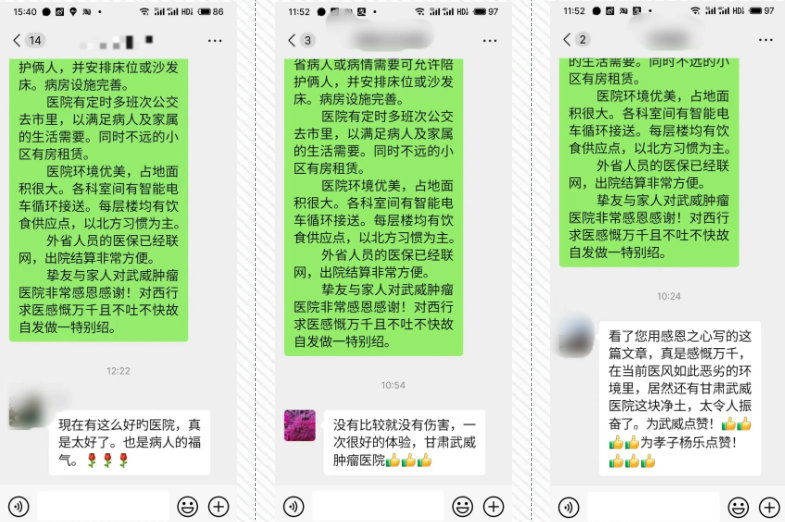
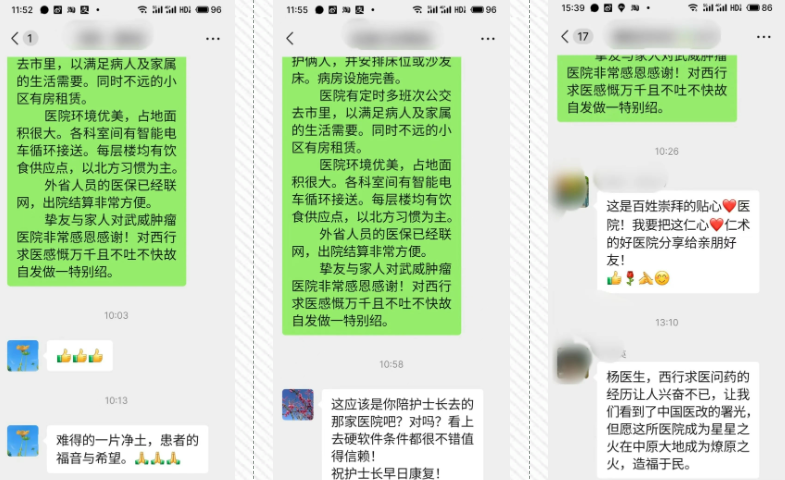
My dear friend and their family are deeply grateful to the Wuwei Cancer Hospital. Their profound appreciation for the life-changing treatment they received in this western city inspired them to share their experience in this heartfelt testimonial.