
Wuwei Heavy Ion Center: Clinical Analysis of 76 Glioma Cases Treated with Heavy (Carbon) Ion Therapy
Wuwei Heavy Ion Center: Clinical Analysis of 76 Glioma Cases Treated with Heavy (Carbon) Ion Therapy
Brain tumors represent a key focus and a major challenge in the field of radiotherapy, primarily consisting of two types: primary brain gliomas and secondary brain metastases. Relying on China's first domestically produced heavy (carbon) ion therapy system, the Wuwei Heavy Ion Center has accumulated extensive clinical experience in the treatment of brain tumors. Since the first patient received heavy (carbon) ion therapy in November 2018, as of March 2026, the center has treated a total of 198 brain tumors, including 76 cases of glioma and 122 cases of brain metastasis, totaling 198 cases across both categories. This article focuses on the clinical analysis of 76 cases of glioma to demonstrate the therapeutic advantages of heavy (carbon) ions in primary brain tumors.
I. Statistics on the Basic Situation of Glioma
As of March 20, 2026, a total of 76 patients with glioma have been treated. Among them, there were 43 males and 33 females; the mean age was (51.66 ± 15.80) years, with the oldest patient being 85 years old and the youngest 14 years old.
II. Examples of Typical Medical Cases
Case 1: Patient Ma, female, 48 years old, from Lanzhou. The patient presented with mild weakness in the right lower limb without apparent cause more than one year before admission. On January 17, 2019, she visited Lanzhou University Second Hospital, where a cranial MRI revealed a space-occupying lesion in the left frontal parietal lobe, with involvement of the corpus callosum, right cingulate gyrus, and periventricular regions, as well as disruption of the left corticospinal tract, bilateral corpus callosum tracts, and local long and short arcuate fibers. A high-grade glioma was considered, extending to the contralateral side along the splenium of the corpus callosum. After comprehensive evaluation, the physician considered the surgical risk to be high. On June 30, 2020, the patient experienced a seizure without apparent cause. A repeat cranial MRI showed diffuse abnormal signals in the bilateral periventricular region, corpus callosum, and left thalamic area, measuring approximately 90 × 92 × 79 mm, highly suggestive of a high-grade glioma. Diagnosis: High-grade glioma. Treatment: On July 20, 2020, the patient underwent heavy (carbon) ion therapy at our center. Following heavy (carbon) ion therapy, the patient has been under continuous follow-up observation without further drug treatment. As of the manuscript submission date in March 2026, 68 months after heavy (carbon) ion therapy, the tumor has regressed, and the patient has achieved complete recovery.
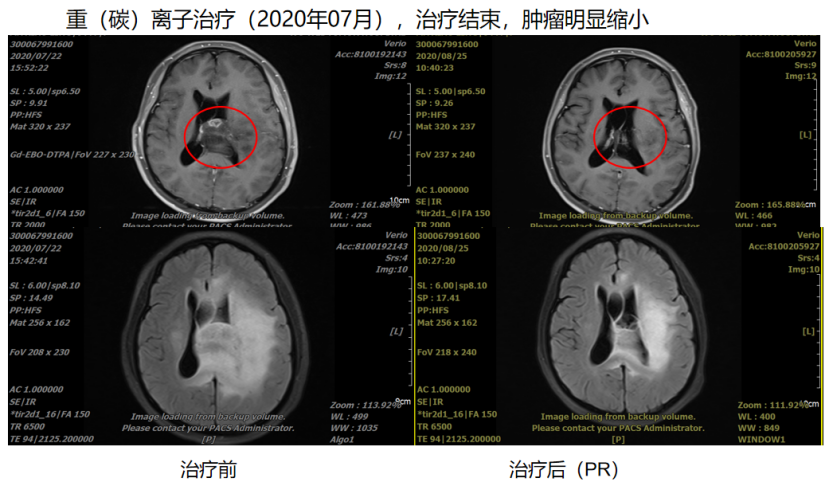
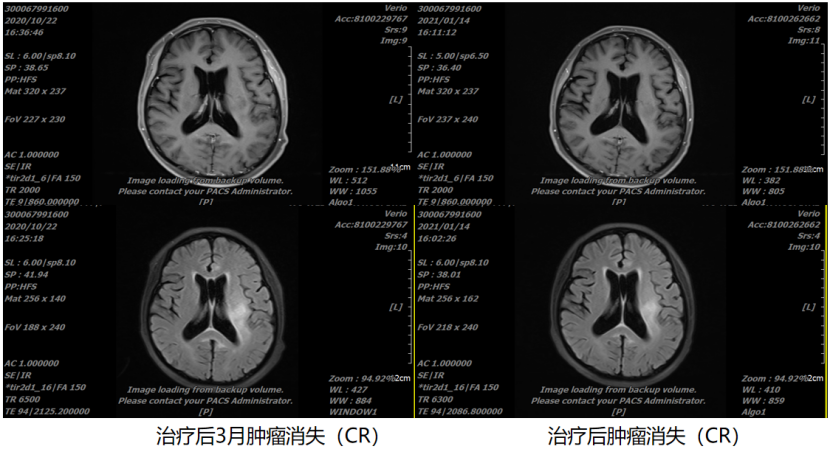
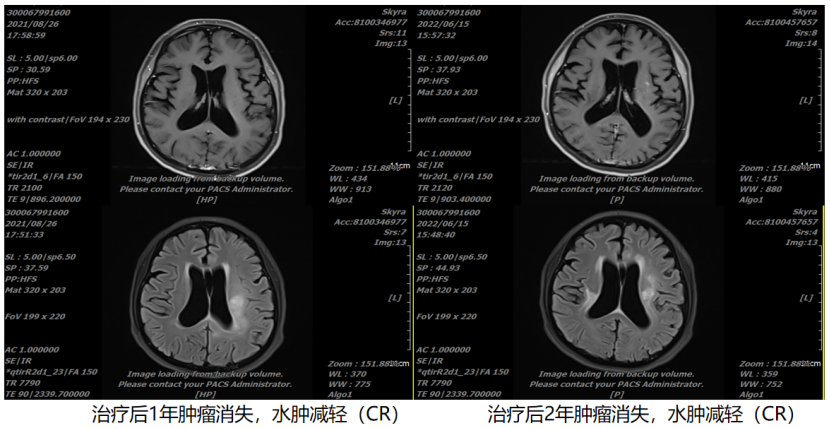
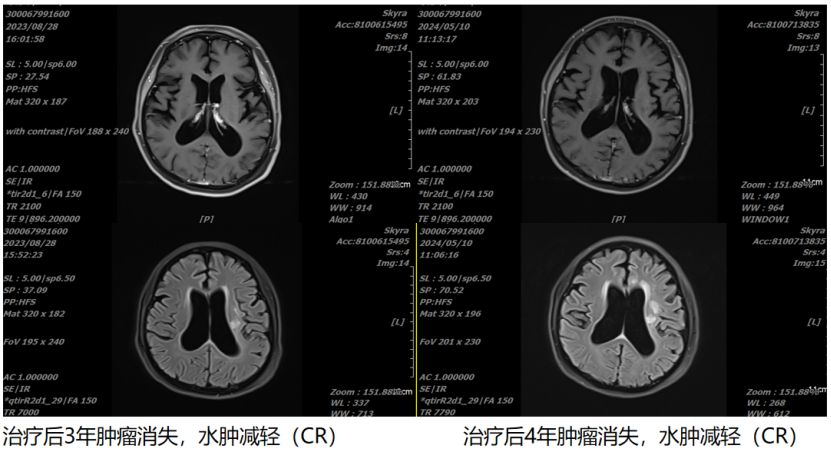
As of the manuscript submission date in March 2026, 68 months after heavy (carbon) ion therapy, the tumor has regressed, and the patient has achieved complete recovery.
Case provided by: Director Zhang Yihe
Department: Radiation Oncology Center Ⅰ(International Medical Department Ⅰ)
Case 2: Female, 46 years old, diagnosed with high-grade glioma. History: The patient experienced seizures and underwent a cranial CT scan at the Affiliated Hospital of Qingdao University on June 29, 2021, which revealed an intracranial space-occupying lesion suggestive of high-grade glioma. She subsequently visited Beijing Tiantan Hospital, where a diagnosis of high-grade glioma was considered. Surgery was recommended but was associated with high risk and potential motor nerve injury. The patient declined surgical treatment and opted for traditional Chinese medicine and physical therapy on her own. On July 13, 2023, a follow-up cranial MRI showed a cystic-solid space-occupying lesion in the left frontal parietal lobe, suggestive of a neoplastic lesion, likely high-grade glioma, which had increased in size compared to the previous scan (June 21, 2023), with the formation of subfalcial herniation. The patient presented with left-sided limb weakness, intermittent headaches, and was unable to care for herself. She then sought treatment at Wuwei Heavy Ion Center. Treatment: From July 26, 2023, to August 16, 2023, the patient underwent heavy (carbon) ion therapy, concurrently receiving oral temozolomide 120 mg.
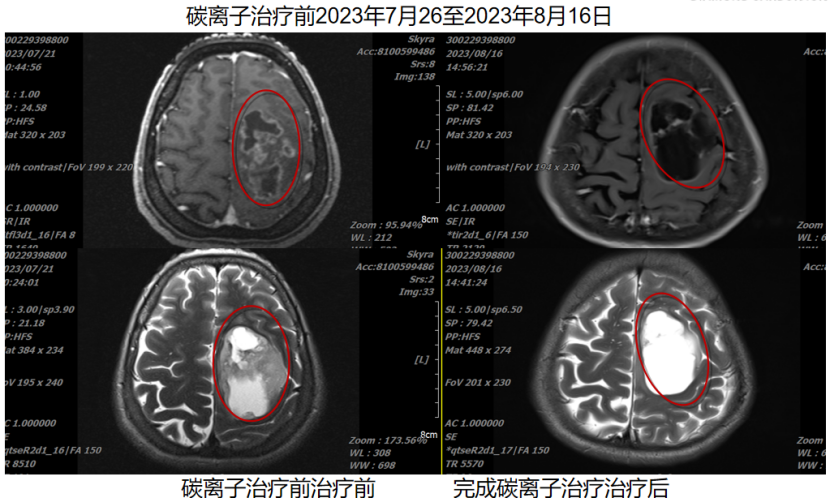
After heavy (carbon) ion therapy: The tumor extent was reduced, the solid components decreased significantly, liquefactive necrosis was observed within the tumor, and the patient's limb muscle strength and headache symptoms improved markedly.
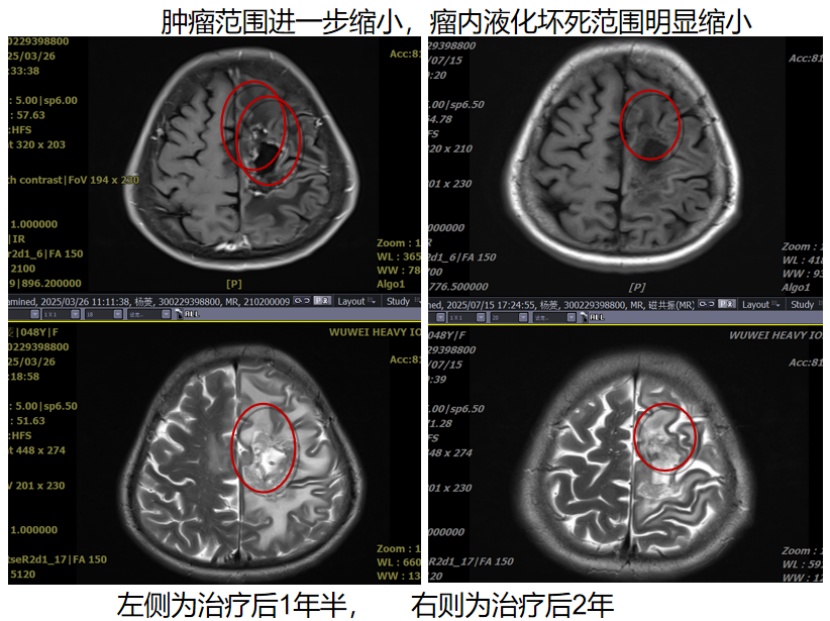
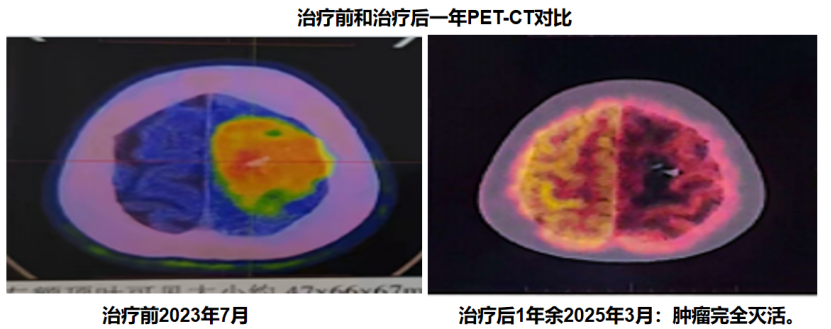
As of the manuscript submission date in March 2026, 31 months after heavy (carbon) ion therapy, the tumor has regressed favorably. There is hydrocephalus of the lateral ventricle, a lateral ventricular drainage tube has been placed, and there is dysfunction of one limb.
Case provided by: Dr. Ma Tong
Department: Radiation Oncology Center Ⅰ(International Medical Department Ⅰ)
III. Survival Status of Gliomas
For the 76 patients with glioma, the follow-up period ranged from 0 to 67 months. Survival analysis was performed using the Kaplan–Meier method. The median survival time was 44 months (95% CI: 19–68). The cumulative survival probability at the completion of treatment was 1. The cumulative survival probabilities at 12, 24, 36, 48, and 60 months after treatment completion were 0.6553, 0.5790, 0.5224, 0.4155, and 0.3562, respectively (see Table 1).
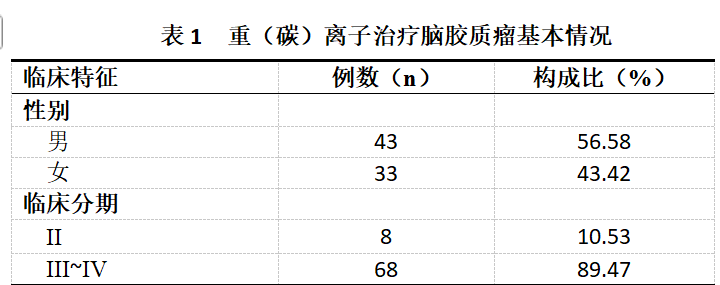
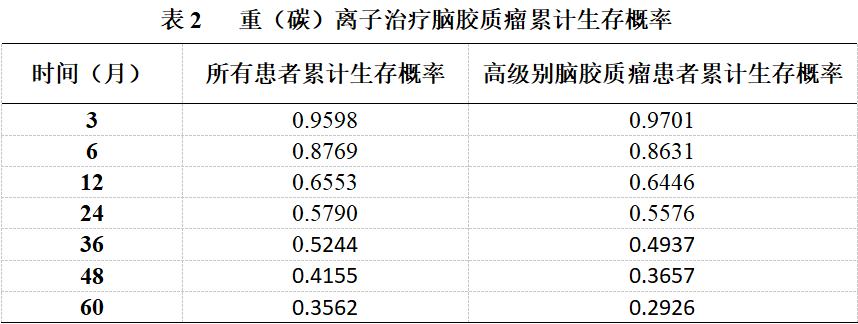
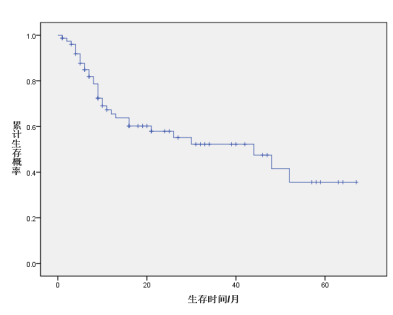
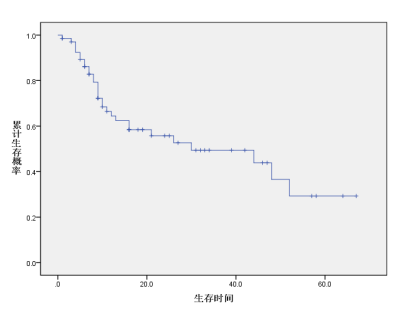
Figure 1 Survival curves from the end of treatment to 60 months after the end of treatment, where the left panel shows the survival curve of all glioma patients, and the right panel shows the survival curve of patients with high-grade glioma
IV. Survival Status of High-Grade Gliomas
For the 76 patients with glioma, the follow-up period ranged from 0 to 67 months. Survival analysis was performed using the Kaplan–Meier method. The median survival time was 44 months (95% CI: 19–68). The cumulative survival probability at the completion of treatment was 1. The cumulative survival probabilities at 12, 24, 36, 48, and 60 months after treatment completion were 0.6553, 0.5790, 0.5224, 0.4155, and 0.3562, respectively.
Among them, 68 patients had high-grade glioma, with a follow-up period ranging from 0 to 67 months. Survival analysis using the Kaplan–Meier method showed a median survival time of 30 months (95% CI: 2–58). The cumulative survival probability at the completion of treatment was 1. The cumulative survival probabilities at 12, 24, 36, 48, and 60 months after treatment completion were 0.6446, 0.5576, 0.4937, 0.3657, and 0.2926, respectively (see Table 2, Figure 1).
When analyzing only patients with WHO grade IV glioblastoma, a total of 61 cases, the median survival time was also approximately 24 months, consistent with the overall results for high-grade gliomas.
V. Summary of Heavy (Carbon) Ion Therapy for Glioma
Real-world data from this cohort of 76 patients with glioma demonstrate that heavy (carbon) ion therapy achieves significant clinical efficacy in the treatment of glioma. The median survival time for the entire cohort was 44 months, with cumulative survival probabilities at 12, 24, 36, 48, and 60 months of 65.5%, 57.9%, 52.2%, 41.6%, and 35.6%, respectively, which are substantially superior to historical data for conventional treatments. Among patients with high-grade glioma (WHO grades III–IV), the median survival time was 30 months, with cumulative survival probabilities at 12, 24, 36, 48, and 60 months of 64.5%, 55.8%, 49.4%, 36.6%, and 29.3%, respectively, indicating that heavy (carbon) ion therapy also provides a significant survival benefit in high-grade gliomas, which are associated with a poorer prognosis. Furthermore, no severe radiation necrosis of the brain or grade ≥3 toxicity was observed during treatment, demonstrating a favorable safety profile. These findings suggest that heavy (carbon) ion therapy can serve as an effective treatment modality for glioma, particularly for high-grade glioma.
VI. Overview of Brain Metastasis Treatment
As the most common secondary brain tumors, brain metastases have also achieved remarkable treatment outcomes. As of February 2026, the center has treated 122 patients with brain metastases, with a median survival time of 32 months. The cumulative survival probabilities at 12, 24, 36, and 48 months were 0.8791, 0.8209, 0.6760, and 0.5469, respectively, significantly superior to the median survival of 6 to 12 months typically reported with conventional whole‑brain radiotherapy. No severe radiation necrosis of the brain or grade ≥3 toxicity was observed, indicating a safe and manageable profile. (This part has been previously reported; details can be found at https://www.wwzlz.cn/news/1941: Basic Statistics on Heavy (Carbon) Ion Therapy for Brain Metastases at Wuwei Heavy Ion Center.)
Wuwei Heavy Ion Center
Wuwei Heavy Ion Center serves as the clinical application base for China’s first heavy (carbon) ion therapy system with completely independent intellectual property rights. The system is technologically supported by the Institute of Modern Physics, Chinese Academy of Sciences, and its clinical operations are managed by Gansu Wuwei Cancer Hospital. The center officially began treating tumors in November 2018 and has to date treated over 2,800 patients, covering more than 50 tumor types, including lung cancer, prostate cancer, liver cancer, glioma, nasopharyngeal carcinoma, rectal cancer, and various sarcomas.
As the only medical institution in the world operating two heavy (carbon) ion therapy systems simultaneously, Wuwei Cancer Hospital has achieved eight “world-first” innovations in the field of technology: pioneering precise treatment under ventilator control; bladder cancer treatment with precise bladder capacity management; single‑session treatment using surgically implanted spacers between organs and tumors; developing China’s first 360‑degree rotating and elevating ion radiotherapy chair; and completing the world’s first cases of heavy (carbon) ion therapy for cardiac tumors, among others.
Leveraging 30 research platforms, including the CAS Key Laboratory of Heavy Ion Radiation Biology and the University of Sydney Biomedical Data Analytics and Visualization Laboratory, the center has conducted over 30 clinical studies on major disease types. To date, the center has published nine monographs, including Standard Operating Procedures for Carbon Ion Radiotherapy, establishing a comprehensive knowledge system covering physics technology, clinical diagnosis and treatment, and health management.
Contributor: Zhang Yanshan (Vice President of Gansu Wuwei Cancer Hospital)
Data Providers: Chen Xuelian, Li Pengqing (Cancer Registration and Follow-up Office)
Date: March 24, 2026