Summary of Heavy Ion Therapy for Primary or Secondary Tracheal Tumors
Summary of Heavy Ion Therapy for Primary or Secondary Tracheal Tumors
Regardless of whether tracheal tumors are primary squamous cell carcinoma, adenoid cystic carcinoma originating in the trachea, or secondary tracheal invasion from other malignant tumors, heavy ion therapy has demonstrated unique advantages and reliable efficacy. We now summarize the treatment experience and data from our center in recent years as follows, for the reference of colleagues and patients.
I. Why is heavy ion therapy needed for tracheal tumors?
The trachea is the 'lifeline' of breathing. When a tumor grows here, even just 2–3 centimeters, it can lead to severe dyspnea, hemoptysis, and even suffocation. Traditional treatment modalities each have significant shortcomings:
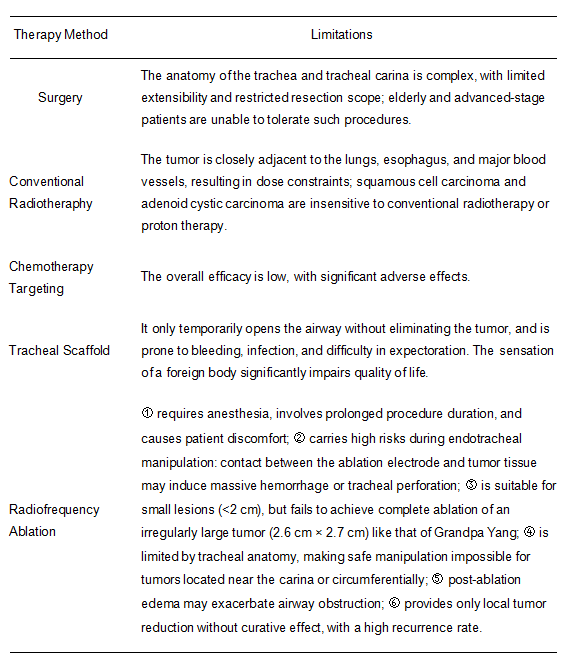
The Bragg peak and high relative biological effectiveness (RBE) of heavy ions precisely address the above challenges—delivering precise tumor targeting while sparing normal tissues, and achieving high efficacy even against tumors that are resistant to conventional radiotherapy.
II. Real case data of our center (Primary or Secondary Tracheal Tumors)
The following are some representative cases
(Data Source: Medical Record System of Our Center, as of April 2026):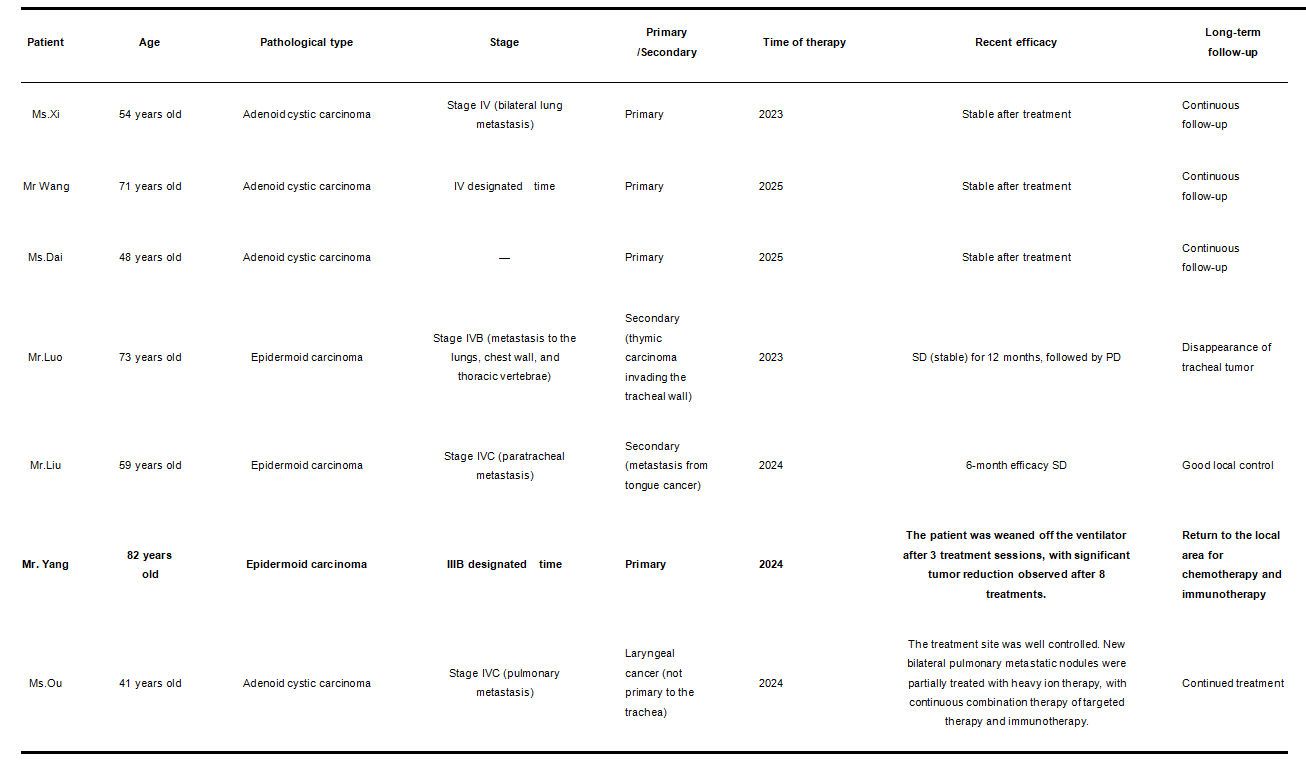
III. Four core advantages of heavy ion therapy for tracheal tumors
1. Fast-acting, quickly relieves breathing difficulty
After three sessions of treatment, Grandpa Yang was able to be weaned off non-invasive ventilation; after eight sessions, he no longer required nasal cannula oxygen supplementation. For airway obstruction caused by tumors, heavy ion therapy often leads to early tumor regression within the first one to two weeks of treatment.
2. Non-invasive with no bleeding risk
Even bronchoscopic biopsy carries a risk of massive bleeding, but heavy ion therapy is a non-invasive irradiation modality that completely avoids procedure-related risks of massive hemorrhage and suffocation. For patients like Grandpa Yang, who cannot undergo pathological biopsy, treatment can still be initiated before a definitive diagnosis is made.
3. Equally effective against tumors insensitive to radiotherapy
Squamous cell carcinoma and adenoid cystic carcinoma are relatively resistant to conventional radiotherapy. However, the high relative biological effectiveness (RBE) of heavy ions can directly induce double-strand breaks in the DNA of tumor cells, resulting in irreparable damage.
4. Equally well-tolerated in elderly and frail patients
The oldest tracheal tumor patient treated at our center was 82 years old, with concurrent respiratory failure and poor cardiopulmonary function; all patients successfully completed the treatment. Age is not a contraindication, as long as the patient's general condition is stable.
IV. Our team's treatment strategy
1. Emergency assessment, race against time
For patients with severe airway obstruction, positioning, target delineation, and treatment planning are completed immediately upon admission, with the aim of initiating heavy ion therapy within 48–72 hours. When the risk of biopsy is extremely high, heavy ion therapy may be initiated first based on typical imaging findings, while sputum cytology is sent for examination. A bronchoscopic biopsy can be performed later after tumor reduction.
2. Full ICU Escort
During the initial phase of treatment, patients may still require ventilator support. The ICU team at our center is on standby 24 hours a day to ensure treatment safety.
3. Pursue both radical cure and safety
Close follow-up is conducted after treatment to monitor long-term issues such as tracheal perforation, cicatricial stenosis, recurrence, and metastasis. A comprehensive treatment plan is developed in accordance with the NCCN guidelines.
V. Which patients with tracheal tumors are suitable for heavy ion therapy?
- Primary malignant tracheal tumors (squamous cell carcinoma, adenoid cystic carcinoma, carcinoid tumor, sarcoma, etc.)
- Secondary tracheal/main bronchial invasion (direct invasion from esophageal cancer, lung cancer, thymic cancer, thyroid cancer, etc.)
- Unresectable or surgically refused cases
- Insensitive or refractory to conventional radiotherapy
- Elderly patients or those with poor cardiopulmonary function who cannot tolerate invasive treatments
- Patients requiring rapid relief of airway obstruction
Contraindications: Complete suffocation, unable to lie flat, severe coagulation disorders (however, heavy ion therapy itself is non‑invasive, so there are relatively few absolute contraindications)
Typical Case: Heavy Ion Therapy for a Complex Tracheal and Main Bronchial Carcinoma
A severe tumor was suddenly found in the main trachea
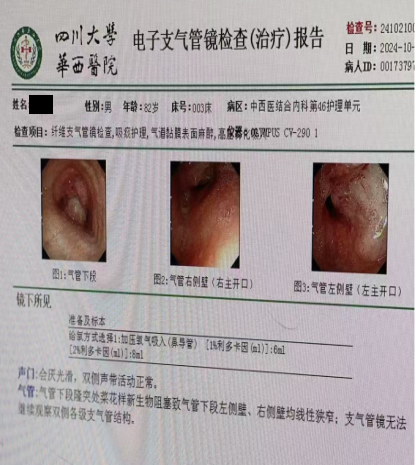
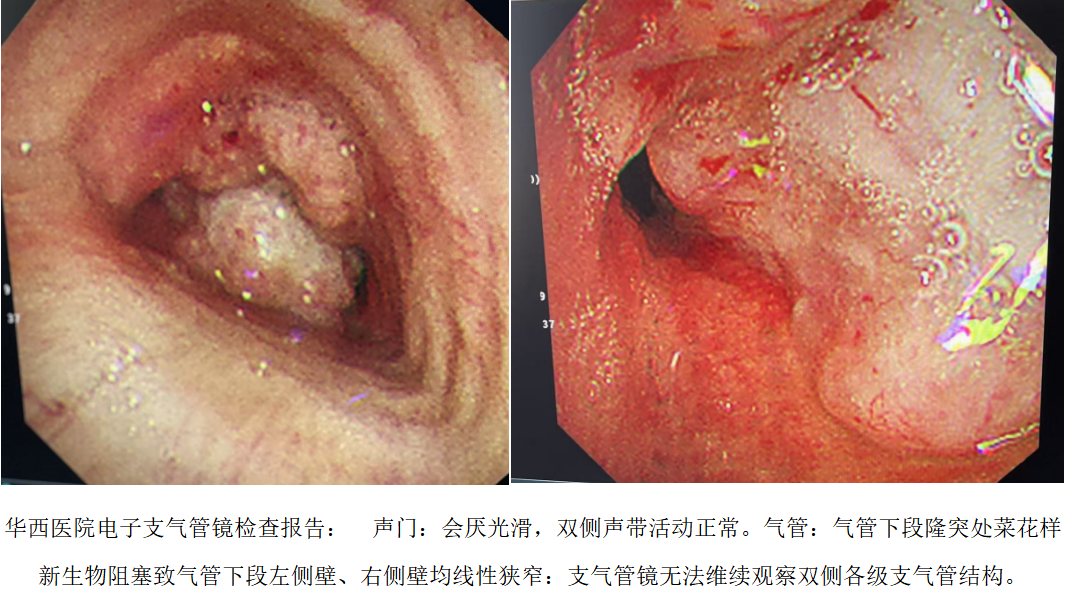
Patient Mr. Yang, male, 82 years old, from Chengdu, Sichuan Province. He presented with chest tightness and shortness of breath for two weeks. On October 21, 2024, he experienced sudden worsening of chest tightness and shortness of breath, accompanied by blood-streaked sputum. CT scan revealed a soft tissue nodule in the carinal region of the trachea with irregular morphology, measuring approximately 2.6 cm × 2.7 cm on its largest cross-section, associated with mild thickening of the adjacent tracheal wall and localized luminal narrowing. Bronchoscopy performed at West China Hospital showed a cauliflower-like neoplasm obstructing the lower trachea at the carina, causing linear stenosis of the left and right lateral walls of the lower trachea. The bronchoscope could not advance further to visualize the bilateral segmental bronchial structures, and the risk of bleeding during biopsy was considered high. The physicians at West China Hospital deemed that due to the patient's advanced age and difficulty in obtaining a pathological biopsy, the tumor had already caused severe respiratory compromise, and no active treatment options were feasible. They only suggested the possibility of placing a tracheobronchial stent.
At the point of despair, one of the patient‘s family members, who had previously visited the Wuwei Heavy Ion Center, immediately thought of heavy ion therapy and asked Zhang Yanshan whether it could be used for treatment. Professor Zhang Yanshan’s answer was very clear: the outcome would be very good. However, the long distance posed a challenge, and the patient's safety during the journey could not be guaranteed. He stated that as long as the patient could be safely transported to Wuwei, there would be a way. The family member said she understood, needed to discuss it with her family, and would come back to see him in four or five days.
Rushing a thousand miles overnight
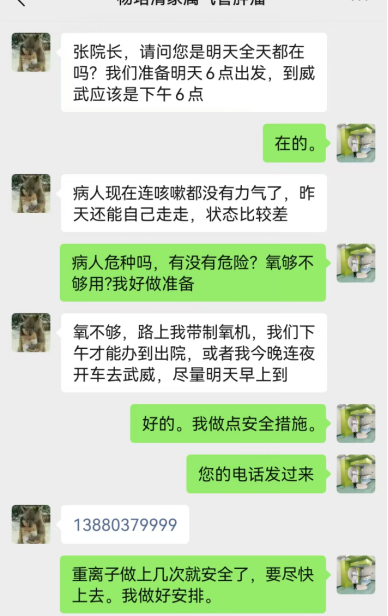
The patient's condition was rare and critical. The doctors at West China Hospital had suggested placing a tracheal stent, which could temporarily relieve breathing difficulties. However, a tracheal stent itself does not treat the tumor and may easily cause bleeding and reduce quality of life. In contrast, heavy ion therapy could rapidly reduce the tumor. Yet the patient was thousands of miles away, and traveling to Wuwei carried significant risks! Nevertheless, just a few hours later, the family informed Zhang Yanshan that both the patient himself and the family were determined to pursue this option. They decided to drive to Wuwei immediately—a journey of over ten hours—with oxygen prepared in the car, determined to fight for a chance. Upon receiving this heavy trust, Zhang Yanshan and his team decided to take full action. The patient was expected to arrive at the Wuwei Heavy Ion Healthcare Center around 1:00 a.m. The ICU team was fully mobilized: as long as the vehicle could reach the center, the elderly patient's life would be safeguarded. A strong ICU team, ventilators, ECMO, and various modern medical devices were immediately made ready.
Arrived safely
Despite all the dangers along the way, they finally arrived safely at 4 a.m. The ICU team was already waiting and began managing the situation methodically. With the assistance of non-invasive ventilation, the hypoxia improved, and the crisis was averted. Thank goodness.
Emergency consultation initiated immediately; rush to arrange heavy ion therapy without delay
The patient's imaging diagnosis was relatively clear, but there was no pathological diagnosis. The top domestic hospital, West China Hospital, considered it too risky to perform a bronchoscopic biopsy due to the high risk of massive bleeding. We urgently initiated a multidisciplinary consultation and formulated the following treatment plan, advancing on multiple fronts: First, to initiate heavy ion therapy as soon as possible. Second, to continuously send sputum samples for exfoliative cytology. Based on our experience, heavy ion therapy can rapidly shrink malignant tumors. After approximately three sessions of heavy ion treatment, the tumor is expected to regress, breathing difficulty will be relieved, and the risk of bleeding will be greatly reduced. This will allow us to safely perform bronchoscopy and obtain a pathological biopsy. Although heavy ion therapy may affect the morphology of tumor cells, a diagnosis can still be established. Third, our ICU team will provide full support during the critical initial days of treatment to ensure patient safety.
The positioning for heavy ion therapy was successfully completed on the day of admission
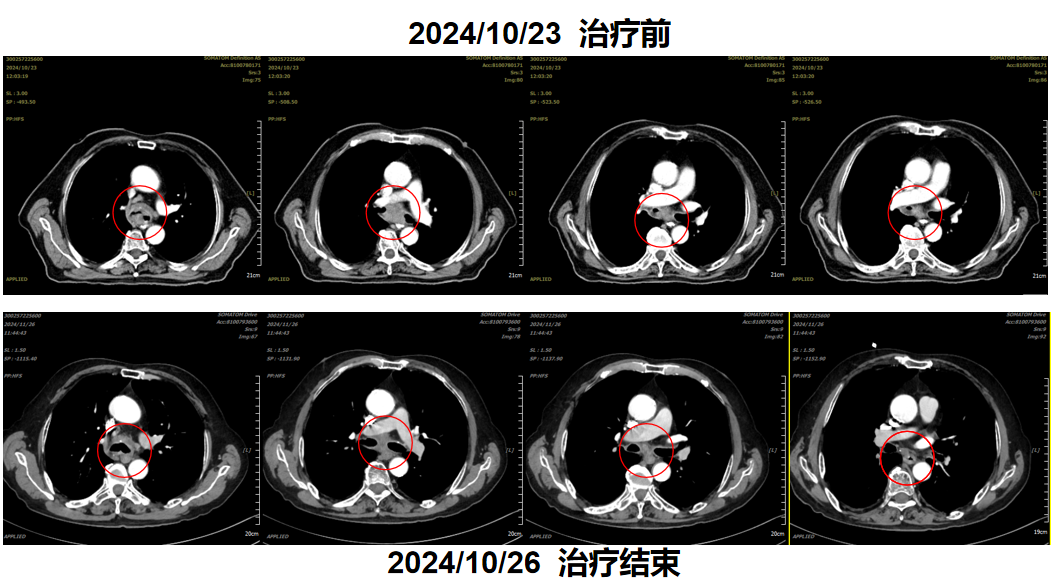
With the assistance of the ICU team, the patient remained on non-invasive ventilation while maintaining stable vital signs. Positioning and simulation were successfully completed, followed by urgent target delineation, treatment planning, dose verification, and setup verification—everything proceeded methodically. On the third day after admission, October 26th, the first session of heavy ion therapy was completed. The patient felt well, and his shortness of breath had improved, though he still required ventilator support. After the third treatment session on October 28th, he was successfully weaned off non-invasive ventilation. The elderly gentleman was in good spirits and humorously remarked that he could finally play mahjong again—it had been a long time since he last played.
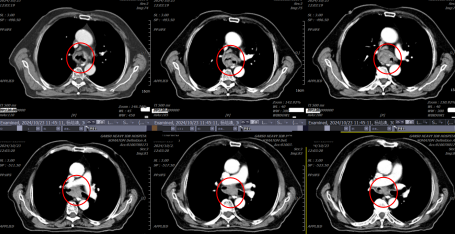
Pre-treatment enhanced CT scan dated 20241121 (the tracheal tumor is circled in red)
Finally safe
Once the critical danger was resolved, we arranged a painless bronchoscopy, and the patient was admitted to our center for further treatment. After just three sessions of low-dose heavy ion therapy, the tumor had significantly regressed, and signs of bleeding had markedly improved. A pathological biopsy was successfully obtained and confirmed as squamous cell carcinoma. The diagnosis was malignant tracheal tumor, squamous cell carcinoma.
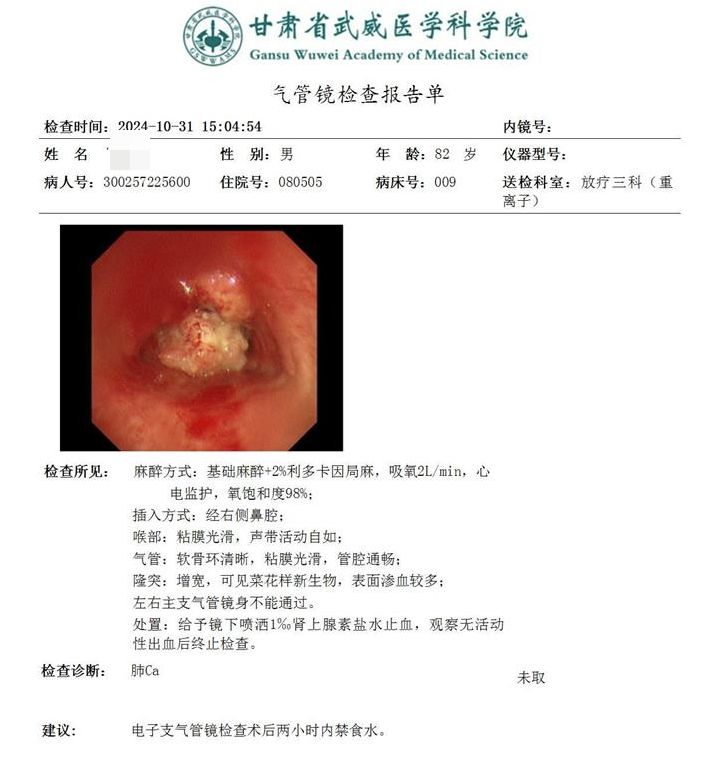
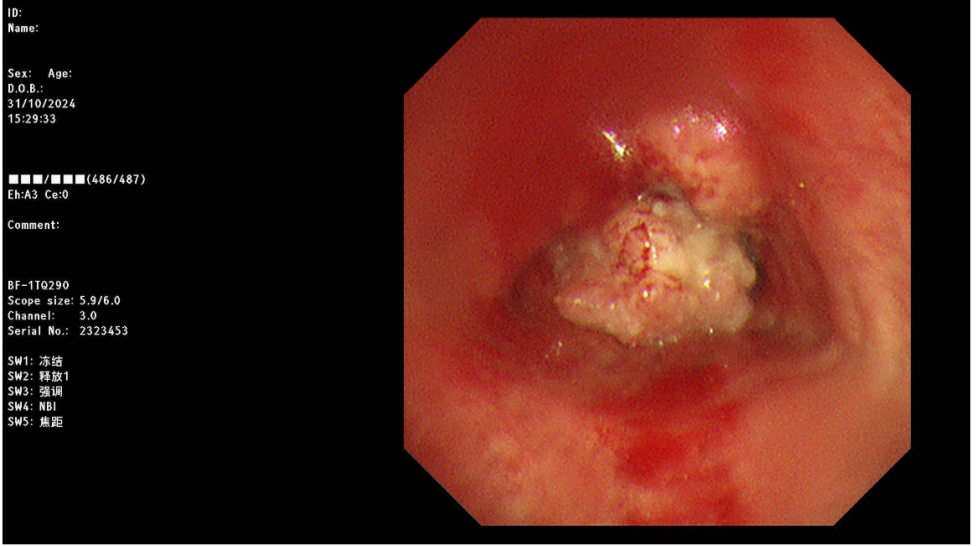
After only three low-dose heavy ion therapy sessions, the tumor has shrunk, bleeding symptoms have improved significantly, pathological examination was successfully performed, and the condition was confirmed to be squamous cell carcinoma
Continue the treatment and strive for a radical cure
Tracheal tumors are rare and difficult to treat. It is common to see reports from well-known hospitals about resecting tumors at the tracheal bifurcation. However, for such a complex tracheal tumor, we chose to continue active treatment, pursuing both radical cure and safety. We needed not only to preserve the gains already achieved but also to aim for long-term curability and safety, preventing later complications such as tracheal perforation, tracheal scarring, tumor recurrence, and metastasis. At this point, we once again leveraged our team's strengths by searching and retrieving the latest global information.
Our team is proficient in English listening, speaking, reading, and writing, and we use English for consultations, rounds, and academic exchanges. Every day, we study the latest international cancer treatment guidelines (NCCN Guidelines, the National Comprehensive Cancer Network) to ensure that the comprehensive treatment for every cancer patient is aligned with the most advanced global standards. By combining the latest oncology guidelines with the national treasure of heavy ion therapy, we strive to become leaders in the field of cancer treatment.
Grandpa Yang was about to be discharged, and everything had turned out well. He asked us, "How can I thank you?" Zhang Yanshan replied directly, "Grandpa Yang, share your story with more people so that they can learn about China's own heavy ion technology. Refer ten patients who need heavy ion therapy to us, so that we can help more people and pass on the love." Grandpa Yang said, "That's easy."
As Grandpa Yang was discharged, the medical staff were overjoyed, and his children were also radiant with happiness.
Author: Zhang Yanshan (Vice President, Gansu Wuwei Cancer Hospital)
Data Providers: Chen Xuelian, Li Pengqing (Tumor Registration and Follow-up Office)
Date: April 28, 2026