
National Record! Wuwei Heavy Ion Center: 345+ Pancreatic Cancer Cases
National Record! Wuwei Heavy Ion Center: 345+ Pancreatic Cancer Cases
Abstract
As of March 2026, the Gansu Wuwei Heavy Ion Center has completed 345 cases of heavy ion therapy for pancreatic cancer, the highest number in the country, with late-stage patients accounting for over 87% of cases. As of February 2026, the median survival time for the entire cohort reached 17 months, significantly outperforming conventional radiotherapy, demonstrating the unique advantages of domestically developed heavy ion technology in treating the "king of cancers." The center adheres to a philosophy of "no patient selection," using precise, non-invasive methods to secure valuable survival time and quality of life for numerous late-stage patients. At the Annual Conference of the Ion Radiotherapy Branch of the China Association of Medical Equipment, held on March 21, 2026, in Hefei, Anhui, a set of data drew significant attention and discussion among attending experts: China's first heavy (carbon) ion therapy system with independent intellectual property rights, located in Wuwei, Gansu, has completed 345 cases of pancreatic cancer treatment. This figure surpasses all other heavy ion centers in China, ranking first nationwide. Pancreatic cancer, known as the "king of cancers," is characterized by insidious onset, rapid progression, and limited treatment options. In this western city along the Hexi Corridor, a team of physicians is leveraging this "national treasure" to ignite hope for countless desperate pancreatic cancer patients.
I. Forging a sword in eight years: From the first case to 345 cases, firmly ranking first in the country
Since the Wuwei Heavy Ion Center performed its first heavy (carbon) ion therapy in 2018, pancreatic cancer has consistently been the second most common cancer type treated at the center, following lung cancer. Over eight years of dedicated work, the center has built the largest database of heavy (carbon) ion therapy cases for pancreatic cancer in China. Among the 345 cases, stage III and IV patients account for over 87%, with stage IV patients alone numbering 164, representing 48.24% of the total. Behind this data lies the center's treatment philosophy of "no patient selection"—regardless of disease stage, as long as patients express a willingness to receive treatment and the center's multidisciplinary team (MDT) evaluation determines that while heavy ion therapy may not achieve cure, it can extend life, alleviate pain, and improve quality of life, the center will pursue this valuable treatment opportunity for the patient. It is this unwavering commitment to never giving up on any patient that has enabled the Wuwei Heavy Ion Center to achieve not only the highest treatment volume but also the most extensive clinical experience in pancreatic cancer treatment nationwide.
II. The survival period is far longer than that of traditional treatment
The center does not select patients for the sake of producing favorable data. Here, every life is precious and worth fighting for. Among these 345 patients, the survival data have delivered an encouraging outcome:
Median survival for the entire cohort: As of February 2026, the median survival time for all patients reached 17 months.
Median survival for stage IV patients: As of February 2026, the median survival time for stage IV patients reached 14 months.
These results are significantly superior to historical data for conventional photon radiotherapy (typically 11–15 months) and are comparable to outcomes from heavy ion clinical trials in Japan and other countries that employed strict patient selection criteria. Even more notably, nearly half of the stage IV patients achieved a median survival of 14 months, fully demonstrating the unique value of heavy ion therapy in the local treatment of advanced pancreatic cancer.
48-month cumulative survival rate: For stage I–III patients, this reached 38.65%; for the entire cohort, it reached 28.29%. For the "king of cancers," this represents a hard-won extension of life.
III. Why can heavy ions "defeat" pancreatic cancer?
The difficulty in treating pancreatic cancer is closely tied to its "three major challenges":
Complex anatomy: Deeply located in the abdomen, the pancreas is surrounded by critical organs such as the duodenum, stomach, and colon, making it difficult for conventional radiotherapy to avoid damaging surrounding tissues.
Extreme hypoxia: Pancreatic tumors are dense and poorly vascularized. This hypoxic environment makes cancer cells 2–3 times more resistant to conventional photon radiotherapy and chemotherapy.
Neural invasion: Pancreatic cancer has a tendency for perineural invasion, often infiltrating along nerve plexuses, leading to severe pain and local recurrence.
Heavy (carbon) ion therapy precisely addresses these challenges:
Physical advantage: The unique "Bragg peak" effect concentrates energy release within the tumor, minimizing damage to surrounding normal tissues both anterior and posterior to the target.
Biological advantage: The killing effect on hypoxic cancer cells is 2–3 times greater than under normoxic conditions, and heavy ions can effectively eliminate pancreatic cancer stem cells that are resistant to conventional treatments.
Coverage advantage: Heavy ion therapy can encompass the tumor itself, the nerve plexuses, and regional lymph nodes (such as the celiac trunk and superior mesenteric lymph nodes), achieving effective "regional control."
IV. Surgery vs. Heavy Ion Therapy: Not a Single-Choice Question, but a "Deployment of Forces"
In pancreatic cancer treatment, heavy ion therapy is not a panacea, but its emergence has provided a powerful new tool in the treatment arsenal.
In which cases is surgery the first choice?
Early-stage pancreatic head cancer, especially cases without duodenal invasion, in patients with good overall health who can tolerate pancreaticoduodenectomy (Whipple procedure).
In which situations is heavy ion therapy more advantageous?
Locally advanced unresectable: When the tumor encases major blood vessels, heavy ion therapy combined with concurrent chemotherapy is currently internationally recognized as the optimal strategy. High risk of postoperative recurrence: For patients with lymph node metastases after surgery, heavy ion therapy can deliver precise treatment and prophylactic irradiation to the tumor bed and lymphatic drainage areas. Elderly or medically unfit for surgery: Heavy (carbon) ion therapy is non-invasive with mild side effects; most patients experience no significant discomfort during treatment. Pancreatic body/tail cancer: Located away from the duodenum, heavy ion therapy can deliver full radiation doses, achieving significant efficacy.
The "Special Treatment" for Pancreatic Head Cancer
For pancreatic head cancer, which is located adjacent to the duodenum, conventional heavy ion therapy faces dose limitations. However, the Wuwei Center has successfully overcome this bottleneck through two “global first” technologies: SPACER (spacer placement surgery) and HFOV (high-frequency oscillatory ventilation for respiratory control), enabling sufficient radiation dose delivery to tumors that were previously considered unreachable.
V. He verified the miracle with his life
Here is a case example of pancreatic head cancer:
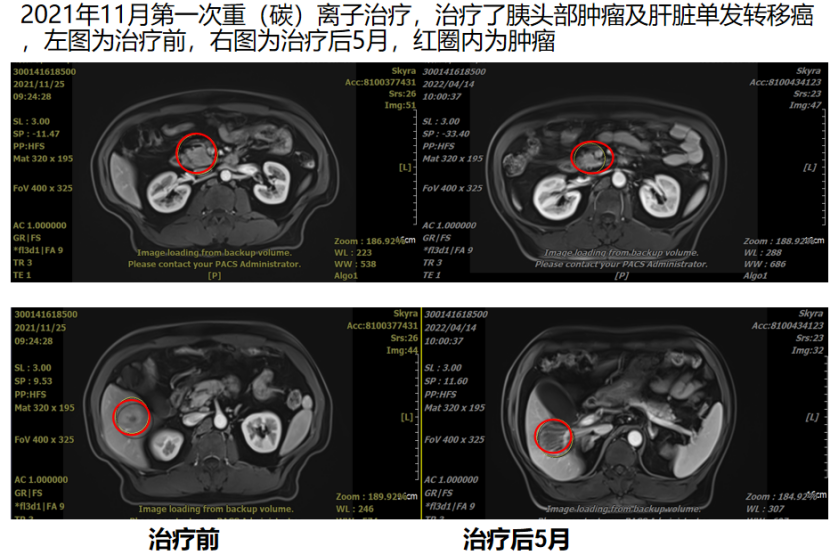
In 2021, 61-year-old Mr. Hu was diagnosed with malignant pancreatic head tumor (cT4N2M1, stage IV). When hospitalized at a major medical center, he joined a pancreatic cancer surgery support group. Most patients in the group underwent chemotherapy, surgery, further chemotherapy, immunotherapy, targeted therapy… but almost none survived longer or enjoyed a better quality of life than he did.
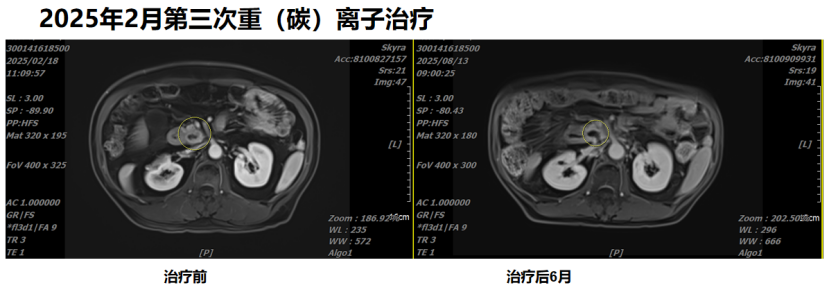
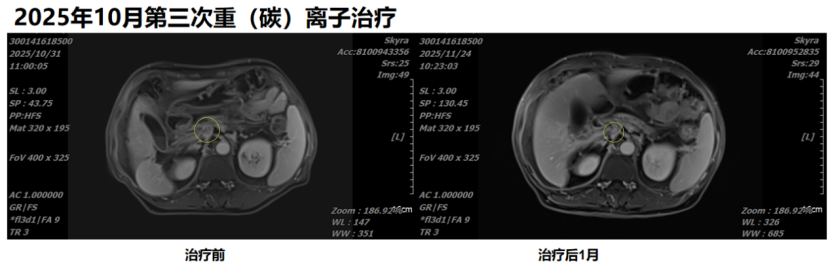
In November 2021, he received his first heavy (carbon) ion therapy at the Wuwei Heavy Ion Center, with a pancreatic lesion dose of 55.2 Gy/12 fractions and a liver metastasis dose of 60 Gy/10 fractions. In the four years following treatment, he played soccer and engaged in strenuous physical activities—no one would have believed he was a pancreatic cancer patient. Although the tumor later recurred and he underwent heavy ion therapy twice more in 2025, with some decline in physical strength, the three rounds of heavy (carbon) ion therapy together provided him with survival time and quality of life far exceeding expectations. His experience demonstrates one thing: heavy ion therapy is not a last resort, but a precision tool that can be proactively used to achieve long-term, high-quality survival.
Case provided by: Director Zhang Yihe
Department: Radiation Oncology Center Ⅰ(International Medical Department Ⅰ)
VI. Not just about "quantity", but more about "quality"
Behind the 345 cases lies eight years of dedicated effort by the Wuwei Heavy Ion Center:
The only medical institution in the world operating two heavy (carbon) ion therapy systems simultaneously;
Eight global first technologies, including ventilator-controlled precision treatment, precise bladder volume control, and single-session treatment with surgically implanted spacer;
Over 2,800 patients treated across more than 100 cancer types, forming a comprehensive knowledge system covering physics technology, clinical diagnosis and treatment, and health management;
A special feature report by CCTV13, "Accelerating the Application of Frontier Technologies to Benefit the People with National Treasures," marking the transition of domestically developed heavy ion technology from "technological breakthrough" to "clinical accessibility."
Conclusion
The "king of cancers" is not invincible. At the Wuwei Heavy Ion Center, the life journeys of 345 patients are continuously reshaping the landscape of pancreatic cancer treatment.
Surgery, heavy ion therapy, chemotherapy, immunotherapy… these are never a single choice, but rather a "combination punch" based on precise evaluation. With its high efficacy, low toxicity, and precision, heavy ion therapy is becoming an indispensable link in the treatment chain for pancreatic cancer.
With eight years of accumulated experience and the highest treatment volume in the country, we do not select patients—we simply refuse to miss any miracle of life. If you or your family members are facing the challenge of pancreatic cancer, we encourage you to learn more about this "national treasure." Perhaps a well-informed decision could mark a new beginning for life.
Contributor: Zhang Yanshan (Vice President of Gansu Wuwei Cancer Hospital)
Data Providers: Chen Xuelian, Li Pengqing (Cancer Registration and Follow-up Office)
Reviewer: Zhang Yanshan (Vice President of Gansu Wuwei Cancer Hospital)
Date: March 22, 2026