
Gansu Wuwei Cancer Hospital: Photon Therapy for 348 Stage I–III Esophageal Cancer Patients
Gansu Wuwei Cancer Hospital: Photon Therapy for 348 Stage I–III Esophageal Cancer Patients
In the field of esophageal cancer treatment, radiotherapy has always played a critical role. Since its establishment in the early 1990s, the radiotherapy department at Gansu Wuwei Cancer Hospital has undergone over three decades of development, achieving a technological progression from two-dimensional conventional radiotherapy to three-dimensional conformal radiotherapy, and then to intensity-modulated radiotherapy (IMRT) and image-guided radiotherapy (IGRT). As one of the earliest institutions to offer radiotherapy in Gansu Province and the Hexi region, the department has established a systematic and standardized radiotherapy system. In 2015, the national heavy (carbon) ion therapy system project was launched, and Gansu Wuwei Cancer Hospital took the lead in building the country's first clinical heavy (carbon) ion therapy demonstration base. In 2018, China's first heavy ion therapy system with completely independent intellectual property rights was officially put into clinical use, marking the transition from photon therapy to the era of "heavy (carbon) ion precision therapy." Photon therapy, as a foundational radiotherapy modality, has accumulated extensive experience, providing data and clinical pathways to support the development of heavy (carbon) ion technology. This article presents a retrospective analysis of clinical data from 348 patients with stage I–III esophageal cancer who received photon therapy at our center between 2021 and 2024, aiming to evaluate the clinical level of photon therapy for esophageal cancer at the Wuwei Cancer Hospital Heavy Ion Center and to summarize real-world data and treatment experience.
1. Basic Information
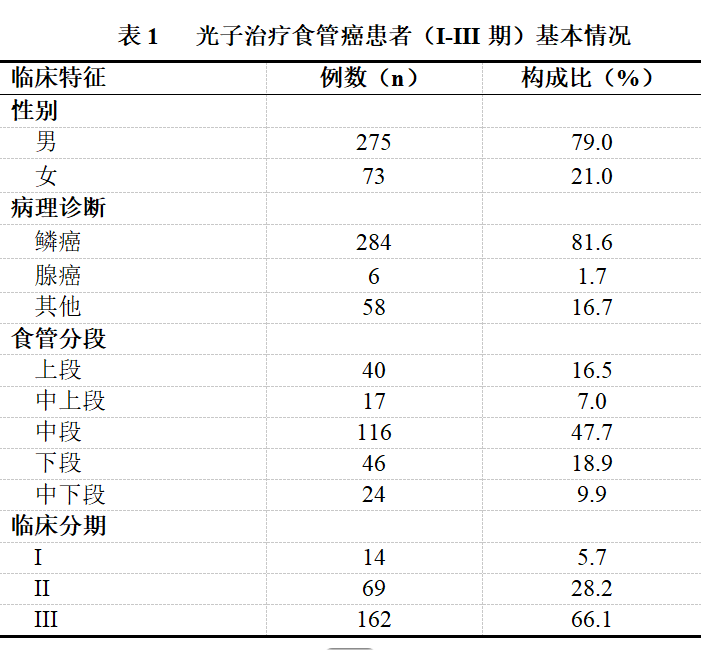
From 2021 to 2024, the Wuwei Heavy Ion Center treated 348 patients with stage I, II, and III esophageal cancer using photon therapy. Among them, there were 275 males (79.0%) and 73 females, with a mean age of 71.83 ± 6.53 years.
II. Survival Status of Esophageal Cancer
For the 348 patients with esophageal cancer, the follow-up period ranged from 0 to 63 months. Survival analysis was performed using the Kaplan-Meier method. The median survival time was 23 months (95% CI: 17–29). The cumulative survival probability at the end of treatment was 1. The cumulative survival probabilities at 12, 24, 36, 48, and 60 months after treatment were 0.6480, 0.4872, 0.4020, 0.3193, and 0.2291, respectively (Table 1).
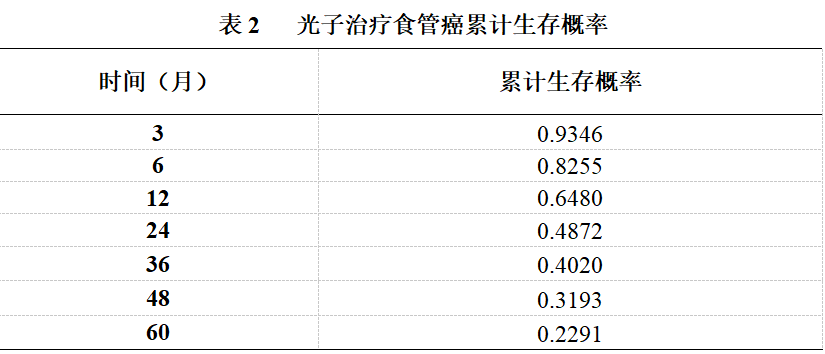
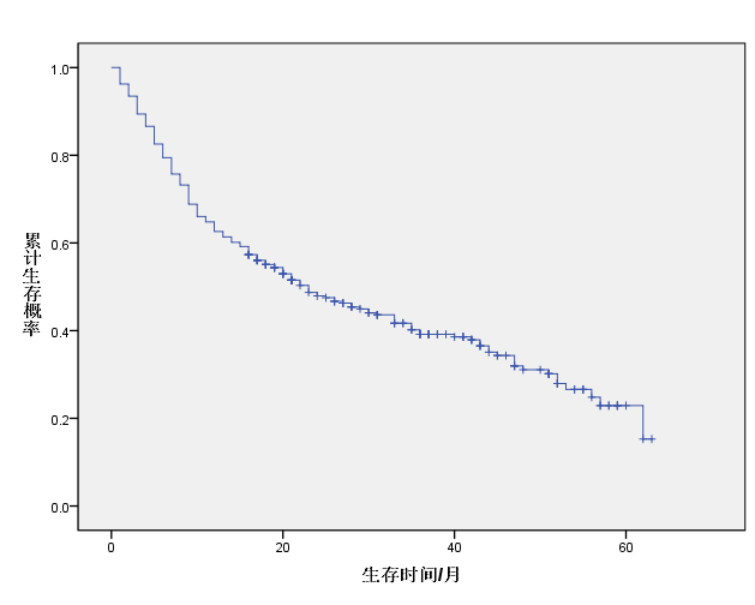
Figure 1 Survival curve from the end of treatment to 60 months after the end of treatment
III. Efficacy Analysis
A total of 348 patients with stage I–III esophageal cancer were included in this study, with a maximum follow-up of 63 months. Kaplan-Meier survival analysis showed that the median overall survival for the entire cohort was 23 months (95% CI: 17–29 months). The cumulative survival probabilities at 12, 24, 36, 48, and 60 months after treatment were 64.8%, 48.7%, 40.2%, 31.9%, and 22.9%, respectively, with a 5-year overall survival rate of 22.9%.
Compared with similar studies domestically and internationally, the survival outcomes in this patient group demonstrated certain advantages: The US RTOG 85-01 study reported a 5-year survival rate of less than 10% for patients receiving radiotherapy alone, compared with 26% for the concurrent chemoradiotherapy group. In the RTOG 94-05 (INT 0123) study, the median survival time for the concurrent chemoradiotherapy group was 14.9 months, with a 5-year survival rate of approximately 20%.
In recent years, multiple meta-analyses have shown that with modern precision radiotherapy techniques (such as IMRT) combined with chemotherapy, the median survival time for esophageal cancer patients can be extended to 20–25 months, with a 5-year survival rate of approximately 30%. The Japanese JCOG 9907 study reported a 5-year survival rate of approximately 25%–30% for postoperative adjuvant chemotherapy combined with radiotherapy.
The results of this study demonstrate that photon therapy for esophageal cancer at the Heavy Ion Center of Gansu Wuwei Cancer Hospital achieved a median survival of 23 months and a 5-year survival rate of 22.9%, which is slightly superior to some historical study data. This suggests that with the support of modern precision radiotherapy techniques and rational comprehensive treatment strategies, photon therapy can still provide significant survival benefits for patients with locally advanced esophageal cancer.
IV. Conclusion
The results of this study indicate that photon radiotherapy for patients with stage I–III esophageal cancer at the Heavy Ion Center of Gansu Wuwei Cancer Hospital achieved a median survival of 23 months and a 5-year overall survival rate of 22.9%, with outcomes comparable to the latest domestic research findings and superior to traditional radiotherapy regimens. This suggests that with the support of modern precision radiotherapy techniques, photon therapy remains an important treatment modality for locally advanced esophageal cancer. This study provides real-world data to support the optimization of radiotherapy strategies for esophageal cancer and lays the foundation for comparative studies between photon therapy and heavy (carbon) ion therapy at the Wuwei Cancer Hospital Heavy Ion Center.
Building on its extensive experience in radiotherapy, the Heavy Ion Center of Gansu Wuwei Cancer Hospital has continuously upgraded its radiotherapy equipment and treatment protocols, achieving a 20% survival benefit with heavy ion therapy for esophageal cancer compared to photon therapy. With nearly eight years of clinical practice and accumulated experience in treating esophageal cancer, heavy ion therapy at the Wuwei Center has become increasingly refined, and further improvements in clinical outcomes are expected.
Based on its long-term experience in photon radiotherapy, the Heavy Ion Center of Gansu Wuwei Cancer Hospital has continuously advanced its radiotherapy equipment and treatment strategies, achieving a 20% survival benefit with heavy ion therapy for esophageal cancer compared to photon therapy (i.e., conventional radiotherapy). Through eight years of clinical practice and accumulated experience, heavy ion therapy for esophageal cancer at the Wuwei Heavy Ion Center has matured significantly, and even better clinical outcomes are anticipated in the future.
Wuwei Heavy Ion Center
The Wuwei Heavy Ion Center is the clinical application base for China's first heavy (carbon) ion therapy system with complete independent intellectual property rights. It is technically supported by the Institute of Modern Physics, Chinese Academy of Sciences, and clinically operated by Gansu Wuwei Cancer Hospital. The center officially began tumor treatments in November 2018 and has since treated over 2,800 patients across more than 50 cancer types, including lung cancer, pancreatic cancer, liver cancer, glioblastoma, nasopharyngeal carcinoma, rectal cancer, and various sarcomas, among others.
As the only medical institution in the world operating two heavy ion therapy systems simultaneously, the center has achieved eight "global firsts" in technological innovation: pioneering precision treatment technology under ventilator control; bladder cancer treatment technology under precise bladder volume control; single-session treatment technology using surgical spacer placement between organs and tumors; developing China's first 360° rotating and height-adjustable ion radiotherapy chair; and completing the world's first heavy (carbon) ion treatments for cardiac tumors, among others.
Leveraging 30 research platforms, including the Key Laboratory of Heavy Ion Beam Radiation Biology of the Chinese Academy of Sciences and the University of Sydney Biomedical Data Analysis and Visualization Laboratory, the center has conducted over 30 clinical studies on key disease types. To date, the center has published nine monographs, including the Standard Operating Procedures for Carbon Ion Radiotherapy, establishing a comprehensive knowledge system covering physics technology, clinical diagnosis and treatment, and health management.
Writer: Zhang Yanshan (Vice President of Gansu Wuwei Cancer Hospital)
Data Providers: Chen Xuelian, Li Pengqing (Cancer Registration and Follow-up Office)
Date: March 21, 2026