Heavy Ion Therapy for Early‑Stage Lung Cancer: Only 49,500 RMB
Heavy Ion Therapy for Lung Cancer Costs Only 49,500 RMB — Observation of Efficacy in Early‑Stage Lung Cancer
Since China's first heavy ion system entered clinical use in Wuwei, Gansu, a growing body of data has demonstrated the high efficacy, low toxicity, and curative potential of heavy ion therapy for tumors. Yet when people hear "heavy ions," many immediately associate it with the high costs — often hundreds of thousands of RMB. However, with the maturation of China's independently developed heavy ion technology and the standardization of medical insurance policies, this situation is being thoroughly rewritten.
Today, at medical institutions such as the Wuwei Heavy Ion Center in Gansu, patients with early‑stage lung cancer need only pay 49,500 RMB (single treatment) to access this top‑tier technology, hailed as "the jewel in the crown of radiotherapy." It offers confirmed efficacy, non‑invasiveness, extremely mild side effects, and definitive curative potential — and has given renewed hope to many elderly patients who were previously unable to undergo surgery due to poor cardiopulmonary function.
1. Heavy Ion Pricing: From "High‑End Option" to "Affordable Price"
Heavy ion equipment and center construction costs run into billions of RMB, and treatment fees were once considered prohibitively high. In 2020, when the Wuwei Heavy Ion Center first began clinical application, market‑adjusted pricing was applied, with a course of treatment costing approximately 200,000 to 260,000 RMB. However, as the National Healthcare Security Administration intensively issued guidelines for radiotherapy pricing projects between 2024 and 2025, granting more reasonable pricing standards for heavy ion radiotherapy, provinces and municipalities have successively introduced standardized guidance prices. Taking Gansu Province's 2025 Notice on Standardizing Radiotherapy Medical Service Price Items (Gan Yi Bao Han [2025] No. 287) as an example, the charging model was clearly standardized: first treatment: 49,500 RMB per session; subsequent treatments: 16,500 RMB per session; course cap: no more than 198,000 RMB per course. Multi‑site discount: if a second or additional site is treated, only one first‑treatment fee is charged, with no additional charges thereafter.
At the Wuwei Heavy Ion Center, to minimize patient costs and benefit more patients, the medical team has extensively carried out "single‑session heavy ion therapy" for suitable patients with peripheral lung cancer. This means that eligible early‑stage lung cancer patients need only pay 49,500 RMB to complete curative treatment. Compared with the past, the cost has been dramatically reduced, truly achieving the "inclusive accessibility" of cutting‑edge technology.
2. Completing Heavy Ion Therapy for Lung Cancer at 49,500 RMB: Single Irradiation, Complete Tumor Disappearance
With costs reduced, how effective is the treatment? Three real clinical cases provide the best answer:
Case 1 (Elderly + Heart Disease): A 71‑year‑old male diagnosed with early‑stage lung cancer. Due to extremely poor cardiac function and an implanted pacemaker, he could not tolerate general anesthesia or open‑chest surgery. After receiving single‑session heavy ion therapy at the Wuwei Heavy Ion Center, the tumor rapidly shrank and completely disappeared within just half a month, with no radiation pneumonitis complications.

Case 2 (Double Primary Cancers): Ms. Feng, 55 years old, declined surgery for left breast cancer and received heavy ion therapy at the center. During admission workup, right lung cancer was also detected. She received single‑session heavy ion therapy for the lung cancer. As of October 2026, more than 6 years after heavy ion treatment for both lung and breast cancers, she has achieved clinical cure.
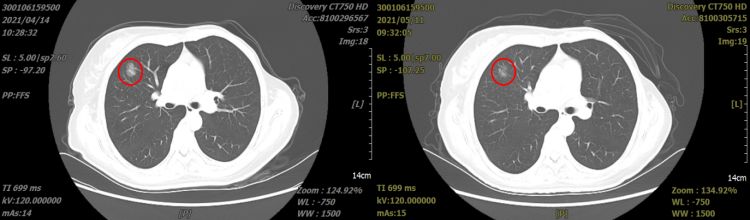
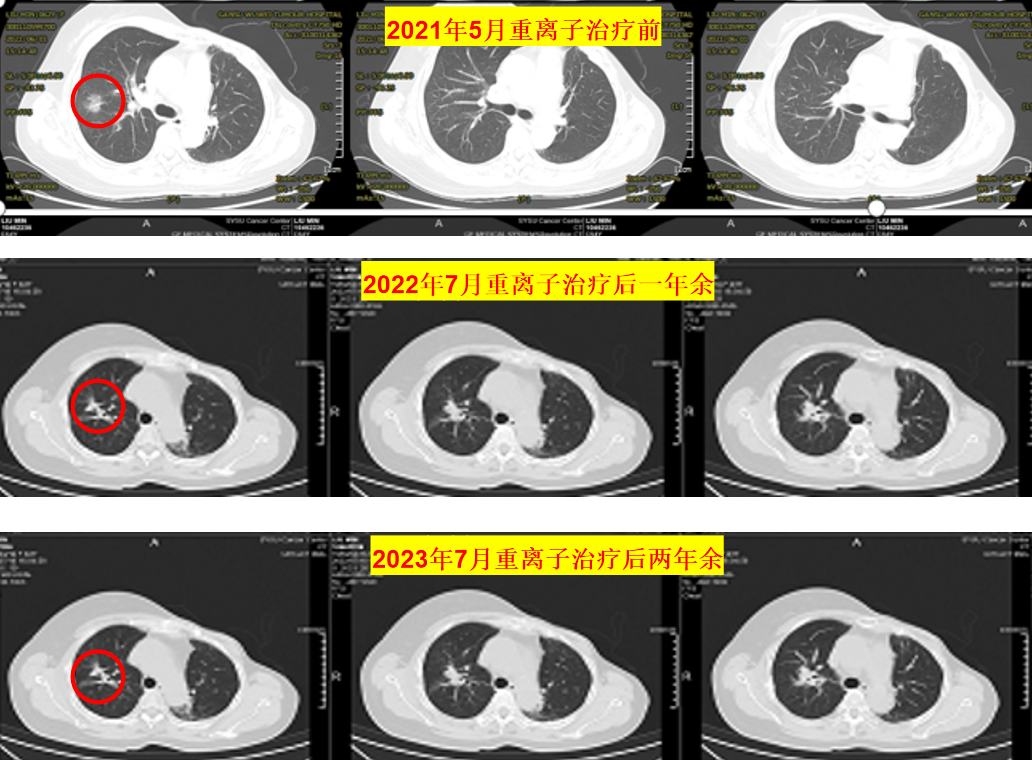
Case 3: Ms. Liu, 62 years old, with right lung cancer. After single‑session heavy ion therapy, the tumor completely disappeared, leaving only a small amount of fibrous streak shadow at the original lesion site (equivalent to a healed "scar"). Follow‑up has now exceeded 5 years with no recurrence, meeting the criteria for cure.
3. Two‑Year Local Control Rate of 100%
The Wuwei Heavy Ion Center conducted detailed follow‑up statistics on 19 patients with lung cancer who received single‑session heavy ion therapy (mean age 65 years, oldest 84 years). Results showed: all patients achieved a two‑year local control rate (PFS) of 100%. Using Kaplan‑Meier survival analysis, follow‑up duration ranged from 6 to 75 months. The cumulative survival probabilities at 3, 4, and 5 years after treatment were all 65.81%. Most deaths were due to other cardiovascular and cerebrovascular complications rather than lung cancer itself. Excluding deaths from other causes, the 5‑year disease‑specific survival rate for single‑session lung cancer treatment reached 76%.
Furthermore, from an international perspective, heavy ion therapy for lung cancer has a history of over 30 years. As early as 1994, Japan pioneered heavy ion therapy for lung cancer. After more than three decades of clinical validation, the 5‑year disease‑specific survival rate for early‑stage non‑small cell lung cancer can reach 70%–80%, comparable to surgical outcomes. In direct comparisons with currently commonly used stereotactic body radiotherapy (SBRT), heavy ions demonstrated significantly higher 3‑year local control rates (87.7% vs. 79.1%) and overall survival rates (80.1% vs. 71.6%).
4. Why Are Heavy Ions So Remarkable? Decoding the "Bragg Peak"
The reason heavy ions can achieve such remarkable efficacy at extremely low cost and with very few sessions (even a single session) lies in their unique physical and biological advantages:
The "precise blasting" Bragg peak: Conventional X‑rays (photons) release energy along their entire path through the body, resulting in "killing a thousand enemies while losing eight hundred of one's own." Heavy ions, by contrast, release very little energy upon entering the body, then instantly release enormous energy upon reaching the tumor target (the Bragg peak), followed by rapid attenuation. This enables "targeted blasting" of the tumor while perfectly protecting surrounding heart, major blood vessels, and healthy lung tissue. For patients with poor cardiopulmonary function, this is literally tailor‑made.
Stronger "killing power": The relative biological effectiveness (RBE) of heavy ions is far higher than that of conventional radiotherapy. They can more effectively break both DNA strands of tumor cells, making it extremely difficult for cancer cells to repair, thereby reducing recurrence rates.
The "subtraction" from 18 sessions to 1: Early heavy ion treatment required 18 or 9 fractions. However, clinical exploration has found that through precise respiratory control, single high‑dose irradiation for early peripheral lung cancer is not only safe but also dramatically shortens the treatment cycle — sparing patients the burden of multiple trips to the hospital.
Summary
The development of China's heavy ion therapy has not only achieved a technological "leapfrog" but has also pioneered a path from "sky‑high pricing" to "affordable pricing" in its charging model. For 49,500 RMB, a single irradiation session lasting less than half an hour, with no pain, allowing patients to walk away immediately after treatment, with the tumor gradually disappearing after inactivation — this is not only a victory for medical science and technology but also good news for countless early‑stage lung cancer patients, especially elderly patients with underlying cardiopulmonary conditions. As heavy ion therapy becomes more widely available across the country, it is believed that more patients will benefit from the hope brought by this high technology.
6. Introduction to the First Department of the Radiotherapy Center, Wuwei Heavy Ion Center
The First Department of the Radiotherapy Center at the Wuwei Heavy Ion Center is a national key construction specialty, a Gansu Provincial key discipline, and a Wuwei Municipal key discipline. Founded and led by Dr. Zhang Yanshan, the department focuses on basic research and clinical application of heavy ions and has become China's earliest clinical center dedicated to heavy ion clinical application, also cultivating a large number of talents for domestic heavy ion clinical application. It is currently the department in China that completes the largest number of heavy ion treatment cases for tumors at all body sites each year, with the most complex range of diseases and the largest case volume. On the basis of continuously summarizing and refining clinical experience, it has now formed a model in which, building on heavy ion treatment for tumors at all body sites, the heavy ion treatment of liver cancer, lung cancer, esophageal cancer, pancreatic cancer, and other tumors serves as the leading disease focus. The department was the first in the world to carry out the "galloping scheme" for the treatment of bladder cancer, and the first in the world to use high‑frequency oscillatory ventilation to control respiratory motion, keeping organ motion within approximately 1 mm. It pioneered the "spacer technique" and introduced the concept of "heavy ion surgery," collaborating with surgery so that tumors adjacent to normal organs can safely receive heavy ion treatment.
The First Department of the Radiotherapy Center has accumulated relatively rich experience in the treatment of primary and metastatic liver cancer and has greatly expanded the heavy ion indications for liver cancer. Especially for intermediate‑ and advanced‑stage liver cancer, we have expanded the heavy ion indications for liver cancer from the common indications for early‑ and intermediate‑stage liver cancer to advanced cases, even including patients who cannot undergo liver transplantation and those with recurrence and/or metastasis after liver transplantation — all of whom have achieved good outcomes at our center. We have found that the non‑irradiated portion of the liver can compensate, enlarge, and regenerate well. Heavy ions can completely destroy the tumor while effectively protecting the non‑tumor portion of the liver. After heavy ion therapy, the tumor area gradually shrinks, while the normal liver undergoes compensatory enlargement. For patients with extensive infiltration and multiple lesions, we can proceed step by step and in stages, addressing each lesion individually. In addition, for liver cancers >3 cm and those adjacent to the hepatic hilum, carbon‑ion therapy can also achieve good local control. Using our department's original high‑frequency oscillatory ventilation to control respiratory motion, keeping organ motion within approximately 1 mm, and then applying our department's original "heavy ion surgery" technique, we have successfully treated patients with multiple liver metastases, even more than ten metastatic lesions. In some patients, because the tumor was close to the gastrointestinal tract, we collaborated with surgery so that tumors adjacent to normal organs could safely receive heavy ion treatment. In the treatment of liver tumors, heavy ion therapy offers greater advantages than hepatectomy, transcatheter arterial embolization (TAE), transcatheter arterial chemoembolization (TACE), percutaneous ethanol injection (PEI), and radiofrequency ablation (RFA), both in terms of radicality and comfort.
The department has pioneered and refined heavy ion treatment for esophageal cancer, bladder cancer, breast cancer, cardia cancer, rectal cancer, cardiac tumors, and other diseases both domestically and internationally, continuously accumulating experience in the treatment of gliomas and various sarcomas, and has summarized a complete set of "Wuwei protocols" for heavy ion treatment of solid cancers. It has innovatively used general anesthesia with high‑frequency oscillatory ventilation, bladder capacity and pressure control devices, breast immobilization devices, and other world‑first technologies to control organ motion — further increasing the local heavy ion treatment dose to the tumor, better protecting normal organs, and achieving the goal of highly precise heavy ion radiotherapy with improved efficacy and reduced side effects.
The department also routinely uses advanced photon radiotherapy techniques such as stereotactic body radiotherapy/stereotactic radiosurgery (SBRT/SRS), intensity‑modulated radiotherapy (IMRT), and volumetric modulated arc therapy (VMAT).
Department members are proficient in English and routinely strengthen English‑language ward round communication. The latest National Comprehensive Cancer Network (NCCN) guidelines serve as the guiding principles for our comprehensive tumor treatment, forming a department that uses heavy ions as a powerful tool and comprehensively integrates targeted therapy, immunotherapy, cellular immunotherapy, chemotherapy, and other comprehensive tumor treatments. The department is deeply integrated with our hospital's follow‑up office, with well‑established post‑heavy‑ion‑therapy follow‑up tracking and continuous summary and observation. In terms of tumor diagnosis and comprehensive treatment, the department remains synchronized with the world and continuously writes papers, contributing our unique strength to the global heavy ion cause.
The department has a total of 16 medical and nursing staff. The team led by Professor Zhang Yanshan, Vice President, Director Zhang Yihe, Chief Physician, and Deputy Director Pan Xin has been engaged in the earliest domestic clinical practice of domestically produced heavy ions since 2018. With heavy ion technology as its core, the department follows the "two‑cycle, three‑multi" precision diagnosis and treatment quality management model. Department members are proficient in English and extensively carry out international and domestic academic exchanges, providing personnel training and technical output for newly established heavy ion facilities in China. Since its establishment, the department has been rated as an outstanding physician team in Gansu Province for many consecutive years, has registered and conducted more than 20 clinical trials, and has published multiple research results in core journals both domestically and internationally.
Under the influence of the department motto "Learned, Refined, Humble, Sincere" and the department culture of "cultivation rooted in the heart, self‑discipline that requires no reminder, freedom premised on restraint, and kindness that considers others," all medical and nursing staff of the First Department of the Radiotherapy Center have earned praise from a wide range of patients and their families through rigorous professional spirit and compassionate medical services.
Department Leader Zhang Yanshan, PhD, is a Visiting Researcher and Graduate Supervisor at the University of Chinese Academy of Sciences, Professor and Master's Supervisor at Gansu University of Chinese Medicine, and Professor and Master's Supervisor at Northwest Normal University. He is a Leading Talent of Gansu Province, an Outstanding Expert of Gansu Province, a First‑Tier Leading Talent of Wuwei City, and the lead for the creation of a national key discipline. The team he leads has received honors including Outstanding Team from the Provincial Department of Human Resources and Social Security, the Provincial Health Commission, and the Provincial Trade Union. As first/corresponding author, he has published 25 SCI papers and 20 papers in domestic core journals, and is proficient in English listening, speaking, reading, writing, and translation.
Comrade Zhang Yanshan served as Director of Surgical Oncology from 2004 to 2014 and has been professionally engaged in heavy ion therapy since 2011. He served as Director of China's first heavy ion therapy center and has cultivated a group of professional talents in heavy ion therapy for China. Joerg Hauffe, CEO of the German RPTC Proton Center, called him "Mr. Carbon."
Director Zhang Yanshan is the heavy ion expert in China who personally treats the largest number of heavy ion patients each year and handles the most complex cases. He has accumulated rich experience in heavy ion therapy for solid tumors at all body sites, including primary and metastatic brain tumors, bone metastases, liver cancer, lung cancer, pancreatic cancer, chordoma, and sarcoma. He has extensive experience in re‑irradiation for recurrent esophageal cancer and lung cancer after radiotherapy, and has summarized a set of Wuwei protocols in the field of heavy ion therapy, benefiting numerous patients with complex and critical tumors.
Comrade Zhang Yanshan is fully responsible for the clinical application of China's first heavy ion therapy system with independent intellectual property rights, overseeing indication determination, target volume delineation, fractionation scheme design, dose and risk control, efficacy evaluation, and management of adverse events and toxic reactions — driving the development of China's heavy ion cause. Each year, he personally delineates target volumes and fully treats more than 500 patients receiving heavy ion therapy, insisting on being present on the frontline and personally involved in diagnosis and treatment.
Professor Zhang Yanshan pioneered the "galloping scheme" for bladder cancer treatment internationally, pioneered the use of high‑frequency oscillatory ventilation (HFOV) to control respiratory motion, pioneered the surgical "spacer technique," and proposed the concept of "heavy ion surgery." Using the original HFOV technique, he has successfully treated multiple liver and bilateral pulmonary metastases. He has promoted the application of heavy ion therapy to liver tumors at all stages; in terms of radicality and treatment comfort, it offers certain advantages over hepatectomy, TAE, TACE, PEI, and RFA. He has refined heavy ion treatment strategies for esophageal cancer, bladder cancer, breast cancer, and other diseases, and accumulated experience in treating gliomas and various sarcomas. He has innovatively applied bladder capacity and pressure control devices and breast immobilization devices to strictly control organ motion, increasing the local heavy ion treatment dose to tumors while better protecting normal organs — thereby improving efficacy, reducing adverse reactions, and achieving precise heavy ion radiotherapy.
Professor Zhang Yanshan has a background encompassing basic tumor research, pharmacotherapy, surgical oncology, and radiotherapy. He possesses proficient imaging interpretation skills and excellent English listening, speaking, reading, writing, and translation abilities, enabling him to stay abreast of first‑line international oncology advances. He is a leader in composite tumor treatment, capable of radiotherapy and tumor treatment quality control, process optimization, team building, AI tool application, and medical safety management. He excels in clinical decision‑making for complex and advanced tumors, emphasizing multidisciplinary integration, whole‑course management, and humanistic communication.
7. Introduction to the Wuwei Heavy Ion Center
The Wuwei Heavy Ion Center is the clinical application base for China's first heavy (carbon) ion therapy system with complete independent intellectual property rights. It is technically supported by the Institute of Modern Physics, Chinese Academy of Sciences, and clinically operated by Gansu Wuwei Cancer Hospital. Since the first patient was treated in November 2018, as of October 15, 2026, the center has treated more than 3,300 patients, covering more than 100 tumor types, including lung cancer, pancreatic cancer, liver cancer, glioblastoma, nasopharyngeal carcinoma, rectal cancer, and various sarcomas. Heavy (carbon) ions have a strong tumor cell‑killing effect; the relative biological effectiveness of heavy (carbon) ions can reach 2 to 5 times that of conventional radiotherapy and proton therapy, with minimal impact on surrounding normal tissues [1‑2].
As the only medical institution in the world operating two heavy (carbon) ion therapy systems simultaneously, Wuwei Cancer Hospital continues to advance technological innovation and has achieved nine "world‑first" accomplishments, including precision treatment under ventilator control, bladder cancer treatment under precise bladder capacity control, single‑session treatment with surgical implantation of spacers between organs and tumors, and dual Bragg peak heavy (carbon) ion lattice radiotherapy. It has also developed China's first 360° rotatable and height‑adjustable ion radiotherapy chair and completed the world's first batch of multiple cases of cardiac tumor heavy (carbon) ion treatment.
Leveraging 30 research platforms including the CAS Key Laboratory of Heavy (Carbon) Ion Beam Radiation Biology and the Sydney University Biomedical Data Analysis and Visualization Laboratory, the center has conducted more than 30 clinical studies on key tumor types and published nine monographs including the Standard Operating Procedure for Carbon Ion Radiotherapy, gradually building a knowledge system covering physical technology, clinical diagnosis and treatment, and health management. On February 23, 2026, CCTV‑13's Morning News broadcast a special report on the operation of China's first medical heavy ion accelerator with independent intellectual property rights; Yang Jiancheng, Deputy Director of the Institute of Modern Physics, Chinese Academy of Sciences, provided an introduction in the program.
References
[1] Abousaida B, Seneviratne D, Hoppe BS, Ko SJ, Asaithamby A, Cucinotta FA, et al. Carbon ion radiotherapy in the management of hepatocellular carcinoma. J Hepatocell Carcinoma. 2021;8:1169-1182. (Table 1, reproduced with permission from Kavanagh BD. Introduction to clinical radiation oncology. Radiology. 1998;209(1):168.
[2] Apisarnthanarax S, wen SR, Combs SE. Proton beam therapy and carbon ion radiotherapy for hepatocellular carcinoma. Semin Radiat Oncol. 2018;28(4):309-320.
Case provided by: Zhang Yihe (Director, First Department of the Radiotherapy Center)
Data support: Tumor Registry and Follow‑up Office (Chen Xuelian, Li Pengqing)
Reviewed by: Zhang Yanshan (Chief Physician)
Date: October 28, 2026