Wuwei Heavy Ion Center: Summary of Heavy (Carbon) Ion Therapy for 9 Cases of Synovial Sarcoma
Wuwei Heavy Ion Center: Summary of Heavy (Carbon) Ion Therapy for 9 Cases of Synovial Sarcoma
Synovial Sarcoma is a rare malignant soft tissue tumor that predominantly affects adolescents and young adults. It typically occurs in critical locations such as joints, the thoracic cavity, and the pelvis, making surgery challenging—often leading to amputation, loss of function, or incomplete resection, while also carrying a high risk of metastasis. More troubling still, synovial sarcoma is insensitive to conventional radiotherapy and shows limited response to chemotherapy. Once recurrence or metastasis occurs, many physicians are left with little hope. However, the advent of heavy ion therapy is changing this landscape. Heavy ion beams possess a unique physical property known as the "Bragg peak"—they release minimal energy as they enter the body, concentrating their destructive power only upon reaching the depth of the tumor. Like precision-guided missiles, they accurately destroy cancer cells while maximally preserving surrounding bones, nerves, blood vessels, and vital organs. Their biological effectiveness is 2 to 5 times that of conventional radiotherapy, enabling them to directly break the double strands of tumor cell DNA, leaving those "stubborn" sarcoma cells unable to repair the damage. Because synovial sarcoma is extremely difficult to treat and effective therapeutic options are scarce, heavy ion therapy—being a highly effective treatment—has made this rare disease not so rare in Professor Zhang Yanshan's practice. Since opening for patient treatment in November 2018, the Wuwei Heavy Ion Center has treated a total of 9 synovial sarcoma cases as of April 2026. The results are encouraging: a local control rate of 100%, an overall response rate of 100%, and not a single case of treatment interruption due to severe side effects. Below, we present real data and typical case studies to demonstrate the power of heavy ion therapy.
I. Overall Situation
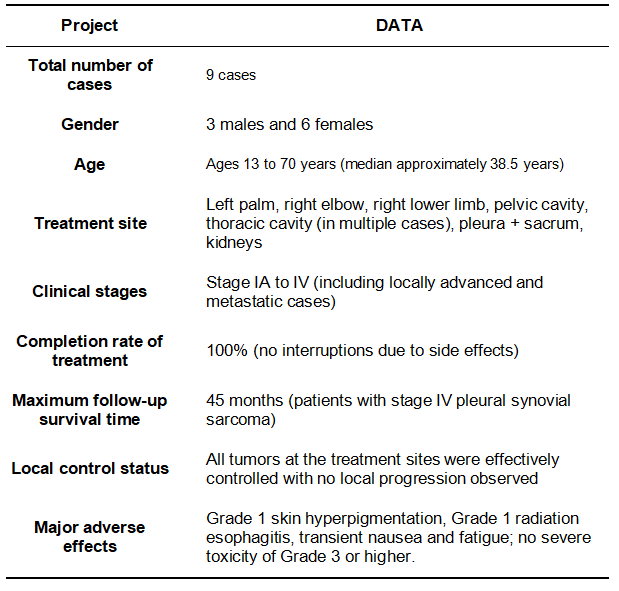
Since our center began treating patients in November 2018, as of April 2026, we have treated a total of 9 patients with synovial sarcoma using carbon (heavy) ion radiotherapy. The baseline characteristics are as follows: Sex: 3 males, 6 females, Age: 13–70 years (median 38.5 years)
- Treatment sites: Limbs (palm, elbow, lower limb), thoracic cavity, pleura, pelvis, kidney
- Clinical stage: Stage IA to Stage IV (including locally advanced and metastatic disease) Treatment outcomes (as of April 1, 2026)
- Overall survival rate: 100% (8 patients alive; one death due to respiratory failure caused by diffuse metastasis)
- Treatment completion rate: 100%, with no interruptions due to severe side effects
- Longest follow-up: 45 months (a patient with stage IV pleural synovial sarcoma)
- Median survival time: 12 months (some patients were treated recently)
- Major side effects: Only grade 1 skin hyperpigmentation, grade 1 radiation esophagitis, and transient nausea and fatigue; no grade ≥3 toxicity
Overall data of 9 cases of synovial sarcoma at Wuwei Heavy Ion Center
Note: Some patients (e.g., those with synovial sarcoma of the thoracic cavity or kidney) have only recently completed treatment, so their follow-up period is relatively short (less than 6 months). However, all have been successfully discharged and have entered regular follow-up, with preliminary treatment outcomes being satisfactory.
Conclusion: Heavy (carbon) ion therapy demonstrates significant efficacy, good local control, and high safety in the treatment of synovial sarcoma. It provides an effective treatment option for patients who are inoperable, have postoperative recurrence, or are at an advanced stage.
II. Typical Cases
Case 1: Ms. Liu, 34 years old, pleural synovial sarcoma (Stage IV, failed multiple lines of treatment)
Liu Q, female, 34 years old. In May 2022, due to chest tightness and shortness of breath, she was found to have multiple left pleural nodules. She visited Tianjin Cancer Hospital, where a chest CT showed multiple left pleural nodules, the largest measuring approximately 3.2 × 2.1 cm. The patient underwent ultrasound-guided needle biopsy; pathology revealed synovial sarcoma, Ki-67 (40%+), with SS18–SSX1 gene fusion. Tumor mutation burden was 1.99 mutations/Mb, and microsatellite status was stable. The patient received oral anlotinib targeted therapy for two months but developed chest tightness, shortness of breath, and fever. Chest CT showed a large left pleural effusion and left lung atelectasis. On September 19, 2022, she underwent video-assisted thoracoscopic partial resection of the left upper lobe, pleural debridement, and pleurodesis at the PLA General Hospital. Postoperative treatment with tislelizumab led to disease progression. On February 27, 2023, the patient enrolled in a clinical trial and received four cycles of sintilimab. On June 2, 2023, follow-up chest CT revealed thickening of the left pleura and interlobar pleura with multiple irregular nodules, larger than before, some confluent into masses, the largest measuring approximately 15.5 × 7.3 cm. On June 12, 2023, she enrolled in another Phase I clinical trial (CAN1012 intratumoral injection for safety, tolerability, and preliminary efficacy in patients with advanced solid tumors) and received two treatments, but the tumor was not effectively controlled. She then presented to the Wuwei Heavy Ion Center. PET-CT showed multiple nodules of thickened left pleura, the largest cross-section approximately 12.6 × 10 cm, SUVmax 18.4. She was admitted on July 26, 2023, and received heavy (carbon) ion radiotherapy, along with two cycles of concurrent sintilimab. During the initial phase of treatment, she experienced transient nausea and fatigue, which gradually improved. The treatment course was uneventful. After treatment, she developed grade 1 skin hyperpigmentation in the radiation field and grade 1 radiation esophagitis, both of which improved with symptomatic management. No other radiation-related adverse effects were observed. Follow-up chest CT after treatment showed that the left pleural and interlobar pleural nodules had significantly reduced in size, with the largest measuring approximately 10 × 4.1 cm. The patient achieved a partial response (PR) to treatment. Midway through her treatment, specifically after the ninth fraction, a follow-up CT scan revealed that the 10 cm tumor had shrunk considerably. In Ms. Liu's own words, it was "incredible, unbelievable, that it could shrink so much."
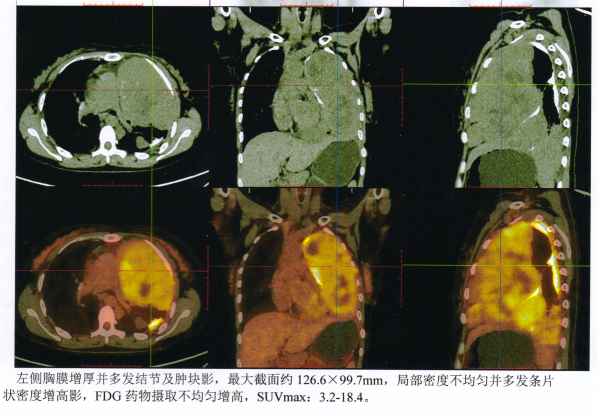
Left pleural thickening with multiple nodules and masses, the largest cross-section measuring approximately 126.6 × 99.7 mm, with inhomogeneous local density and multiple strip-like areas of increased density. FDG uptake is inhomogeneously increased, SUVmax: 3.2–18.4.
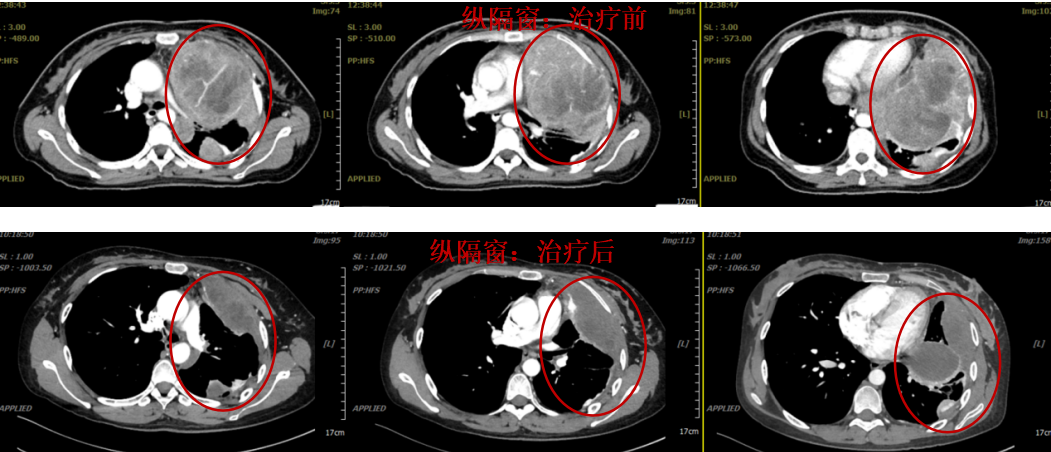
Mediastinal window:
Before treatment, the tumor occupied the entire left thoracic cavity with a significant mass effect, and the heart was markedly compressed.
After treatment, the left lung re-expanded, most of the tumor disappeared, and the heart returned to its normal position.
Case 2: Ms. Yang, 43 years old, synovial sarcoma of the right lower limb (Stage I, early-stage extremity)
Medical history: Synovial sarcoma of the right lower limb, Stage I, no metastasis. Our center's biopsy pathology confirmed synovial sarcoma, which was further verified by consultation with an external hospital. The patient opted for direct heavy ion therapy, thereby avoiding surgical trauma and postoperative functional impairment. At the same time, heavy ion therapy achieved complete local tumor inactivation, improving quality of life and reducing the risk of metastasis.
Heavy (carbon) ion therapy: Underwent heavy (carbon) ion therapy in March 2025, with a treatment course of 21 days.
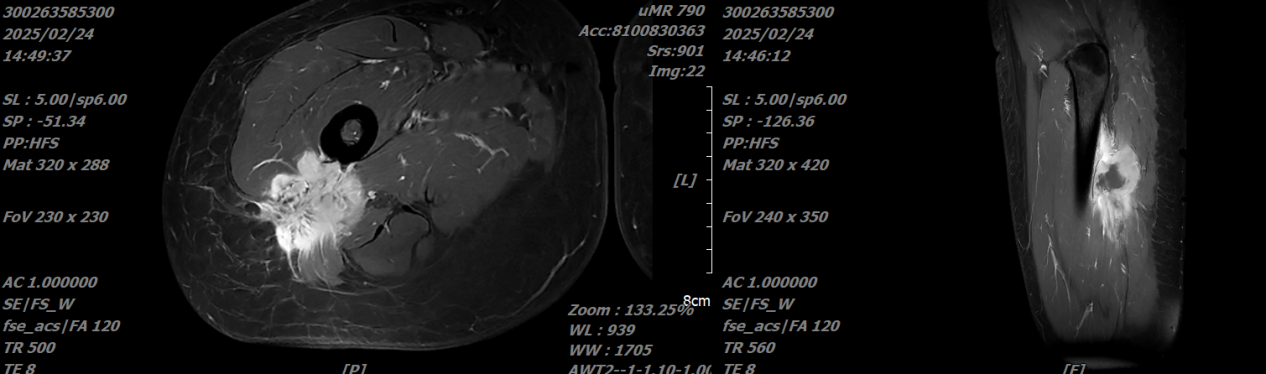
Before treatment (February 24, 2025): MRI revealed a mass in the posterolateral muscle space of the upper right thigh with unclear borders from surrounding tissues.
One year after treatment (January 12, 2026): Follow-up examination showed that the mass had been inactivated and absorbed, with residual edema visible in the surrounding area.
Outcome: The treatment course was uneventful, with no lower limb motor dysfunction and good local control. The patient received 4 cycles of concurrent chemotherapy during heavy (carbon) ion therapy. The patient has recovered well and, to date, no pulmonary metastasis has been detected. She remains under close follow-up.
III. Core Advantages of Heavy Ion Therapy for Synovial Sarcoma
Precision: Bragg peak characteristics result in minimal damage to surrounding normal tissues (bones, nerves, blood vessels, heart).
High efficacy: High LET directly breaks DNA double strands, making it effective even against sarcomas that are resistant to conventional radiotherapy.
Non‑invasive: No surgery required; preserves limb function and appearance, making it particularly suitable for adolescents.
Writer: Chen Xuelian, Li Pengqing (Office of Cancer Registry and Follow-up)
Reviewed by: Zhang Yanshan (Vice President)
Date: April 20, 2026