Patient, male, 24 years old, diagnosis: sacrococcygeal chordoma
1. Patient, male, 24 years old, diagnosis: sacrococcygeal chordoma
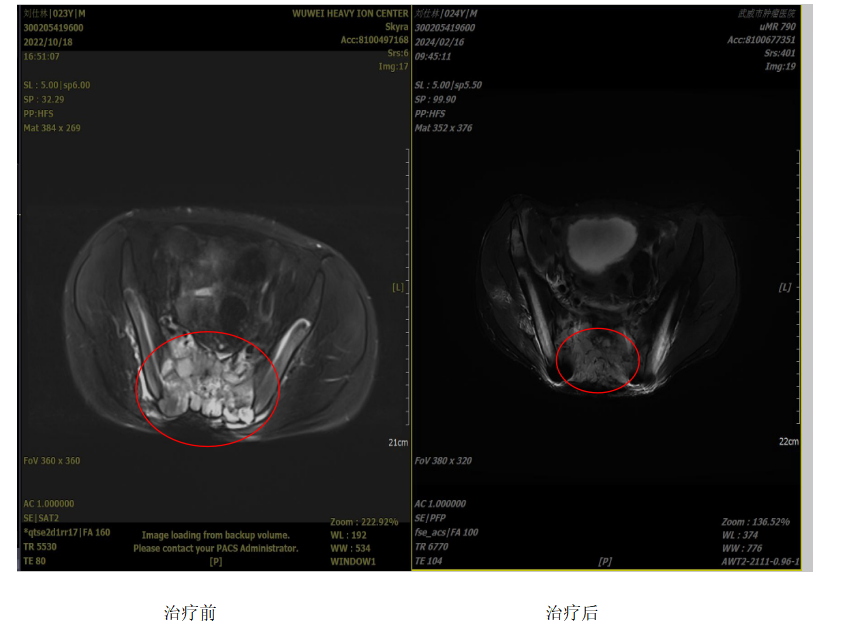
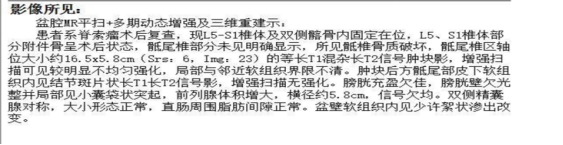
2. Medical History: The patient first experienced sacrococcygeal pain on August 1, 2021, without urinary difficulties, frequent urination, urgency, or bowel movement issues. By April 2022, the pain in the lumbosacral region gradually worsened, accompanied by difficulty in urination and defecation. In May 2022, the patient visited the Second Affiliated Hospital of the Air Force Medical University for evaluation. An MRI of the lumbosacral region revealed a space-occupying lesion in the sacrococcygeal region, suspected to be a chordoma. On May 17, 2022, the patient underwent surgical resection and internal fixation of the sacrococcygeal lesion. Pathological results confirmed sacrococcygeal chordoma. Postoperatively, the sacrococcygeal pain slightly improved, but the patient continued to experience difficulty with urination and defecation. On October 12, 2022, the patient experienced recurrent sacrococcygeal pain, accompanied by pain in the posterior lateral region of the right lower limb. A follow-up MRI at the Second Affiliated Hospital of the Air Force Medical University showed a space-occupying lesion in the sacrococcygeal region (8.8 cm × 5.7 cm), suggesting tumor recurrence. Postoperative changes were noted in the L5-S1 vertebrae and partial attachments, with high-signal shadows in the lumbosacral subcutaneous tissues. On October 18, 2022, the patient was admitted to our hospital and underwent carbon ion radiotherapy for the sacrococcygeal chordoma. The total dose administered was: PTV 39.6 Gy (RBE) in 9 fractions PTVboost: 30.8 Gy (RBE) in 7 fractions A follow-up pelvic MRI on February 16, 2024, revealed a large mass in the sacrococcygeal region with surrounding nodular and patchy shadows, invasion of adjacent soft tissues, and localized fluid accumulation in the soft tissues posterior to the mass. Compared to the previous MRI (November 15, 2022), the mass had ecreased in size and showed reduced enhancement.
3. Treatment Plan:
Carbon Ion Radiotherapy for Chordoma
- Total Dose: 70.4 Gy (RBE) in 16 fractions
4. Therapeutic Effect: