
Domestic First: Single-Session High-Dose Heavy Ion Therapy
Domestic Pioneering Clinical Breakthrough in Single-Session High-Dose Hypofractionated Heavy Ion Therapy
In recent years, the Wuwei Heavy Ion Center of Gansu Wuwei Cancer Hospital has been continuously committed to the independent innovation and clinical expansion of heavy ion therapy technology. A domestic pioneering clinical breakthrough has been achieved in single-session high-dose hypofractionated heavy ion therapy. This technology compresses heavy ion radiotherapy, which originally required multiple sessions, to be completed within one to five sessions. It not only provides cancer patients with a precise and patient-centric treatment option but also marks a historic leap for China's heavy ion medical technology from "running alongside" to "taking the lead."

"Hypofractionated radiotherapy" significantly reduces the number of treatment sessions by increasing the dose per fraction while ensuring equivalence in total biological effective dose. The single-session high-dose hypofractionation technology developed by the Wuwei Heavy Ion Center deeply integrates this concept with the unique physical and biological advantages of heavy ions, forging four core strengths and leading cancer treatment into a new era of high efficiency, precision, and accessibility.
The Three Core Advantages of This Technology:
- Highly Efficient and Convenient Treatment, Greatly Improving Patient Quality of Life This technology compresses the traditional treatment cycle lasting several weeks to just a few days or even a single day. It significantly reduces the number of hospital visits and associated time costs for patients, lowers non-medical expenses, alleviates physical and mental burden, and helps patients return to normal life more quickly.
- Possesses Unique Radiobiological Advantages, Potentiating Anti-Tumor Immunity High-dose irradiation can exert a stronger killing effect on tumor cells, especially on cancer cells with weak repair capabilities. Simultaneously, it can induce "immunogenic cell death" in tumor cells, stimulating the body's own immune system to attack the tumor, providing a new pathway for combined immunotherapy.
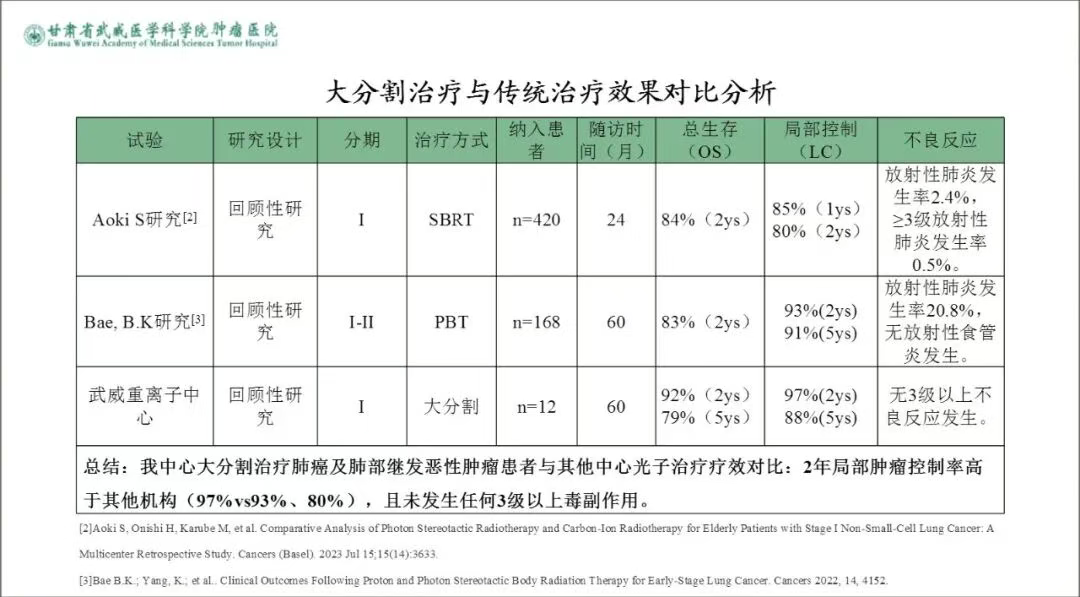
- Definitive Clinical Efficacy, Already a Standard Treatment for Some Tumors In the treatment of early-stage lung cancer, liver cancer, sacrococcygeal chordoma, and other tumors, its local control rate is equivalent to or better than traditional radiotherapy, and it has become one of the international standard protocols. It also shows promising prospects for the precise eradication of oligometastases, offering a new radical treatment option for patients who are unable or unwilling to undergo surgery.
As the only medical institution in the world operating two heavy ion therapy systems simultaneously, the Wuwei Heavy Ion Center, relying on its "dual-center synergy" development model, has overcome multiple core technical challenges through years of scientific research, including precise dose control and real-time tumor tracking. This technology fully leverages the unique "Bragg Peak" physical characteristic and high relative biological effectiveness (RBE) of heavy ions. It precisely focuses high-energy carbon ion beams on the tumor target area, achieving a "targeted strike" on cancer cells, causing difficult-to-repair DNA double-strand breaks while minimizing radiation damage to surrounding healthy tissues. Coupled with China's first 360° rotating and lifting ion therapy chair and MRI-guided tracking technology, the treatment accuracy reaches the millimeter level, ensuring the safety and effectiveness of single-session high-dose irradiation.
Patient Case: Ms. Liu, 62 years old. Diagnosis: Secondary malignant tumor of the lung, pT0N0M1 Stage IV. Auxiliary examination (2021/05/24 PET/CT): A mixed ground-glass opacity with increased metabolism in the right upper lung lobe, considered a pulmonary metastasis. Treatment: Completed in a single session.
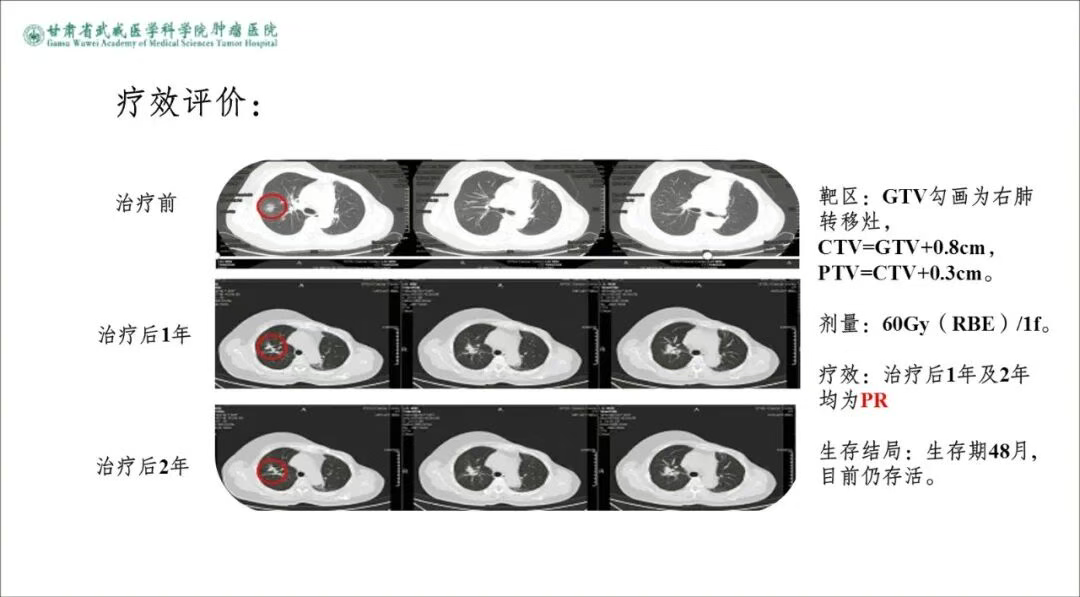
Clinical data shows this technology has been successfully applied in treating various malignant tumors including lung cancer, liver cancer, and sacrococcygeal chordoma. It has demonstrated significant advantages, especially for complex cases where tumors are adjacent to sensitive organs and are difficult to resect surgically. Compared to the traditional radiotherapy schedule of 20-25 sessions, the single-session high-dose hypofractionation technology, using one to five sessions, shortens the treatment cycle from several weeks to within one week. This not only greatly reduces the burden of travel for patients but also decreases the risk of tumor cell repair and metastasis during treatment intervals. To date, the Wuwei Heavy Ion Center has cumulatively completed nearly 2,400 heavy ion treatments. The number of cases using the single-session high-dose hypofractionation technology ranks first globally, attracting patients from countries including Belgium, South Korea, and Malaysia to seek treatment.
In the future, the Wuwei Heavy Ion Center of Gansu Wuwei Cancer Hospital will continue to deepen technological innovation and clinical expansion. It aims to promote the large-scale adoption and comprehensive disease coverage of single-session high-dose hypofractionated heavy ion therapy. The center strives to make this top-tier, originally Chinese technology benefit more cancer patients worldwide, contributing the "Chinese Approach" and "Wuwei Strength" to building a global community of health for all.