Heavy (Carbon) Ion Therapy for Prostate Sarcoma: A Report of 6 Cases
Heavy (Carbon) Ion Therapy for Prostate Sarcoma: A Report of 6 Cases
Prostate sarcoma is an extremely rare but highly malignant tumor of the prostate gland, originating from mesenchymal tissues (such as muscles, blood vessels, and other connective tissues). It is fundamentally different from common prostate adenocarcinoma, which arises from glandular epithelial cells. This is an aggressive, rapidly progressive malignancy. The incidence of prostate sarcoma is very low, accounting for less than 1% of all prostate malignancies, making it a rare entity. A study based on the US SEER database from 2004 to 2020 identified only 125 adult patients. Prostate sarcoma can occur at any age, but its presentation varies by histological subtype. Leiomyosarcoma is the most common type in adults. Rhabdomyosarcoma is relatively more common in children and adolescents.
Due to its insidious onset, rapid progression, and resistance to conventional radiotherapy and chemotherapy, prostate sarcoma is often referred to as the "silent killer in the pelvis." Because heavy ions are highly sensitive against various refractory tumors, the Wuwei Heavy Ion Center has treated many rare tumors. For example, we have treated over 100 cases of adenoid cystic carcinoma, more than 10 cases of rare synovial sarcoma, and more than 10 cases of cardiac sarcoma. For the rare prostate sarcoma, as of May 2026, we have treated 6 cases. Below we report and share these cases.
I. The difficulty in treating prostate sarcoma is closely related to three major "culprits":
1. Complex anatomy: The tumor is located adjacent to the rectum, bladder, and urethra. Complete surgical resection often results in permanent urinary incontinence or colostomy, severely compromising the patient's quality of life.
2. Severe hypoxia: Sarcomas grow rapidly, developing large areas of necrosis and hypoxic regions within the tumor, making them highly resistant to conventional photon radiotherapy and chemotherapy.
3. High risk of local recurrence and metastasis: Even after complete surgical resection, the local recurrence rate remains high, and early distant metastasis to the lungs, bones, or other sites can occur.
II. Advantages of Heavy Ions: Why Can Heavy Ions Overcome This Disease?
1. Physical advantage – "precise blasting" via the Bragg peak: Heavy ion beams can deposit most of their energy precisely into the tumor target, causing nearly "zero damage" to surrounding organs at risk such as the anterior rectum and posterior bladder, achieving non‑invasive function‑preserving treatment.
2. Biological advantage – "armor-piercing" effect with high RBE: The relative biological effectiveness (RBE) of heavy ions is 2–5 times that of conventional photons, enabling direct double‑strand breaks in tumor cell DNA. They are equally effective against hypoxic cells and radiotherapy‑resistant sarcoma cells.
3. Spatial advantage – regional control: Heavy ion therapy can cover the main tumor, its invasive margin, and high‑risk lymphatic drainage areas, achieving "regional clearance" and effectively reducing the risk of local recurrence.
III. Treatment Data for Prostate Sarcoma at the Wuwei Heavy Ion Center
As of March 2026, the Wuwei Heavy Ion Center has treated a total of 6 patients with prostate sarcoma, all of whom had locally advanced or metastatic disease. Patients with stage III/IV accounted for 100% of the cohort.
Survival analysis results (Kaplan‑Meier method, based on real‑world data):
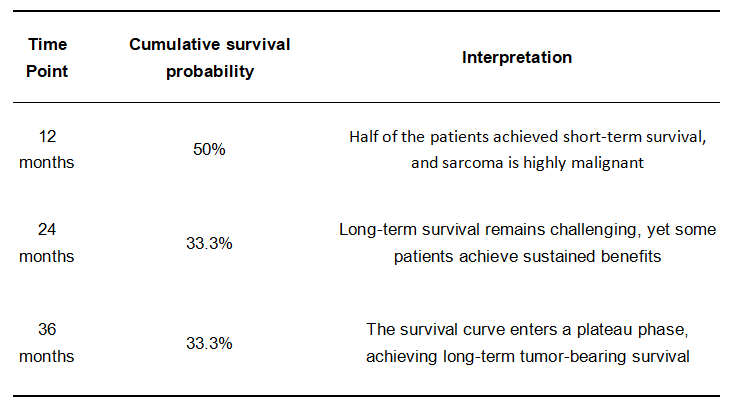
Heavy ion therapy for prostate sarcoma achieved a 100% response rate and a 100% 1‑year local control rate. Most patients in this group already had systemic metastases at the time of presentation due to advanced disease at diagnosis. If patients can receive heavy ion therapy before distant metastasis occurs, there is a potential for cure.
Conclusion: For locally advanced or metastatic prostate sarcoma – a highly aggressive malignancy – heavy ion therapy provides patients with opportunities for long‑term local control and survival.
IV. Efficacy Comparison: Comparison with Historical / International Data
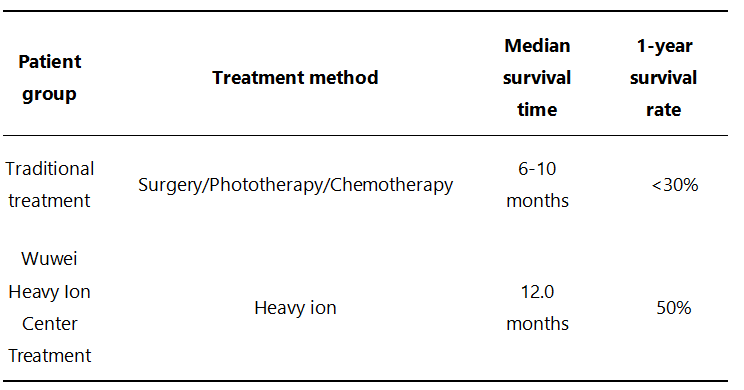
Comparison with historical data: The outcomes from this cohort are comparable to internationally advanced levels. Notably, all patients in this cohort had stage III/IV disease. Achieving survival outcomes similar to those of early‑stage patients treated with conventional therapy further highlights the unique value of heavy ion therapy.
V. Representative Cases:
Case 1: Mr. Li, male, 63 years old, prostatic stromal sarcoma.
In August 2024, the patient developed urinary obstruction without obvious cause, accompanied by difficulty urinating, increased nocturia, frequency, urgency, and dysuria. An initial diagnosis of benign prostatic hyperplasia was made, and he received medication and prostate thermal vapor ablation therapy, but with poor results. In January 2025, an MRI showed a multinodular mass in the prostate (7.1 × 8.3 × 11.4 cm), predominantly on the left side, with the rectum displaced to the right and indistinct borders with the bladder. He underwent transurethral laser resection of the prostate. Postoperative pathology revealed high‑grade prostatic stromal sarcoma. After surgery, his urinary and defecation difficulties did not resolve. A PET/CT scan on February 11, 2025, showed: following transurethral resection of the prostate, the residual prostate was significantly and irregularly enlarged with metabolic activity, consistent with malignancy. Involvement was noted of both seminal vesicles, the prostatic urethra, the posterior bladder wall, the sigmoid colon, the rectum, and adjacent peritoneum. The lesion had indistinct borders with the left obturator internus and left levator ani muscles. Two lesions in the left lower lobe were highly suggestive of metastatic disease. From March to April 2025, the patient received heavy ion therapy at our center. At present, the local lesion is significantly shrinking and being resorbed, with no severe adverse reactions.

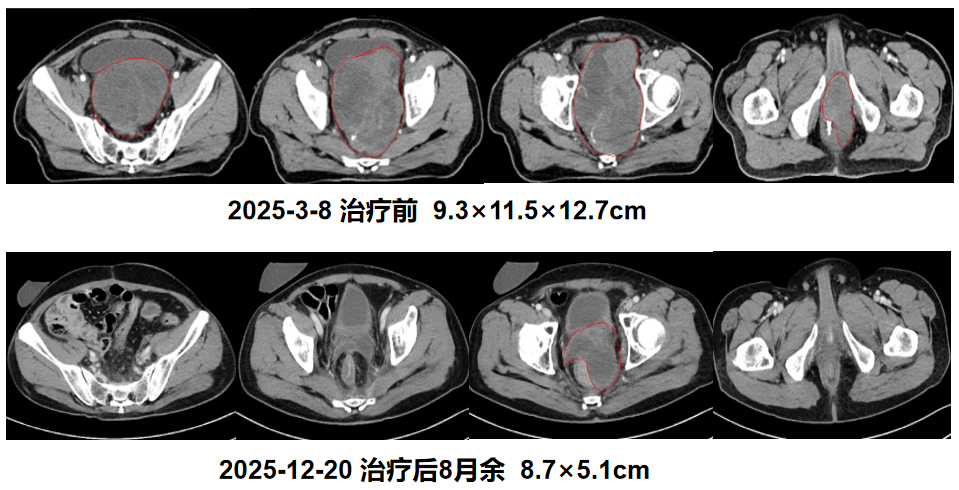
Case provided by: Dr. Wang Xin
Department: Radiation Oncology Center Ⅰ(International Medical Department Ⅰ)
Case 2: Mr. Zhong, male, 59 years old, prostatic leiomyosarcoma.
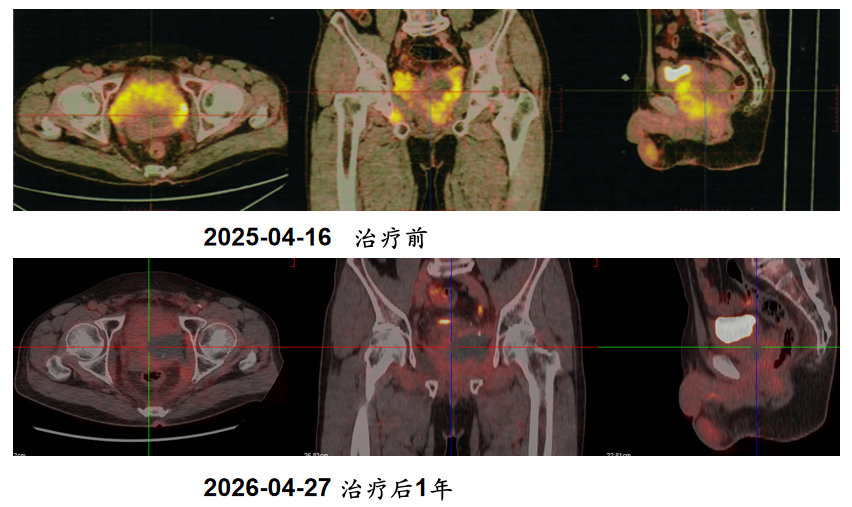
In May 2024, the patient presented with dysuria. Laboratory tests showed PSA of 2.46 ng/mL. Contrast‑enhanced pelvic MRI revealed multiple nodules and masses in the prostate, measuring 92 × 123 mm, with invasion of the posterior and left lateral bladder walls. A prostate needle biopsy was performed, with findings suggestive of sarcomatoid carcinoma. In June 2024, a transperineal prostate biopsy under ultrasound guidance was performed. Pathology indicated a malignant spindle cell tumor, consistent with leiomyosarcoma. From July 2024 to January 2025, the patient received 8 cycles of AI regimen (liposomal doxorubicin + ifosfamide), with a treatment response of PR. He was then maintained on oral anlotinib 12 mg. In April 2025, he presented to our hospital. PET/CT showed a significantly enlarged prostate with multiple soft tissue nodules and masses, indistinct borders with the posterior bladder wall, seminal vesicles, and anterior rectal wall, and heterogeneous increased metabolic activity. From April 2025 to May 2025, he received carbon ion therapy. One year after treatment, the lesion had shrunk and metabolic activity had significantly decreased. Heavy ion therapy achieved effective local control.
Case provided by: Dr. Yang Yuling
Department: Radiation Oncology Center Ⅰ(International Medical Department Ⅰ)
VI. Safety and Tolerability
During treatment and follow‑up, no patient in this cohort experienced grade ≥3 acute or late adverse reactions. Most reactions were grade 1–2 minor events (e.g., urinary frequency, mild lower abdominal pain), and patients tolerated the treatment well.
VII. Which Patients Are Suitable?
1. Patients with locally advanced, unresectable disease, or those who decline surgery
2. Patients with postoperative recurrence or residual disease not amenable to repeat surgery
3. Stage IV patients with oligometastasis (e.g., single or few metastatic lesions in the lung or bone)
VIII. Summary
Prostate sarcoma was once considered a "tough nut" in the treatment of pelvic tumors. At the Wuwei Heavy Ion Center, we have demonstrated with real‑world data and compelling clinical cases that heavy ions—with their high efficacy, low toxicity, and precision—are becoming an indispensable component of comprehensive treatment for prostate sarcoma. Surgery, heavy ions, chemotherapy, immunotherapy… they are never a single choice, but rather a "combination punch" based on precise evaluation. If you or your family member is facing the treatment dilemma of prostate sarcoma, it is worthwhile to learn more about this "national heavy instrument." Perhaps one scientific decision could be a new starting point for life.
Introduction to the Wuwei Heavy Ion Center
The Wuwei Heavy Ion Center is the clinical application base for China's first heavy ion (carbon ion) treatment system with complete independent intellectual property rights. The system is technically supported by the Institute of Modern Physics, Chinese Academy of Sciences, and clinically operated by Gansu Wuwei Cancer Hospital. The center officially began treating tumors in November 2018. To date, it has treated over 2,800 patients, covering more than 100 tumor types, including lung cancer, pancreatic cancer, liver cancer, glioblastoma, nasopharyngeal carcinoma, rectal cancer, and various sarcomas. As the only medical institution in the world operating two heavy ion (carbon ion) treatment systems simultaneously, the center has achieved nine "world‑first" innovations in technology: pioneering precise radiotherapy under ventilator control; bladder cancer treatment with accurate bladder capacity management; single‑fraction radiotherapy using surgically implanted spacers between organs and tumors; developing the world's first 360° rotatable and liftable ion radiotherapy chair; performing the world's first heavy ion (carbon ion) treatments for cardiac tumors; and pioneering dual‑Bragg‑peak lattice radiotherapy with heavy ions, among others. Leveraging 30 research platforms including the CAS Key Laboratory of Heavy Ion Radiation Biology and Biomedicine and the Sydney University Biomedical Data Analysis and Visualization Laboratory, the center has conducted over 30 clinical studies on major tumor types. To date, the center has published nine monographs, including the Standard Operating Procedure for Carbon Ion Radiotherapy, establishing a comprehensive knowledge system covering physical technology, clinical diagnosis and treatment, and health management.
Writer: He Nana (First Department of Radiotherapy Center)
Data Support: Chen Xuelian, Li Pengqing (Tumor Registration and Follow-up Office)
Reviewer: Zhang Yanshan (Vice President)
Date: May 15, 2026