Heavy (Carbon) Ion Therapy for Laryngeal Cancer: A Summary of 24 Clinical Cases
Heavy (Carbon) Ion Therapy for Laryngeal Cancer: A Summary of 24 Clinical Cases
Laryngeal cancer, due to its insidious onset, easily overlooked early symptoms, and the potential impact on speech and respiratory function following treatment failure, often leads to a significant decline in quality of life. The treatment of laryngeal cancer adheres to the principle of balancing individualization with functional preservation. The main options include two types of local curative approaches: surgery and radiotherapy. For early‑stage laryngeal cancer, minimally invasive surgery or radiotherapy alone can achieve high cure rates while preserving voice function. For locally advanced disease, combination therapy with surgery plus chemoradiotherapy or concurrent chemoradiotherapy is often used in an attempt to preserve the larynx. For cases with extensive invasion, total laryngectomy is required. For recurrent or metastatic disease, chemotherapy, EGFR‑targeted therapy, and immunotherapy (e.g., PD‑1 inhibitors) serve as important complementary treatments. The overall treatment strategy should be determined by a multidisciplinary team based on tumor stage, tumor location, and the patient's general condition. In Wuwei, Gansu, a cutting‑edge technology known as a "national heavy instrument" – heavy (carbon) ion therapy – is using robust clinical data to open a new lifeline for patients with laryngeal cancer.
The Wuwei Heavy Ion Center is equipped with China's first heavy ion treatment system possessing complete independent intellectual property rights. Since the first patient was treated in November 2018, the center has completed eight years of clinical practice. As of May 2026, over 2,800 patients have been treated, covering more than 100 tumor types, including 24 cases of laryngeal cancer.
1. Survival Data of Laryngeal Cancer Treatment at Wuwei Heavy Ion Center
From November 2018 to May 2026, the Wuwei Heavy Ion Center treated a total of 24 patients with laryngeal cancer, including 22 males and 2 females, with a mean age of 66.13 ± 10.32 years. Patients with stage III/IV disease accounted for 70.8% of the cohort. The survival analysis results (Kaplan‑Meier method) are shown in Table 1 and Figure 1.
Table 1 Cumulative Survival Probability of Laryngeal Cancer (%)
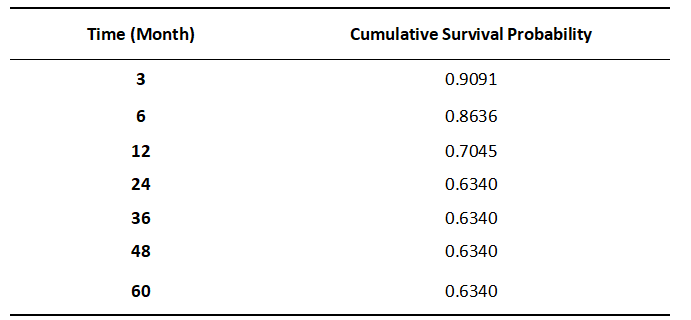
Among the patient cohort, the proportions of stage I and II cases were very small, while stage III/IV accounted for more than 70%. The mean survival time was 48 ± 6.91 months. After 24 months, the survival curve shows a clear plateau, with the survival rate at 24 months being the same as that at 60 months (63.40%), suggesting that patients who remain free of recurrence two years after treatment may achieve long-term survival.

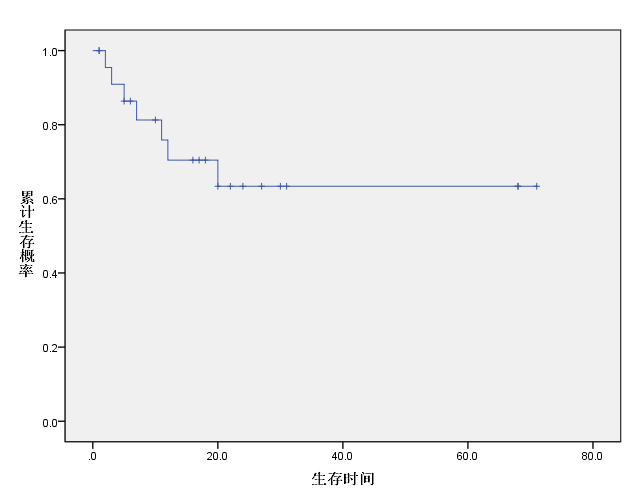
Figure 1 Survival curve of laryngeal cancer patients after heavy ion therapy (0~60 months)
II. Efficacy Comparison: Comparison with Traditional Treatments and International Data
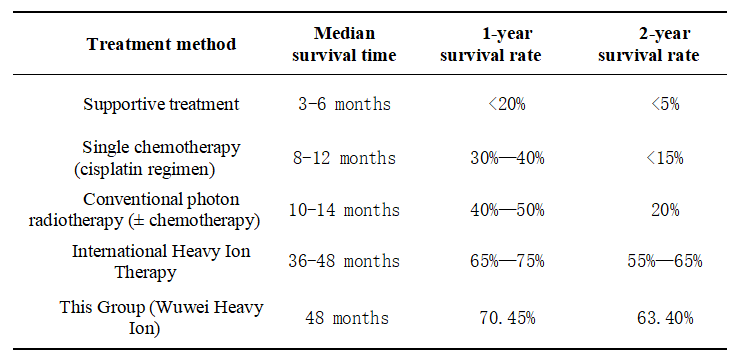
Conclusion: These data are comparable to internationally advanced levels. Notably, this outcome was achieved despite a higher proportion of stage III/IV patients (70.8%), and with preservation of laryngeal function, making the result even more significant. Based on the above comparisons, heavy (carbon) ion therapy offers a clear survival advantage over conventional treatment modalities for laryngeal cancer, particularly for locally advanced, postoperative recurrent, or inoperable cases. It not only prolongs median survival but also significantly improves 1‑year, 2‑year, and even 5‑year survival rates, while the incidence of severe treatment‑related adverse reactions remains extremely low. For patients who wish to preserve laryngeal function and avoid total laryngectomy, heavy ion therapy has become a highly attractive organ‑preserving treatment strategy. This real‑world data once again confirms: For early‑ and intermediate‑stage laryngeal cancer, heavy ion therapy can achieve curative results directly; for patients with locally advanced or advanced laryngeal cancer, heavy ion therapy is not a "last resort," but rather one of the preferred curative treatments for locally advanced laryngeal cancer.
III. Why is laryngeal cancer difficult to treat?
What makes laryngeal cancer particularly challenging can be attributed to three main factors:
1. Complex anatomy: The larynx is a critical passage for breathing and voice production. Tumors are located deep within the larynx, surrounded by delicate structures. Surgery is technically demanding, and conventional radiotherapy often risks damaging the vocal cords, trachea, and esophagus.
2. Severe hypoxia: Laryngeal tumors frequently create a hypoxic microenvironment, which significantly reduces the effectiveness of conventional photon radiotherapy.
3. High invasiveness and metastatic potential: Laryngeal cancer can spread along the vocal cords, epiglottis, and hypopharynx, and readily metastasizes to cervical lymph nodes, leading to a high rate of local recurrence.
IV. Advantages of Heavy Ions: Why Can Heavy Ions Treat Laryngeal Cancer Effectively
1. Physical advantage – "precise blasting" via the Bragg peak: Heavy ions release very little energy as they travel through the body, delivering maximum energy only at the tumor depth. This enables precise targeting of the lesion while maximizing protection of normal laryngeal structures.
2. Biological advantage – "armor-piercing" effect with high RBE: The relative biological effectiveness (RBE) of heavy ions is 2–5 times that of conventional photons. Heavy ions directly induce double-strand breaks in tumor cell DNA and are equally effective against hypoxic cells and radioresistant cells.
3. Spatial advantage – regional control: Heavy ion therapy can cover the primary laryngeal tumor, its invasion pathway, and regional lymph nodes, achieving "regional clearance" and reducing the risk of local recurrence.
V. Typical Cases
Case 1: Mr. Shi, 66 years old, moderately differentiated squamous cell carcinoma of the larynx, cT3N2M0 stage IVA, KPS: 90.
Before treatment, the patient had multiple enlarged lymph nodes in the right neck, with the largest exceeding 5 cm. The treatment plan proposed by Xijing Hospital was total laryngectomy combined with neck dissection, which the patient refused due to the inability to accept total laryngeal removal. He sought heavy ion therapy. Five years after heavy ion treatment, the patient's tumor has completely regressed, with no hoarseness. He has achieved full recovery.
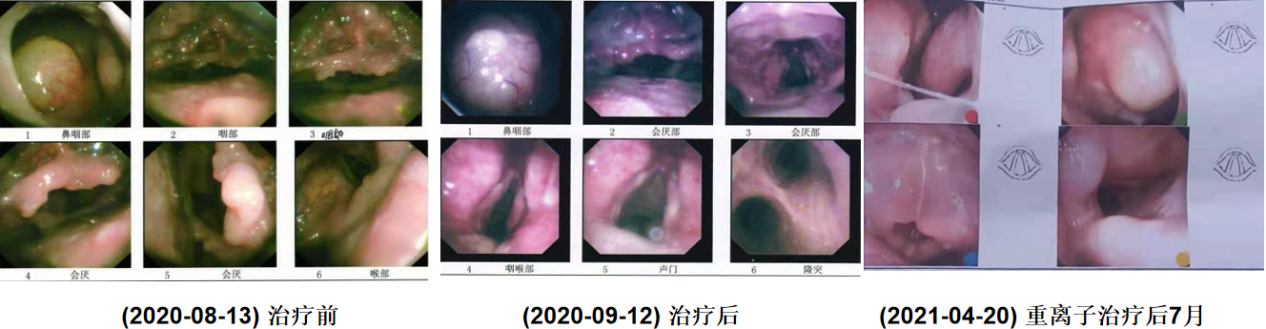
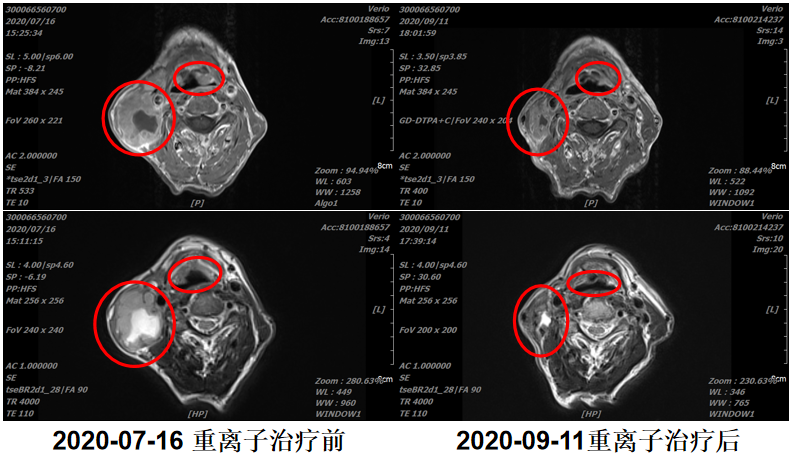
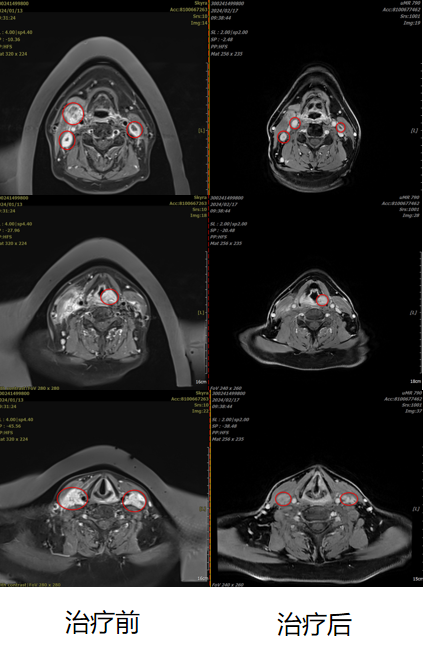
Case 2: Mr. Ma, 65 years old, poorly differentiated squamous cell carcinoma of the larynx, cT4aN2cM0 stage IVA.
Pre‑treatment presentation: In December 2023, the patient developed a sensation of a foreign body in the throat, accompanied by blood‑streaked sputum and swelling on the right side of the neck. CT findings: (1) An abnormally enhanced mass in the left vocal cord area, suggestive of a tumor, with possible involvement of the right vocal cord and local destruction of the left thyroid cartilage; (2) Possible multiple enlarged metastatic lymph nodes in both sides of the neck. Pathology: (laryngeal mass) poorly differentiated squamous cell carcinoma. The tumor invaded surrounding structures, and surgery was not indicated. After receiving one cycle of chemo‑immunotherapy, the patient presented to our hospital.
Treatment regimen: On January 16, 2024, carbon ion radiotherapy was delivered to the laryngeal lesion and bilateral cervical metastatic lymph nodes, along with two cycles of concurrent chemo‑immunotherapy.
Case provided by: Dr. Wang Xin
Department: Radiation Oncology Center Ⅰ(International Medical Department Ⅰ)
After treatment, the laryngeal lesion and bilateral cervical metastatic lymph nodes reduced in size compared to before, with a treatment response evaluation of partial remission (PR). At the three‑month follow‑up, the tumor had completely regressed, achieving a complete response (CR).
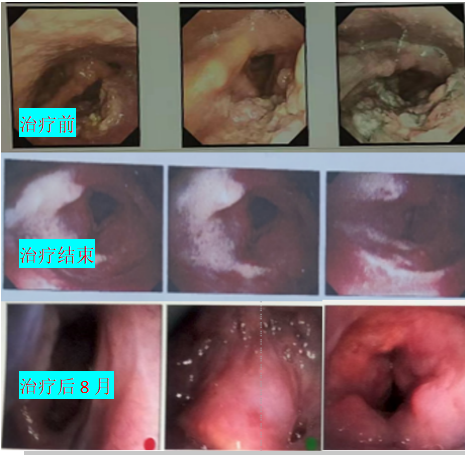
Case 3: Mr. Chen, 68 years old, moderately differentiated squamous cell carcinoma of the laryngeal surface of the epiglottis, cT3N2cM0 stage IVA.
Pre‑treatment presentation: On September 20, 2024, the patient developed throat pain. MRI showed marked thickening and abnormal enhancement of the soft tissue of the bilateral epiglottic walls (more pronounced on the left), with a shallow and indistinct pyriform sinus, unclear demarcation from the left thyroid cartilage, and corresponding narrowing of the laryngeal cavity, highly suggestive of laryngeal cancer. Pathology: (laryngeal surface of the epiglottis) invasive moderately differentiated squamous cell carcinoma. The tumor invaded surrounding structures. After surgical evaluation deemed the patient inoperable, he presented to our hospital.
Treatment regimen: On October 2, 2024, carbon ion radiotherapy was delivered to the laryngeal lesion and bilateral cervical metastatic lymph nodes, along with concurrent chemo‑immunotherapy.
Case provided by: Dr. Wang Xin
Department: Radiation Oncology Center Ⅰ(International Medical Department Ⅰ)
Treatment outcome: At the completion of heavy ion therapy, the thickening of the soft tissue of the bilateral epiglottic walls had decreased, the enlarged bilateral cervical lymph nodes had reduced in size compared to before, and the lesion under laryngoscopy was markedly reduced. A follow‑up laryngoscopy in August 2025 showed that the lesion had disappeared. As of the publication of this article in May 2026, the patient is living a normal life, with a normal voice and no symptoms.
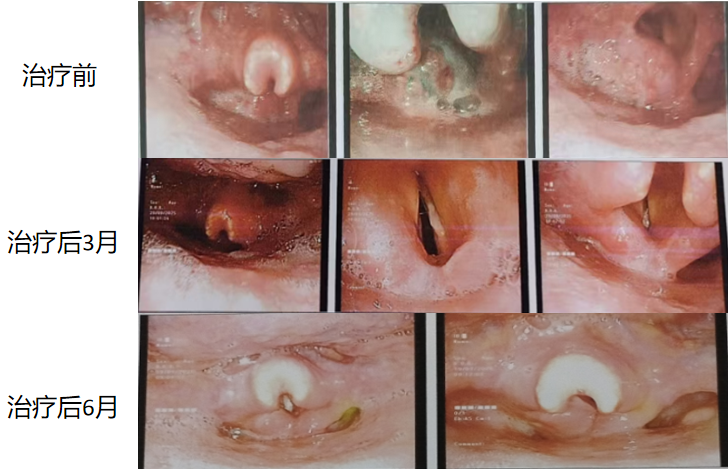
Case 4: Mr. Li, 74 years old, squamous cell carcinoma of the left pyriform sinus, cT2N2M0 stage IVA.
Pre‑treatment presentation: On April 23, 2025, the patient developed throat pain and hoarseness. Laryngoscopy showed mild hypertrophy of the lingual tonsils, curling of the epiglottis, and a shallow left pyriform sinus with neoplastic proliferation involving the arytenoid and left vocal cord. CT revealed enlarged lymph nodes in the left neck and a nodule in the anterior inferior part of the thyroid cartilage, suggestive of metastases. Pathology: (floor of the left pyriform sinus) squamous cell carcinoma. The tumor invaded surrounding structures, and surgery was not indicated. After receiving one cycle of chemo‑immunotherapy, the patient presented to our hospital.
Treatment regimen: On June 4, 2025, carbon ion radiotherapy was delivered to the laryngeal lesion and metastatic lymph nodes, along with concurrent chemo‑immunotherapy.
Case provided by: Dr. Yang Yuling
Department: Radiation Oncology Center Ⅰ(International Medical Department Ⅰ)
Treatment outcome: After treatment, the patient's laryngeal lesion showed slight reduction. A follow‑up laryngoscopy three months later showed that the lesion had nearly disappeared. Six months after treatment, the tumor had completely resolved.
Summary: Laryngeal cancer frequently invades surrounding structures such as the vocal cords, trachea, or cartilage. Surgery carries significant morbidity and is associated with substantial complications. For patients with laryngeal cancer who are unable or unwilling to undergo surgery, heavy ion therapy offers a non‑invasive curative option, with superior organ preservation capabilities. This approach is particularly suitable for elderly patients or those with multiple comorbidities, and is associated with no significant adverse effects or only mild reactions, thereby ensuring a high quality of life.
VI. Which patients are suitable?
Priority Recommendation:
- Patients with early‑stage laryngeal cancer who are unwilling or unable to undergo surgery
- Patients with locally advanced (stage III/IV) laryngeal cancer who are inoperable or unwilling to undergo surgery
- Patients with postoperative recurrence or residual disease not amenable to repeat surgery
- Stage IV patients with cervical lymph node metastases or oligometastases (e.g., lung, mediastinum)
Need for Caution (limited efficacy):
- Patients with extensive distant metastases (e.g., multiple liver, bone, or brain metastases)
- Patients at high risk of severe laryngeal necrosis, perforation, or major hemorrhage
VII. Conclusion
Laryngeal cancer is a common head and neck tumor. Heavy ion therapy offers a better, more non‑invasive, and potentially curative option for patients with early, intermediate, and advanced laryngeal cancer. At the Wuwei Heavy Ion Center, real‑world data from 24 patients demonstrate that heavy ions—with their high efficacy, low toxicity, and precision—are becoming a better choice for achieving high‑quality survival in the comprehensive treatment of laryngeal cancer. Surgery, heavy ions, chemotherapy, immunotherapy... these are never single options, but rather a "combination punch" based on precise evaluation. If you or a family member are struggling with laryngeal cancer, take the time to learn more about this "national heavy instrument." Perhaps this piece of information could be a new starting point for life.
Introduction to Wuwei Heavy Ion Center
The Wuwei Heavy Ion Center is the clinical application base for China's first heavy (carbon) ion treatment system with complete independent intellectual property rights. The system is technically supported by the Institute of Modern Physics, Chinese Academy of Sciences, and clinically operated by Gansu Wuwei Cancer Hospital. The center officially began treating tumors in November 2018. To date, it has treated over 2,800 patients, covering more than 100 tumor types, including lung cancer, pancreatic cancer, liver cancer, glioblastoma, nasopharyngeal carcinoma, rectal cancer, and various sarcomas. As the only medical institution in the world operating two heavy (carbon) ion treatment systems simultaneously, the center has achieved nine "world‑first" technological innovations: pioneering precision radiotherapy under ventilator control; bladder cancer treatment with accurate bladder capacity management; single‑fraction radiotherapy using surgically implanted spacers between organs and tumors; developing the world's first 360° rotatable and liftable ion radiotherapy chair; performing the world's first heavy (carbon) ion treatments for cardiac tumors; and pioneering dual‑Bragg‑peak lattice radiotherapy with heavy (carbon) ions, among others. Leveraging 30 research platforms, including the CAS Key Laboratory of Heavy Ion Radiation Biology and Biomedicine and the Sydney University Biomedical Data Analysis and Visualization Laboratory, the center has conducted over 30 clinical studies on major tumor types. To date, the center has published nine monographs, including the Standard Operating Procedure for Carbon Ion Radiotherapy, establishing a comprehensive knowledge system covering physical technology, clinical diagnosis and treatment, and health management.
Author: Li Zhenlin, First Department of Radiotherapy Center
Data Support: Chen Xuelian, Li Pengqing (Cancer Registration and Follow-up Office)
Reviewer: Zhang Yanshan (Vice President)
Date: May 22, 2026