Heavy (Carbon) Ion Therapy for Ocular Malignancies
Heavy (Carbon) Ion Therapy for Ocular Malignancies
I. Use the nation's core equipment to precisely guard the "window to the soul"
The eyeball is the most delicate optical structure of the human body. When malignant tumors—such as melanoma, adenoid cystic carcinoma, or metastatic cancer—invade this region, patients face not only the risk of vision loss and eye removal but also a life‑threatening risk due to distant metastasis. Conventional treatment often forces a difficult choice between "saving life" and "saving the eye."
In Wuwei, Gansu, the Wuwei Heavy Ion Center, equipped with China's first heavy ion treatment system that has complete independent intellectual property rights, offers a new pathway for patients with ocular malignancies that preserves the eye, vision, and quality of life, thanks to the precise "directional blasting" capability and powerful biological effects of heavy ions.
Since the first clinical application of heavy ions in Wuwei, Gansu, in 2018, our center has treated over 2,800 patients, covering more than 100 tumor types. Among these, we have treated 10 cases of ocular malignancies. Based on our center's clinical data and representative cases, this article systematically presents the "Wuwei experience" in treating ocular malignancies with heavy (carbon) ion therapy.
II. Disease Overview: Why Ocular Malignant Tumors Are Difficult to Treat
1. Extremely delicate anatomy: The eyeball and surrounding orbit are densely packed with critical structures such as the optic nerve, lens, retina, lacrimal gland, and bony walls, within a confined space. Surgery or conventional radiotherapy can easily damage these tissues, leading to severe consequences such as blindness, dry eye syndrome, and facial deformity. The anatomical complexity and diverse tissue origins of orbital malignancies make radical resection extremely challenging.
2. Historically limited eye‑preserving options: Traditionally, enucleation was often the main, albeit unfortunate, choice for many patients. After the COMS study demonstrated that episcleral plaque brachytherapy (EPB) achieved survival rates similar to enucleation, eye‑preserving treatment gradually became mainstream. However, EPB uses conventional photon radiotherapy, which has limited efficacy and cannot overcome tumor resistance.
3. Dose constraints in conventional radiotherapy: Conventional photon techniques such as intensity‑modulated radiotherapy are limited by dose constraints to critical organs like the eyeball and optic nerve, making it difficult to deliver a sufficiently curative dose to the tumor. Moreover, the exit channel of the beam delivers unnecessary high doses to normal tissues.
III. Core Advantages of Heavy Ion Therapy for Ocular Malignant Tumors
3.1 Physical advantage – stereotactic "directional blasting" via the Bragg peak
When a heavy ion beam enters the human body, it releases very little energy before reaching the lesion (forming a low‑dose "plateau region"), and then delivers its full energy in an extremely sharp Bragg peak at the tumor site. This characteristic allows the heavy (carbon) ion beam to perfectly avoid critical anterior structures such as the lens and cornea, as well as posterior structures including the optic nerve and retina, achieving millimeter‑precision "directional blasting." Compared with protons, heavy/carbon ions have a sharper Bragg peak, less lateral scattering, and better dose conformality, making them particularly suitable for the small, delicate space of the eyeball.
3.2 Biological advantage – "armor‑piercing" effect with high RBE
The relative biological effectiveness (RBE) of heavy/carbon ions is 2–5 times that of conventional photons. They have high linear energy transfer (LET) and directly induce double‑strand breaks (DSBs) in the DNA of tumor cells, causing cell death that is beyond repair. This property makes them highly effective in killing:
- Hypoxic cells that are insensitive to conventional photons (ocular melanomas are often hypoxic);
- Radioresistant tumors (such as adenoid cystic carcinoma and poorly differentiated ductal carcinoma);
- Quiescent tumor stem cells.
Thus, heavy ions act like "armor‑piercing bullets" against a variety of intraocular malignancies.
3.3 Functional preservation advantage – preserving partial vision and ocular structure
While precisely destroying the tumor, heavy ion therapy maximizes the preservation of the anatomical structure of the eyeball and the function of the optic nerve. By carefully designing the irradiation angle and utilizing respiratory or ocular tracking techniques, the dose to the lens, lacrimal gland, and retina can be significantly reduced. In several patients treated at our center, although the original visual acuity was compromised, the eyeball and light perception were successfully preserved, and some patients even regained partial useful vision, achieving a meaningful quality of life.
3.4 Non‑invasive – no incision, no bleeding, no scarring
Heavy ion therapy is completely non‑invasive. The patient simply lies on the treatment couch and receives painless, sensation‑free ion beam irradiation, without any skin incision, eye removal, or implantation of any device. The entire process:
- Involves no surgical incision, avoiding complications such as postoperative infection, bleeding, or scar contracture;
- Requires no general anesthesia (only local immobilization and mild sedation), making it particularly suitable for elderly, frail, or postoperative recurrent patients;
- Has no recovery period – each treatment session lasts only 10–20 minutes, and patients can resume normal activities immediately afterward.
Compared with enucleation or open orbital surgery, heavy ion therapy truly achieves "tumor treatment without a scalpel."
3.5 Eye preservation and intact appearance – avoiding disfiguring treatments
After enucleation, patients need to wear an ocular prosthesis, and facial changes such as orbital depression and ptosis severely affect social interaction and mental health. Heavy ion therapy keeps the eyeball intact, and the patient's facial appearance after treatment is no different from that of a normal person:
- Eyelid and eye movement functions remain unaffected;
- No facial scars or deformities;
- Preserves the possibility of future contact lens use or other ophthalmic interventions.
In the 10 cases of ocular malignancy treated at our center, the eye‑preservation rate was 100%, with no therapeutic enucleation, and all patients maintained an intact facial appearance.
3.6 Curative potential – no tumor is inherently resistant to heavy ions
Owing to their high linear energy transfer (LET) and irreversible double‑strand DNA break mechanism, heavy ions have curative potential against all types of solid tumors, including:
- Melanoma, sarcoma, and adenoid cystic carcinoma that are resistant to conventional photon radiotherapy;
- Advanced tumors dominated by hypoxia and necrosis;
- Refractory lesions after multiple recurrences or failure of multiple lines of therapy.
In theory, no tumor is inherently resistant to heavy ions. As long as the target is precisely localized and a sufficient dose is delivered, heavy ions can achieve permanent local eradication. Cases treated at our center – including Case 2 (a poorly differentiated ductal carcinoma that remained responsive to heavy ions even after two recurrences) and Case 3 (breast cancer metastatic to the eye that achieved complete tumor disappearance with heavy ions after systemic therapy had failed) – illustrate the curative power of this "ultimate weapon."
3.7 Cost advantage – short course, lower total cost, one‑time cure
Contrary to the stereotype that "heavy ion therapy costs several hundred thousand RMB," heavy ion therapy for ocular melanoma offers significant price advantages:
- Short course: Ocular melanoma typically requires only 5 fractions of irradiation for curative treatment (compared to 25–30 fractions for conventional photon radiotherapy). At the Wuwei Heavy Ion Center, the total cost for treating ocular melanoma with heavy ions is approximately 130,000 RMB, and the entire course (5 fractions) can be completed within one week.
- Low total cost: The total cost for heavy ion therapy for ocular melanoma at our center (including simulation, planning, 5 fractions, and basic follow‑up) is about 130,000 RMB, which is much lower than similar treatment abroad (approximately 250,000–300,000 RMB in Japan, about 300,000 RMB in Shanghai, and about 500,000–600,000 RMB in Germany).
- High cost‑effectiveness: A short hospitalization (about one week) achieves eye preservation, intact appearance, and permanent local control, avoiding the hidden costs of prosthesis purchase, psychological rehabilitation, and long‑term care after enucleation.
Summary: Heavy ion therapy for ocular malignancies integrates non‑invasiveness, eye preservation, appearance preservation, curative potential, and affordable cost, making it the most advantageous eye‑preserving treatment available today.
IV. Core Data:
4.1 Long-term follow-up data of international heavy ion/proton therapy for uveal melanoma (including real-world data from Wuwei Center)
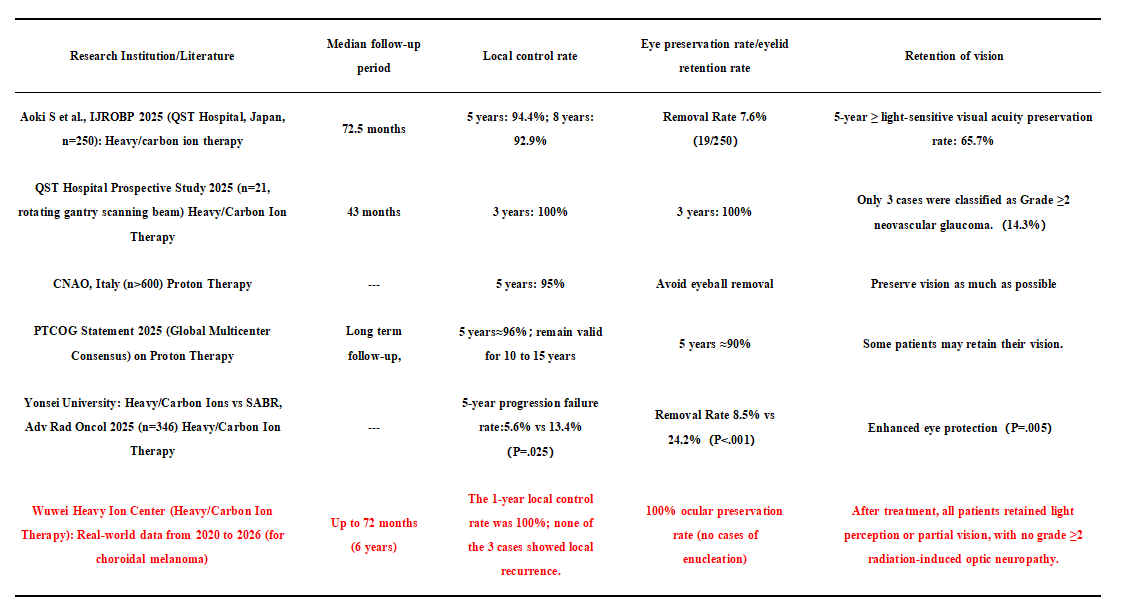
Data from the Wuwei Center: Among patients treated at our center for choroidal melanoma, the median age was 48 years, and stage T3 accounted for 66.7% of cases. With a maximum follow‑up of 6 years, patients maintained good tumor control, intact eyeballs, and stable visual status. In terms of local control, eye preservation, and low toxicity, our results have reached internationally advanced levels, particularly highlighting the unique value of heavy/carbon ions in large tumors (T3 stage) and in patients with double primary cancers.
Data interpretation: The long‑term control data for heavy/carbon ion therapy for uveal melanoma have been well validated. For example, in a large‑sample study of 250 patients treated with heavy/carbon ions at QST Hospital in Japan, stage T3 (larger tumors) accounted for 75.6% of cases, indicating that heavy/carbon ions are also effective in controlling larger uveal melanomas. More notably, a 2025 propensity‑matched comparative study of heavy/carbon ions versus photon stereotactic ablative radiotherapy (SABR) demonstrated that the heavy/carbon ion group was significantly superior to the SABR group in terms of 5‑year progression‑free survival (69.0% vs. 56.5%, P = .024), local failure rate (5.6% vs. 13.4%, P = .025), and enucleation rate (8.5% vs. 24.2%, P < .001), as well as offering better vision preservation (P = .005) – this is the highest‑level evidence to date comparing the efficacy of heavy/carbon ions and photons for uveal melanoma. The trends in the small‑sample data from the Wuwei Center are consistent with these findings, further validating the generalizability and accessibility of heavy/carbon ion therapy.
4.2 Clinical Data of Orbital Malignant Tumors at Wuwei Heavy Ion Center (Covering All Subtypes of Ocular Malignant Tumors)
As of May 2026, the Wuwei Heavy Ion Center has treated 10 patients with ocular malignancies (based on the center's follow‑up data). Patients came from various regions across China, with an age range of 24–69 years (median age 46.5 years), covering multiple pathological types including choroidal melanoma, adenoid cystic carcinoma, and metastatic carcinoma. The majority of patients had locally advanced or metastatic disease, making treatment challenging. A clinical study report from the Wuwei Center published in 2025 showed that after completing heavy ion therapy, the 10 patients with ocular malignancies had a median follow‑up of 20.5 months, with a 1‑year local control rate of 100%, a 1‑year overall survival rate of 100%, and no grade ≥2 adverse reactions. Only one case of grade 1 radiation conjunctival injury and one case of grade 1 radiation skin reaction occurred. The longest follow‑up time reached 6 years, and the patient is still alive as of March 2026. This patient maintains good tumor control, has no radiation‑related side effects, and has unchanged blurred vision, achieving the goal of preserving the eyeball and light perception vision.
Core conclusion: Heavy ion therapy offers comprehensive advantages in eye preservation rate, local control rate, progression‑free survival, and vision preservation.
V. Typical Cases:
Case 1: Patient Zhang JC, female, 41 years old.
Diagnosis: 1. Malignant melanoma of the right choroid; 2. Adenocarcinoma of the right lung.
Pre‑treatment presentation: The patient had double primary cancers. She experienced blurred vision in the right eye.
Treatment regimen: From July 27, 2020, to August 17, 2020, she received heavy/carbon ion therapy for both primary cancers. Dose for right choroidal malignant melanoma: 70 Gy(RBE) in 5 fractions; dose for right lung cancer: 72 Gy(RBE) in 18 fractions.
Treatment outcome: Three months after heavy/carbon ion therapy, orbital MRI showed complete disappearance of the tumor, and visual acuity in the right eye improved compared to before. Chest CT: The right lung tumor completely disappeared 7 months after heavy/carbon ion therapy.
One‑sentence comment: This case confirms the unique value of heavy ion therapy in the complex situation of double primary cancers (ocular malignant melanoma and lung cancer) – a single course of treatment can cover both tumors simultaneously, achieving complete eradication of both.
【Imaging Comparison Before and After Treatment】
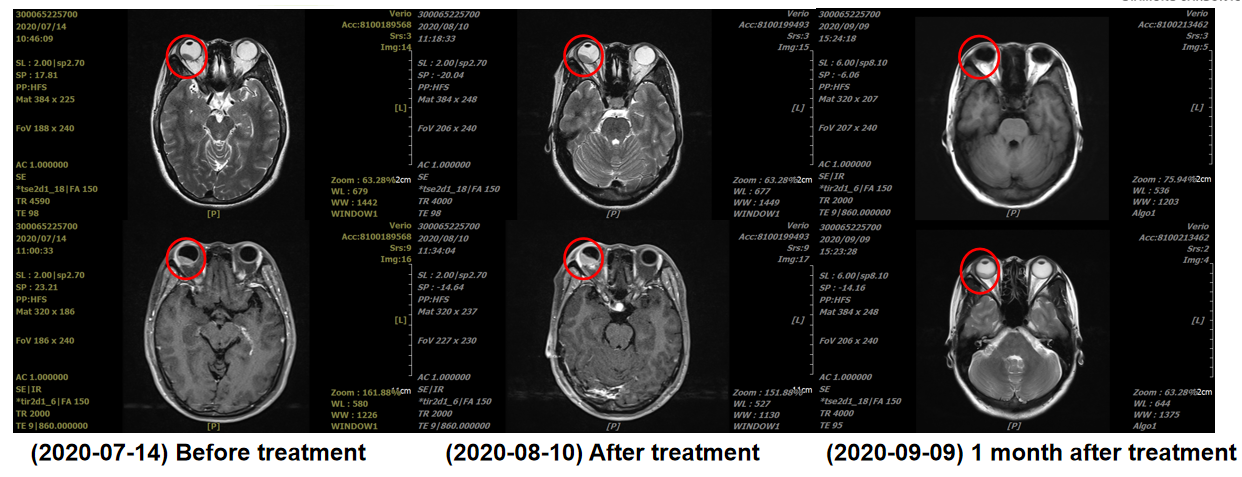
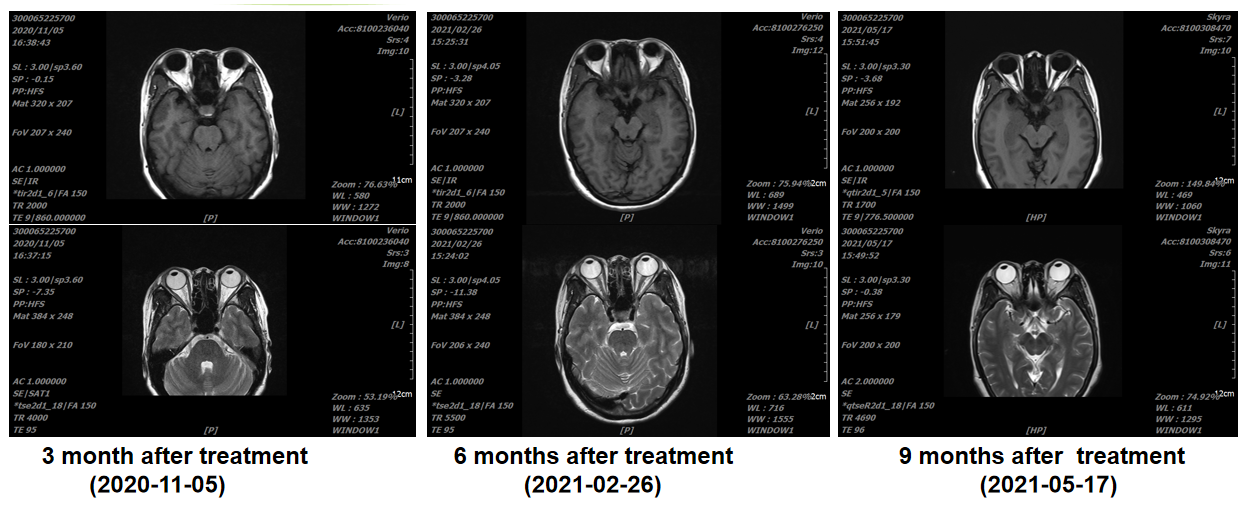
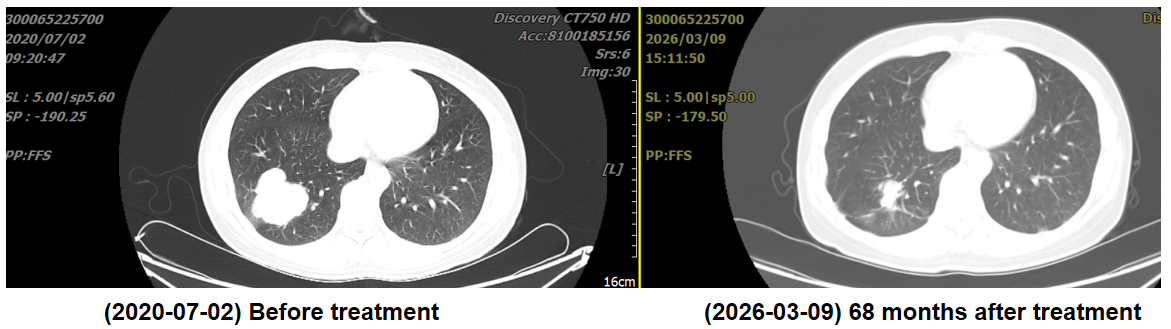
Case provided by: Dr. Yang Yuling
Department: Radiation Oncology Center Ⅰ(International Medical Department Ⅰ)
Case 2: Patient Chen J, male, 46 years old.
Diagnosis: 1. Malignant tumor of the left eye – poorly differentiated ductal carcinoma – postoperative recurrence.
Pre‑treatment presentation: The patient experienced pain and swelling in the left eye. Orbital MRI revealed a space‑occupying lesion in the left lacrimal fossa region. On August 30, 2023, he underwent resection of the left orbital mass under general anesthesia, followed by postoperative chemotherapy. Three months after surgery, the tumor recurred in the left orbit, and the patient underwent a second operation. Postoperative PET‑CT showed irregular soft tissue patches in the left orbit close to the superior and lateral walls, with unclear delineation of the left superior rectus and lateral rectus muscles and indistinct local boundaries, along with increased metabolism, highly suggestive of postoperative residual recurrence. After the second surgery, the patient lost vision and developed ptosis of the eyelid.
First heavy/carbon ion treatment regimen: From December 14, 2023, to January 2, 2024, the patient received heavy/carbon ion therapy for the orbital ductal adenocarcinoma. Dose: 60 Gy(RBE) in 14 fractions.
【Imaging Comparison Before and After Treatment】
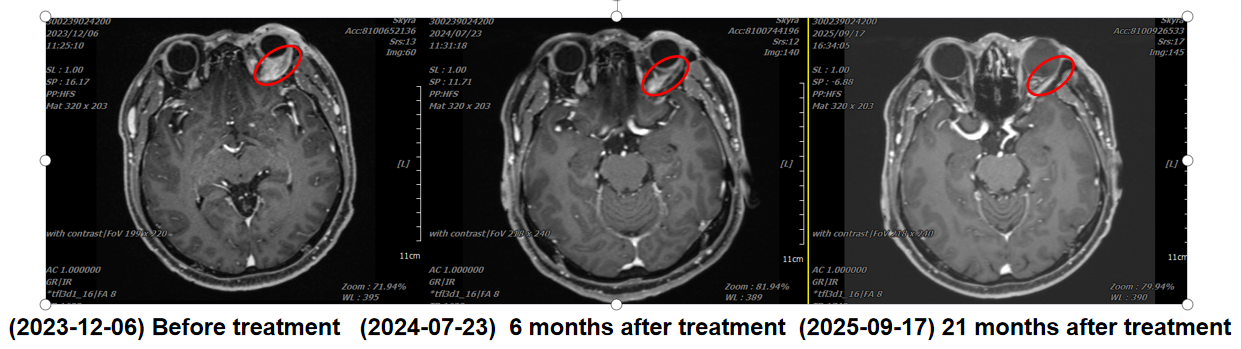

Treatment outcome: Six months after treatment, orbital MRI (plain and contrast‑enhanced) showed no obvious abnormal enhancement or space‑occupying lesion. At 21 months after treatment, the original treatment site showed complete disappearance of the tumor, but a newly enhancing space‑occupying lesion was detected in the medial aspect of the left orbit, suggestive of possible tumor metastasis.
Second heavy/carbon ion treatment regimen: From April 23, 2025, to May 14, 2025, the patient received heavy/carbon ion therapy for the medial orbital metastatic lesion from the orbital ductal adenocarcinoma. Dose: 60 Gy(RBE) in 15 fractions.
【Imaging Comparison Before and After Treatment】

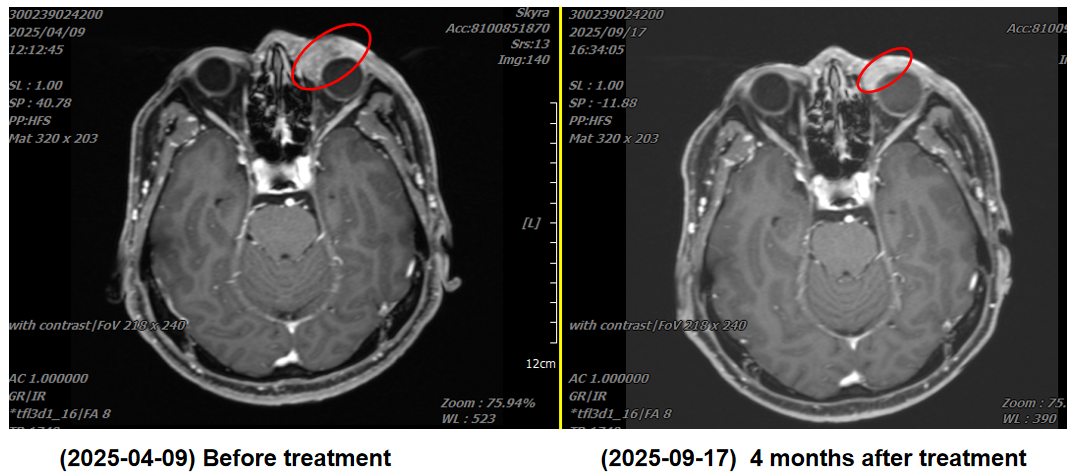
Treatment outcome: Four months after treatment, plain and contrast-enhanced orbital MRI showed that the medial orbital tumor in the patient's left eye had disappeared.
Case provided by: Dr. Yang Yuling
Department: Radiation Oncology Center Ⅰ(International Medical Department Ⅰ)
One‑sentence comment: This case confirms the unique value of heavy ions in the treatment of complex ocular malignancies – the ability to treat tumors at different sites within the eye on multiple occasions while still preserving the integrity of the organ.
Case 3: Patient Zhang Y, female, 44 years old.
Diagnosis: 1. Breast cancer, postoperative, with secondary malignant tumors in multiple sites including the left eye – stage IV.
Pre‑treatment presentation: The patient was initially diagnosed with breast cancer in September 2020, ER(+90%), PR(+90%), Her‑2 positive, Ki67(10%). She underwent neoadjuvant therapy, modified radical mastectomy, postoperative chemotherapy, and postoperative radiotherapy. This was followed by endocrine therapy combined with dual‑targeted therapy with trastuzumab and pertuzumab. During this period, endocrine therapy regimens were changed. On December 18, 2023, the patient underwent needle biopsy of a left lung nodule, and pathology showed metastatic breast cancer: ER(+10%), PR(–), Her‑2(3+), Ki‑67(+)5%. At this point, the patient's disease had progressed. She consulted many renowned physicians and underwent multiple drug treatments, including participation in clinical trials, restarting endocrine therapy, targeted therapy, and chemotherapy, all with poor results and disease progression. On October 21, 2024, she presented to our hospital and received heavy/carbon ion radiotherapy for metastatic lymph nodes in the mediastinum and pulmonary hilum, with a good response. In November 2024, the patient presented with complete loss of vision in the left eye, with no light perception. Further examination revealed a left orbital mass with uneven thickening of the ocular wall and retinal detachment. She subsequently underwent heavy/carbon ion therapy for the ocular metastasis.
Treatment regimen for left ocular metastasis: From December 5, 2024, to December 26, 2024, the patient completed heavy/carbon ion therapy for the left ocular metastatic lesion. Dose: 64 Gy(RBE) in 16 fractions.
【Imaging Comparison Before and After Treatment】
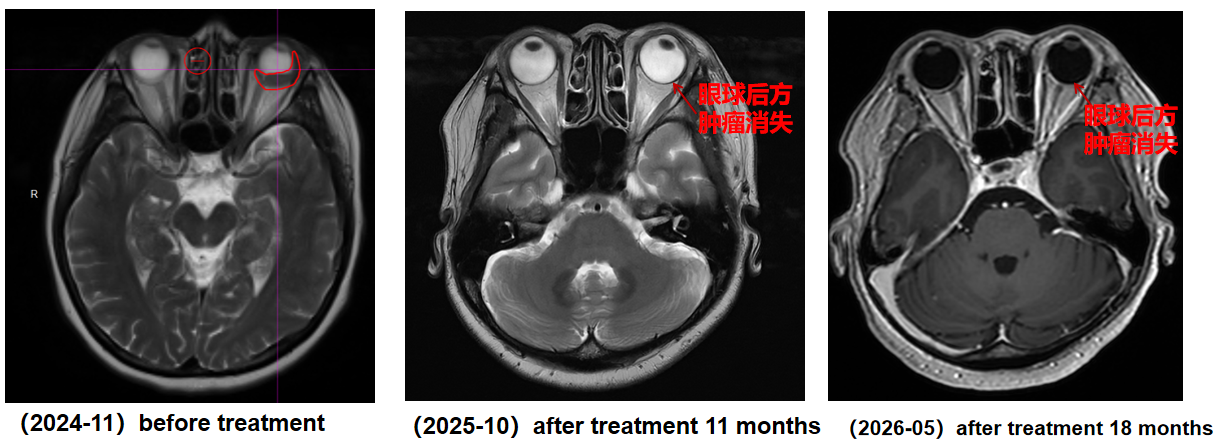

Treatment outcome: Eleven months after treatment, orbital MRI showed that the original tumor behind the left eyeball had completely disappeared, achieving a complete response (CR) in local efficacy. Now, nearly one and a half years after treatment, the patient continues to be in remission, with a completely normal appearance and no complications such as corneal ulceration. The patient had lost vision in the left eye before treatment. Now, nearly one and a half years after treatment, the patient remains in CR, and vision has recovered to the level of light perception.
Case provided by: Dr. Yang Yuling
Department: Radiation Oncology Center Ⅰ(International Medical Department Ⅰ)
One‑sentence comment: This case confirms the unique value of heavy/carbon ions in the treatment of complex ocular malignancies – achieving complete tumor eradication while preserving organ integrity and restoring partial function.
VI. Which patients are suitable?
Priority Recommendation:
- Uveal melanoma (choroidal, ciliary body, iris), especially for patients who wish to preserve the eyeball and vision
- Various ocular malignancies (adenoid cystic carcinoma, rhabdomyosarcoma, malignant melanoma, etc.), particularly those that are unresectable, residual after surgery, or recurrent
- Intraocular or orbital metastases (e.g., breast cancer, lung cancer metastatic to the eye)
- Choroidal melanoma – heavy/carbon ions have been proven to provide good local control even for large tumors (stage T3)
VII. Conclusion:
The eye is the window to the soul. When a malignant tumor tries to close this window, heavy/carbon ion therapy, with its unique advantages of precision, high efficacy, and low toxicity, powerfully pushes open a lifeline for eye preservation.
Eye preservation is no longer an unattainable hope; a cure can be achieved with a gentler approach.
If you or a family member are facing the challenge of an ocular tumor, please do not give up easily. Take the time to learn more about this "national heavy instrument." A scientifically sound decision today may preserve your sight and bring you a new life of high quality.
Introduction to Wuwei Heavy Ion Center
The Wuwei Heavy Ion Center is the clinical application base for China's first heavy/carbon ion treatment system with complete independent intellectual property rights. The system is technically supported by the Institute of Modern Physics, Chinese Academy of Sciences, and clinically operated by Gansu Wuwei Cancer Hospital. The center officially began treating tumors in November 2018. To date, it has treated over 2,800 patients, covering more than 100 tumor types, including lung cancer, pancreatic cancer, liver cancer, glioblastoma, nasopharyngeal carcinoma, rectal cancer, and various sarcomas. As the only medical institution in the world operating two heavy/carbon ion treatment systems simultaneously, the center has achieved nine "world‑first" technological innovations: pioneering precision radiotherapy under ventilator control; bladder cancer treatment with accurate bladder capacity management; single‑fraction radiotherapy using surgically implanted spacers between organs and tumors; developing the world's first 360° rotatable and liftable ion radiotherapy chair; performing the world's first heavy/carbon ion treatments for cardiac tumors; and pioneering dual‑Bragg‑peak lattice radiotherapy with heavy/carbon ions, among others. Leveraging 30 research platforms, including the CAS Key Laboratory of Heavy Ion Radiation Biology and Biomedicine and the Sydney University Biomedical Data Analysis and Visualization Laboratory, the center has conducted over 30 clinical studies on major tumor types. To date, the center has published nine monographs, including the Standard Operating Procedure for Heavy/Carbon Ion Radiotherapy, establishing a comprehensive knowledge system covering physical technology, clinical diagnosis and treatment, and health management.
Author: Ma Tong (Department I, Radiotherapy Center)
Data Support: Chen Xuelian, Li Pengqing (Cancer Registry and Follow-up Office)
Review: Zhang Yanshan (Deputy Director)
Date: May 12, 2026