Become a Lifesaver in Just 4 Minutes
Become a Lifesaver in Just 4 Minutes
In daily life, sudden cardiac arrest and other emergencies can occur at any moment.
Rapid and effective cardiopulmonary resuscitation (CPR) can save lives during these critical times.

"Doctor, help him, quickly!" In familiar places like shopping malls, parks, and gyms, such urgent cries for help can arise unexpectedly. Approximately 540,000 people experience cardiac arrest annually in China, with 80% of cases occurring outside hospitals. When heartbeat and breathing stop abruptly, life enters a countdown measured in minutes. The key to survival might not be the distant ambulance, but you, the person on the scene.
Rapid and effective CPR is the crucial tool in this race against time. Please save and share this highly practical first aid guide. Learning these skills could enable you to save a life at a critical moment.
Learning to Assess: Which Signals are Calls for Help?
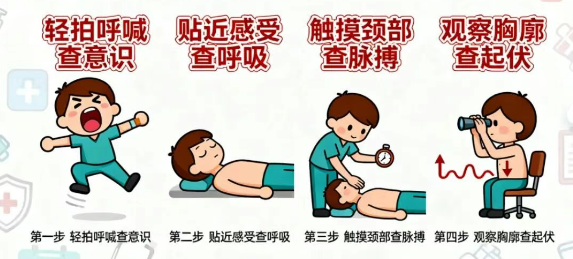
Facing a person who has collapsed suddenly,blind rescue not only ineffective but potentially harmful. The correct approach is to quickly assess for cardiac arrest using these four steps: Tap, Shout, Feel, Look.
1.Loss of Consciousness: Tap the person's shoulders firmly and shout loudly, "Are you okay?". If there is no response, it indicates unconsciousness – the most direct signal.
2.Abnormal Breathing: Place your cheek near the person's mouth and nose to feel for airflow while observing the chest for rise and fall. Absence of breathing or the presence of weak, infrequent gasps (agonal breathing) are danger signs, often occurring within 20-30 seconds after cardiac arrest.
3.Absent Pulse: Place your index and middle fingers on the person's neck beside the Adam's apple to feel the carotid artery. If no pulse is detected within 10 seconds, cardiac arrest is confirmed.
Why Immediate CPR is Essential: The Critical 4-Minute Window
Many hesitate, thinking, "I'm not a doctor, what if I do something wrong?" However, after cardiac arrest, the chance of survival decreases by about 10% with each passing minute. Medically, the crucial rescue time is termed the "Golden 4 Minutes." Beyond this window, brain cells begin to suffer irreversible damage; even if subsequent resuscitation is successful, severe neurological sequelae are likely.
In China, approximately 550,000 people die from cardiac arrest each year, averaging about 1,500 deaths daily. A significant 87% of these incidents happen outside hospitals. Ambulances often cannot arrive within 4 minutes. Therefore, CPR performed by a bystander is vital for sustaining the person's chance of survival. Data shows that CPR administered within 4 minutes can increase survival rates to 50%. In contrast, survival rates drop to below 1% if waiting solely for professional help.
A prime example is the incident during Euro 2021, when Danish footballer Christian Eriksen suffered a sudden cardiac arrest. His survival was directly attributed to his team's rapid initiation of CPR and defibrillation within the golden 4-minute window – a textbook example of effective emergency response.
Ultra-Detailed Operation Guide: Correct Steps for CPR, Easy to Grasp
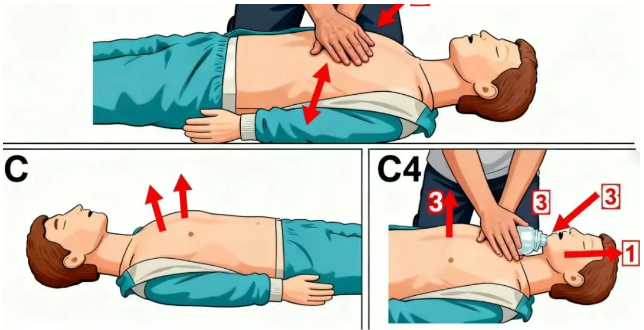
Once a patient is confirmed to be in cardiac arrest, immediately initiate the "First Aid Three-Step Method": Call for Help + CPR + AED (if available). The specific operations are as follows:
1. Emergency Call and Task Delegation
After assessing the patient's condition, immediately instruct people around you to divide tasks: one person should call the emergency number (e.g., 120 in some regions), clearly stating the location, the patient's gender, approximate age, and symptoms, and keep the phone line open. Another person should quickly locate the nearest Automated External Defibrillator (AED), which is now commonly available in public places like shopping malls, airports, and subway stations; its location can often be found via mobile maps. You yourself need to begin CPR immediately.
2. Chest Compressions: The "Artificial Heart" Sustaining Life
Chest compressions are the core of CPR, simulating the heart's pumping function by externally compressing the chest to supply blood to the brain and other vital organs. The operating steps must strictly follow standards:
• Positioning: Place the patient supine on a firm, flat surface (e.g., floor, backboard). Loosen tight clothing around the neck and waist. The rescuer kneels beside the patient's chest, keeping their upper body straight.
• Compression Point: Locate the center of the patient's chest at the nipple line (the intermammary line) or the lower half of the sternum. This is the key area for compressions.
• Hand Placement and Technique: Place the heel of one hand on the compression point, place the other hand on top, and interlock the fingers. Keep arms straight, and using the weight of your upper body, apply pressure vertically downwards. Avoid using only the strength of your arms.
• Compression Standards: The depth should be 5-6 cm for adults, at a rate of 100 to 120 compressions per minute. Allow the chest to recoil completely after each compression to ensure effectiveness.
3. Open the Airway and Provide Rescue Breaths: Supplying Oxygen for Life
After 30 chest compressions, provide 2 rescue breaths. This forms the standard compression-to-ventilation ratio of 30:2 for adult single-rescuer CPR.
• Open the Airway: Use the "head-tilt/chin-lift" maneuver: place one hand on the forehead and the fingers of the other under the bony part of the chin. Gently tilt the head backward and lift the chin to open the airway and prevent the tongue from obstructing it. If a cervical spine injury is suspected, use the "jaw-thrust" maneuver (lifting the jaw without tilting the head).
• Clear Obstructions: Quickly check the patient's mouth and nose. Remove visible foreign material or vomit using a finger (ideally wrapped with cloth) to keep the airway clear.
• Rescue Breaths: While keeping the airway open, pinch the patient's nostrils. Take a normal breath, seal your lips tightly around the patient's mouth, and give a steady breath over about 1 second, watching for the chest to rise. Give a second breath after the first. Each breath should last about 1 second, and the chest should visibly rise.
AED Deployment: Doubling the Chance of Successful Rescue
When an AED arrives, pause CPR immediately and follow the voice prompts:
• Turn on the AED and attach the electrode pads to the patient's bare, dry chest as shown in the diagrams (typically one pad below the right collarbone and the other on the left side of the chest).
• The AED will analyze the heart rhythm. Ensure no one is touching the patient during analysis.
• If a shock is advised, ensure everyone stands clear before pressing the shock button.
• After shock delivery (or if no shock is advised), immediately resume chest compressions. The AED will typically re-analyze the rhythm every 2 minutes.
Mastering CPR isn't about becoming a "first aid expert," but about being prepared to act effectively instead of panicking in an emergency. We cannot predict when danger will strike, but we can prepare in advance. Your effort to learn and willingness to share this knowledge could equip more people with these life-saving skills.
Remember, in a critical moment, every compression and every breath you provide can bring hope to a life.
From today, become a "Guardian of Life" for yourself and others. Believe that you too can be a hero who saves a life.