Conquering the Challenge of Advanced Cancer Pain ——Our Hospital Successfully Performs CT-Guided Gang
Conquering the Challenge of Advanced Cancer Pain
——Our Hospital Successfully Performs CT-Guided Ganglion Impar Neurolysis
Recently, through close collaboration between the Department of Radiotherapy VI and the Pain Department of our hospital, CT-guided ganglion impar neurolysis was successfully performed on a patient suffering from intractable pain caused by advanced rectal cancer. The successful implementation of this technology marks another breakthrough for our hospital in the field of managing and treating cancer pain patients, providing a new solution for numerous patients long plagued by chronic pain.
The patient, Grandpa Ma, 72 years old, was unfortunately diagnosed with rectal cancer six years ago and actively underwent radical surgery and postoperative chemotherapy. Recently, Grandpa Ma was admitted to the Department of Radiotherapy VI of our hospital due to long-term perineal pain and numbness, which led to difficulties with urination and defecation. The severe pain (NRS score 8) accompanied by serious urinary and fecal dysfunction not only hindered the subsequent anti-tumor therapy but also drastically reduced his quality of life. In such a condition, conventional oral painkillers were no longer effective.
Faced with this challenging problem, the Department of Radiotherapy VI invited medical staff from the Pain Department of our hospital for a joint discussion. After detailed examination and evaluation, combined with the patient's past medical history and imaging data, it was considered related to tumor invasion of the surrounding nerves. After comprehensive consideration, the pain management team decided to perform a minimally invasive procedure—CT-guided ganglion impar neurolysis—for Grandpa Ma.
On August 29, Director Zhang Depeng of the Pain Department, along with doctors from the department, completed the ganglion impar neurolysis for this patient under CT guidance. During the procedure, the patient was asked about his feeling upon injection and reported that the perineal pain had somewhat alleviated. After the procedure, the patient's perineal pain was significantly reduced, with an NRS score of 3. Urination and defecation returned to normal, and the patient felt well.
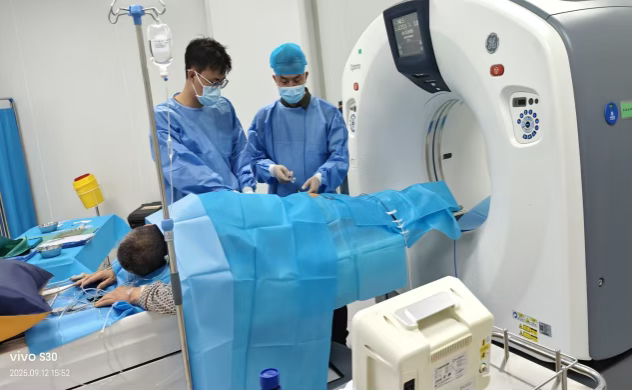
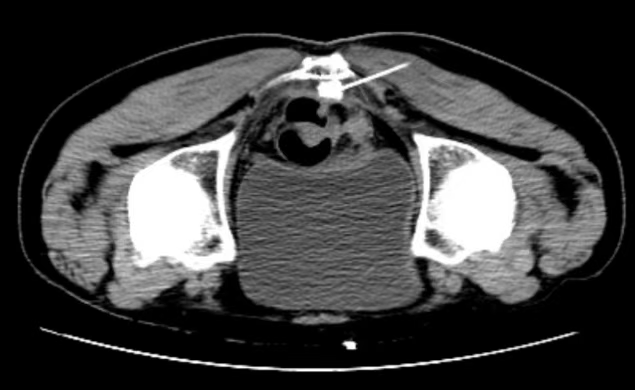
Left image: Zhang Depeng's team performing ganglion impar neurolysis on the patient; Right image: post-treatment scan
In the future, our hospital will continue to deepen the multidisciplinary collaboration model, constantly explore and introduce cutting-edge medical technologies, and, with more refined medical skills and more humane care, help more patients break free from pain and regain their dignity and quality of life.
Knowledge Link
CT-guided neurolytic block is a minimally invasive, precise, and efficient interventional pain management technique. Under real-time, precise guidance of computed tomography (CT), a special thin needle is punctured near the ganglion (or nerve plexus) responsible for transmitting pain signals. By injecting chemical agents (such as absolute ethanol) or applying physical methods (such as radiofrequency thermocoagulation), a selective and controllable lesion is created on the affected nerve, thereby blocking the transmission of pain signals to the brain long-term or even permanently, achieving radical analgesic effects.
Indications for CT-guided neurolytic block:
- Intractable cancer pain: Especially suitable for severe perineal and visceral pain caused by abdominal and pelvic tumors (e.g., rectal cancer, cervical cancer) invading nerves.
- Chronic neuropathic pain: Such as postherpetic neuralgia, complex regional pain syndrome (CRPS), and lumbar disc herniation, which are non-cancerous but intractable and poorly controlled by medication.
Advantages of CT-guided neurolytic block:
- Precision: Real-time CT guidance ensures high puncture accuracy, effectively avoiding blood vessels and organs, with a clear target.
- Minimally invasive and efficient: Only requires a single puncture needle, causes minimal trauma, allows quick recovery, and shows effects during or immediately after the procedure.
- Safe with few side effects: Can be performed under local anesthesia, especially suitable for frail patients; medication acts directly on the lesion, with few systemic side effects.
- Improves quality of life: Provides an effective pain management solution especially for patients with advanced cancer pain, facilitating subsequent treatment.

Our hospital's Pain Department currently has pain outpatient consultation rooms, a cancer pain MDT consultation room, pain outpatient treatment rooms, and pain inpatient wards, dedicated to treating various acute and chronic pains, cancer pain, and intractable pain. The department currently performs interventional treatments for cancer pain, such as intrathecal pain pump implantation, nerve electrical stimulation implantation, celiac plexus neurolysis, nerve radiofrequency modulation, and vertebroplasty for metastatic vertebral lesions. Upholding the hospital's long-standing tradition of "patient-centered" philosophy and rich experience in multidisciplinary diagnosis and treatment, our department is committed to relieving your pain and offering our sincere promise for your pain-free life.