Clinical Practice of Carbon Ion Therapy for Breast Cancer
Clinical Practice of Carbon Ion Therapy for Breast Cancer
Breast cancer is the most common malignant tumor that seriously threatens women's health worldwide and has become the most prevalent cancer globally in 2020. In China, with changes in lifestyle, the incidence of breast cancer has been increasing year by year. In 2020, the number of new cases reached as high as 416,000, accounting for 9.1% of all newly diagnosed cancer patients and 19.9% of newly diagnosed cancers in women, making it the most prevalent cancer among Chinese women. Along with the rising incidence, the mortality rate of breast cancer in China has also been increasing annually—from 4.87 per 100,000 in 2003 to 6.67 per 100,000 in 2015, and further up to 9.50 per 100,000 by 2020.
Patients with breast cancer generally achieve good clinical outcomes with current standard treatment regimens. Much of the current clinical effort is focused on reducing both acute and late toxicities. Carbon (heavy) ion radiotherapy is an emerging technology that can ensure adequate target dose delivery while reducing the dose to organs at risk (OARs).
Compared to conventional photon irradiation, heavy ion (especially carbon ion) therapy utilizes unique physical and radiobiological principles to help improve the therapeutic ratio. Charged particles, including protons and carbon/heavy ions, exhibit a "Bragg peak"—a characteristic energy deposition curve where most of the energy is released at a specific depth, with minimal energy deposition in the proximal or distal regions of the target tumor. Additionally, a potential advantage of carbon (heavy) ions over proton and photon therapy is the steeper lateral dose falloff of carbon (heavy) ions. This steep "penumbra" may further enhance the precision of carbon/heavy ion radiation. These physical properties theoretically ensure adequate target dose while minimizing the dose to OARs.
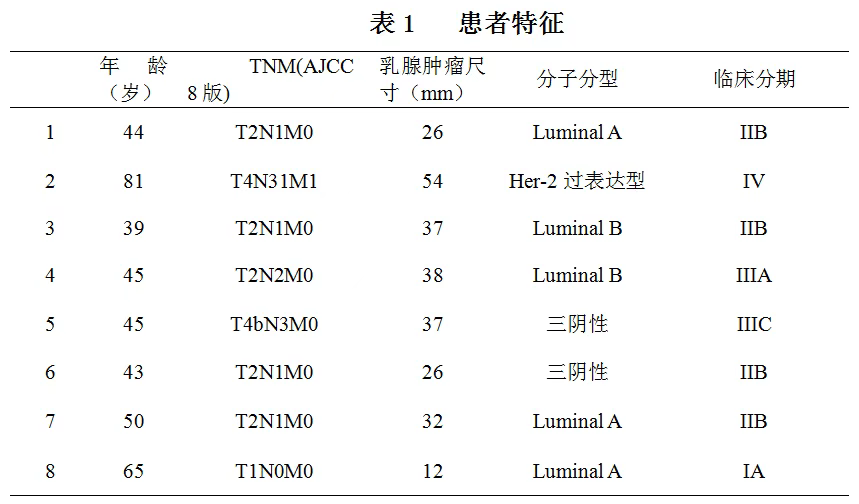
We summarized the clinical data of eight breast cancer patients treated with carbon (heavy) ion therapy at our center between May 2020 and December 2022. The patients' ages ranged from 44 to 81 years. Their tumor stages were as follows: one case in stage I, four in stage II, two in stage III, and one in stage IV (with mediastinal lymph node metastasis). The molecular subtypes included three cases of Luminal A, two of Luminal B, one of HER2-overexpressing, and two of triple-negative (see Table 1).
Case sharing
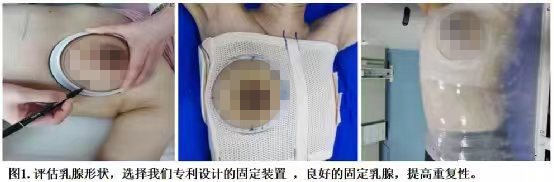
The breast immobilization device developed by our center is characterized by high elasticity, moldability, easy accessibility, and user-friendly operation. It securely integrates the breast immobilization ring with a highly elastic band to shape the patient's thoracic contour and elevate the breasts, ensuring the breasts remain upright even in the supine position. By accommodating individual variations in breast shape and size, this device is effectively applied during the positioning and treatment procedures of carbon (heavy) ion therapy for breast cancer. It significantly improves positioning accuracy, minimizes adverse reactions, enhances patient comfort, and ultimately contributes to better therapeutic outcomes (Figure 1).
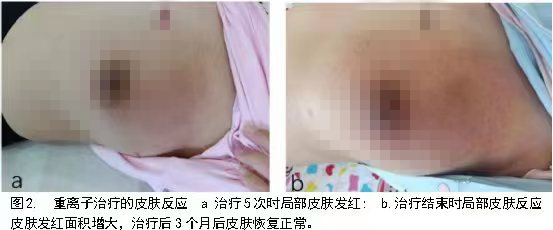
All breast cancer patients treated with carbon (heavy) ion therapy at our center exhibited only Grade I-II radiation dermatitis. Among the four patients with T1-2 stage tumors, manifestations were limited to localized skin erythema accompanied by hyperpigmentation. One elderly patient with T4-stage breast cancer, whose tumor had invaded the skin forming a crater-like ulcer with purulent hemorrhagic surface, showed complete tumor regression and ulcer healing one month post-treatment, with only residual localized skin hyperpigmentation remaining (Figures 2-3).

Eight patients underwent definitive carbon (heavy) ion radiotherapy, with all tumors completely disappearing within 3-12 months. Currently, all patients remain alive with excellent local tumor control. Among them, three breast cancer patients achieved complete tumor disappearance (CR), including two cases of triple-negative breast cancer (Figures 4-5).

Figure 4: 43-year-old female with left breast malignancy (T2N1M0, stage IIb). a) Before carbon ion therapy; b) After carbon ion therapy; c) 3 months after carbon ion therapy; d) 6 months after carbon ion therapy.
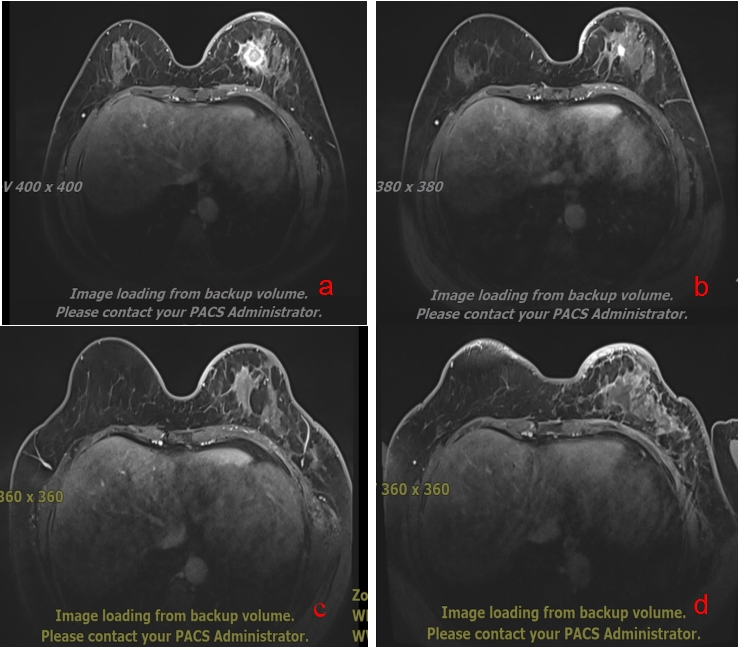
Figure 5: 45-year-old female with left breast malignancy (T4bN3M0, stage IIIC). a) Before carbon ion therapy; b) After carbon ion therapy; c) 3 months after carbon ion therapy; d) 6 months after carbon ion therapy.
Carbon (heavy) ion radiotherapy for breast tumors exhibits mild toxicity, excellent tolerability, remarkable efficacy, non-invasiveness, and breast-conserving advantages. When carbon (heavy) ion beams enter the human body, substantial energy deposition forms a Bragg peak, enabling precise alignment of the high-dose region with the tumor target. Compared to conventional photon radiotherapy, these unique physical properties not only provide superior dose distribution accuracy but also offer significantly better protection for normal tissues. Carbon (heavy) ions possess the characteristic of high linear energy transfer (LET), demonstrating greater relative biological effectiveness, lower oxygen enhancement ratio, and the ability to induce DNA double-strand breaks in tumor cells, achieving complete eradication of cancer cells. These advantages further enhance both the tumoricidal effect and treatment safety.
We will conduct further clinical research on carbon (heavy) ion therapy for breast cancer, enrolling more cases to enable more women to benefit from this non-invasive, breast-conserving, highly effective, and ideal heavy ion treatment modality.
Introduction to Wuwei Heavy Ion Center
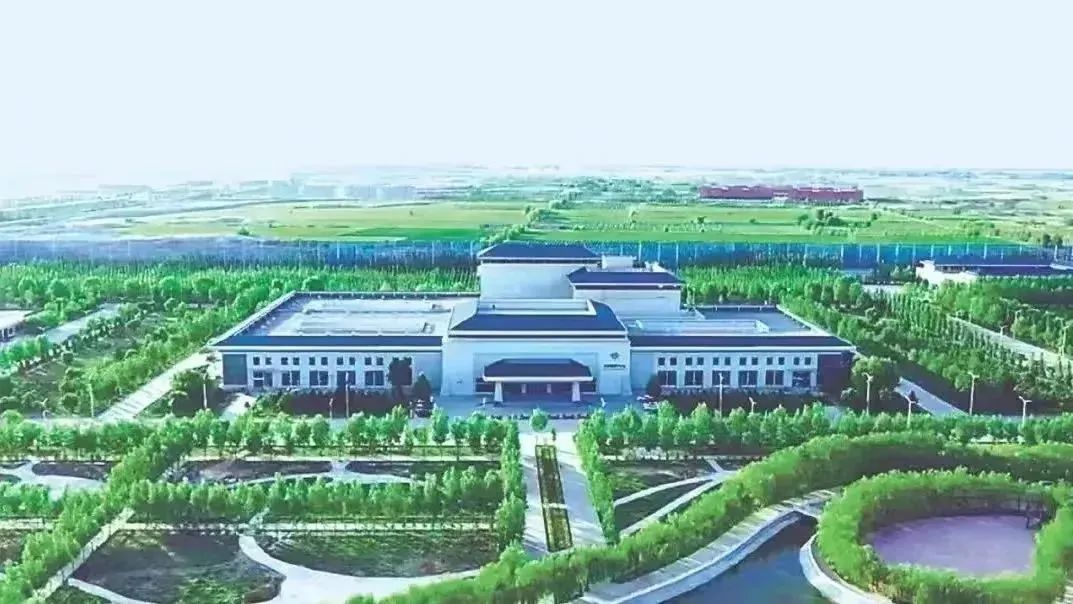
The Heavy Ion Center of Wuwei Academy of Medical Sciences Cancer Hospital is China's first clinical application center for heavy ion therapy systems. Since its official clinical operation in March 2020, it has been successfully running for three years. To date, our center has treated over 700 patients, achieving excellent therapeutic outcomes for challenging lesions in the skull, pancreas, lungs, and other body parts, with patients coming from all over the country. On the third anniversary of its successful operation, the center has established China's first tumor rehabilitation town, creating a comprehensive, full-life-cycle health management system characterized by integrated tumor treatment, dietary management therapy, psychosomatic health management, traditional Chinese medicine syndrome differentiation therapy, rehabilitation physiotherapy, biological immunocellular therapy, agritherapy, and cultural therapy.

Introduction to Department of Radiotherapy IV
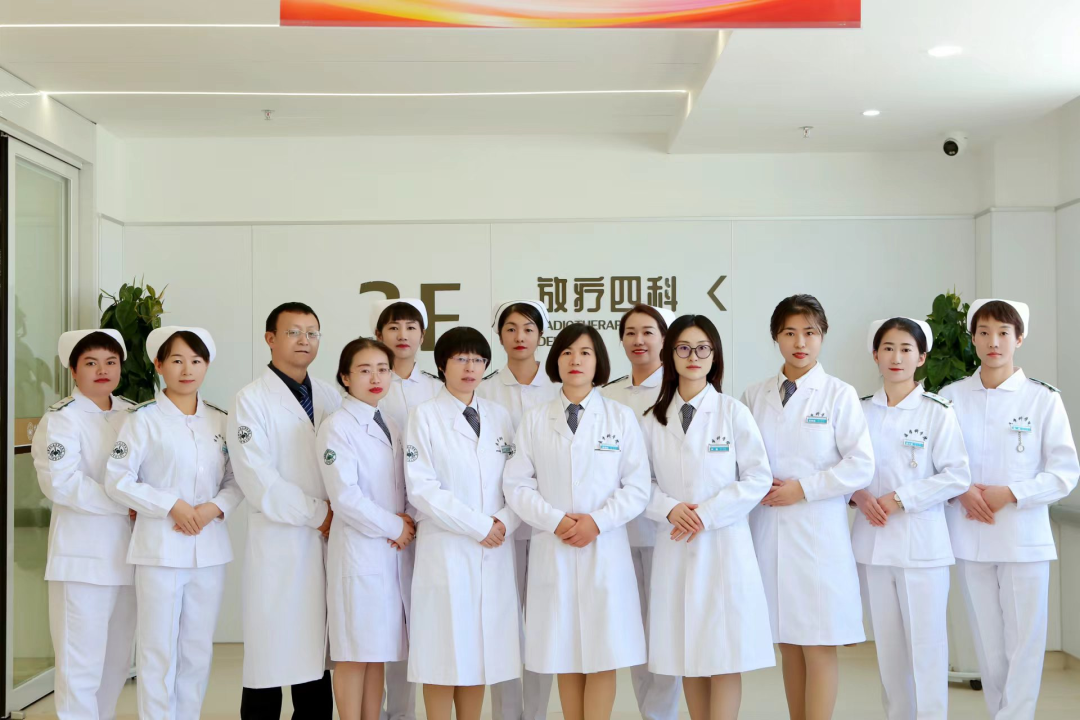
Department of Radiotherapy IV is a specialized unit dedicated to heavy ion and photon therapy for breast and gynecological tumors. The department comprises 2 senior physicians, 1 attending physician, and 3 resident physicians, including 1 talent introduced to Wuwei City. The nursing team consists of 7 members, with 2 chief nurses and 5 registered nurses. The department has engaged Professor Li Sha, a radiotherapy expert from the 940th Hospital of the Joint Logistics Support Force of the PLA, and Professor Liu Zi from the Department of Radiotherapy at the Affiliated Hospital of Xi'an Jiaotong University as guiding experts. Under the long-term guidance of Professor Yee-Min Jen and Professor Jia-Ming Wu from Taiwan, the department conducts daily clinical work, research, and teaching. Staff members have received advanced training at renowned domestic hospitals, including Beijing 301 Hospital, Peking University Third Hospital, Sichuan Cancer Hospital, and Sun Yat-sen University Cancer Center in Guangzhou. The department currently offers advanced radiotherapy techniques such as heavy ion therapy, image-guided intensity-modulated radiotherapy (IGRT), volumetric modulated arc therapy (VMAT/RapidArc), four-dimensional dynamic radiotherapy, stereotactic radiotherapy (SRS/SBRT), and total body irradiation. Specialized services also include image-guided three-dimensional brachytherapy, CT-guided interstitial implantation therapy, and combined internal-external radiation techniques. The department has conducted long-term follow-ups and analyses for patients undergoing definitive radiotherapy for cervical cancer. Additionally, it continuously enhances individualized treatment approaches, incorporating concurrent chemoradiotherapy, targeted therapy, and immunotherapy as part of comprehensive systemic treatment to further improve therapeutic outcomes.
The entire team is committed to patient satisfaction, guided by cutting-edge academic research, and employs precise radiotherapy techniques to ensure patients receive optimal treatment, dedicated to providing the highest standard of care.