Case Sharing: Heavy (Carbon) Ion Therapy for Tongue Cancer with Aplastic Anemia
Case Sharing: Heavy (Carbon) Ion Therapy for Tongue Cancer with Aplastic Anemia
I. Case Summary
Patient: Mr. Guo, 56 years old
Diagnosis: Malignancy of the tongue base, cT3N2M0 stage IVA (locally advanced), KPS 80
Comorbidities: Type 2 diabetes, chronic aplastic anemia (with white blood cell count as low as 2.6×10⁹/L and platelet count 48×10⁹/L at nadir), and eczema.
Because the patient could not tolerate surgery, chemotherapy, or immunotherapy, he sought heavy (carbon) ion therapy and came to the Wuwei Heavy Ion Center. Imaging showed a mass of approximately 3.1×3.2 cm at the tongue base, with multiple metastatic lymph nodes in the left neck. After a multidisciplinary team (MDT) consultation, a heavy ion radiotherapy plan was developed.
After concurrent low‑dose cisplatin chemotherapy was initiated early in treatment, the patient developed grade IV myelosuppression, with platelets dropping to as low as 22×10⁹/L. Following careful evaluation by the medical team, the treatment plan was promptly adjusted, and a decision was made to use heavy (carbon) ion therapy alone.
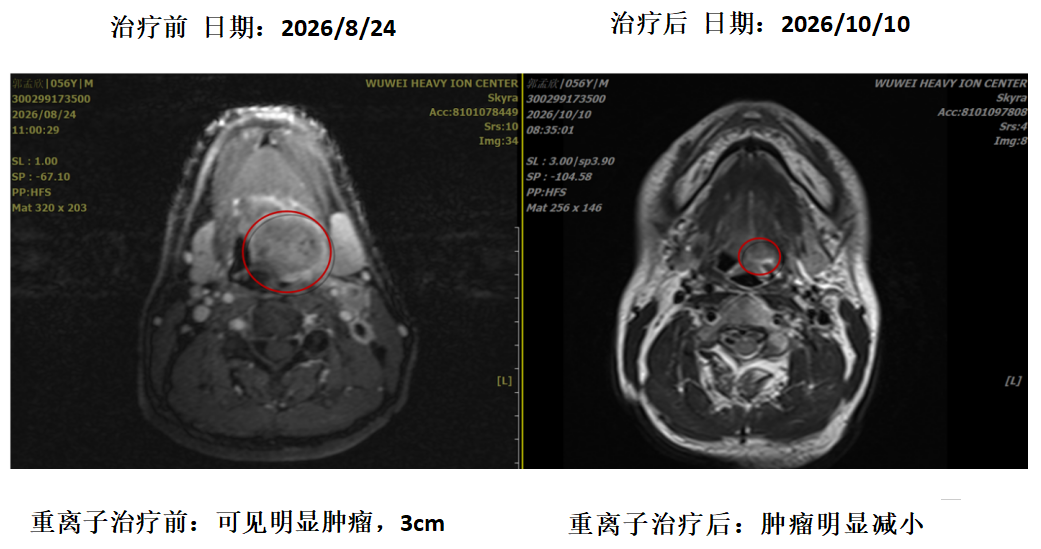
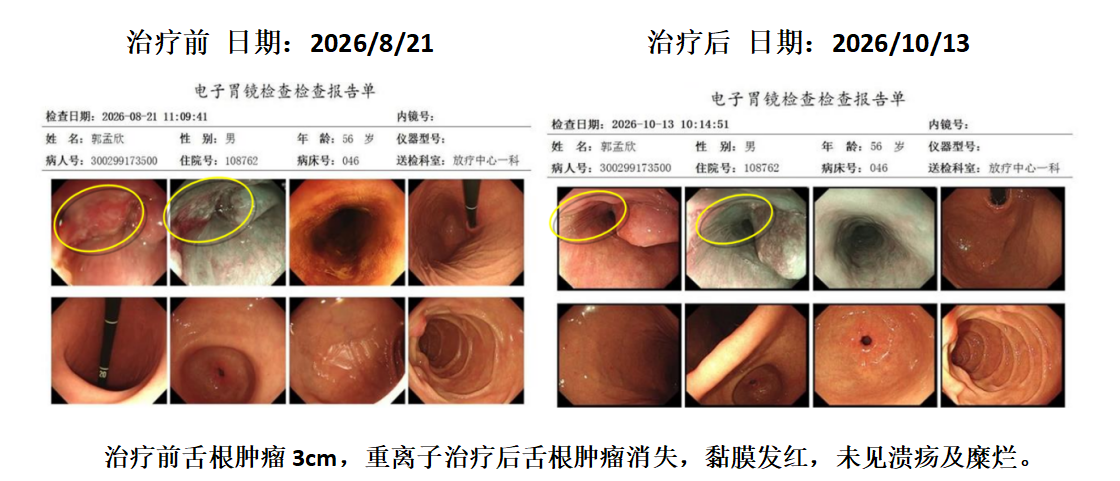
After a period of heavy (carbon) ion therapy, the patient's neck mass shrank markedly, neck pain was reduced, the foreign‑body sensation in the pharynx disappeared, and symptoms such as swallowing pain and tongue pain did not occur. Follow‑up MRI and endoscopy showed marked reduction of the tongue base tumor and metastatic lymph nodes (efficacy evaluation: PR), with no oral mucositis or ulceration. Tongue mobility was good. The follow‑up results were encouraging, and the patient was discharged smoothly.
MRI comparison before and after treatment:
Endoscopic comparison before and after treatment:
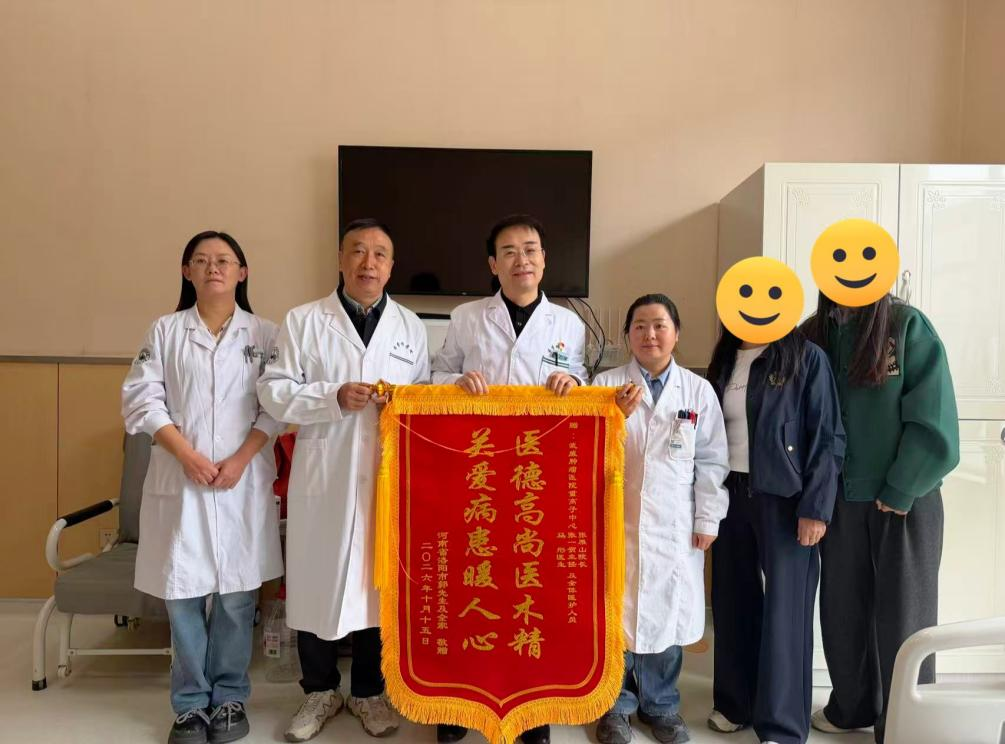
A banner of gratitude — appreciation from a thousand miles away:
Before discharge, Mr. Guo and his family specially commissioned a banner and presented it to the medical and nursing staff of the First Department of the Radiotherapy Center. This was not only a token of gratitude for the meticulous care provided by the medical staff but also a testament to the doctor‑patient trust that spanned a thousand miles.
II. Why Is Tongue Base Cancer Difficult to Treat?
Tongue base cancer is difficult to manage primarily due to three major challenges:
- Complex anatomy: The tongue base is deep within the oral cavity, surrounded by dense blood vessels and nerves, making surgery difficult and highly invasive.
- Significant functional impact: The tongue is the core organ for speech, swallowing, and chewing; even a slight misstep during treatment can severely affect quality of life.
- High metastatic potential: The tongue has abundant lymphatic vessels, and tumors readily metastasize to cervical lymph nodes.
- This patient also had aplastic anemia and eczema (an autoimmune disease), making conventional chemotherapy and immunotherapy unfeasible. Surgical treatment of tongue base cancer also requires postoperative chemoradiotherapy and immunotherapy as part of comprehensive treatment. This patient could not tolerate surgery or pharmacotherapy; only heavy (carbon) ion therapy could achieve a relatively good outcome while preserving the tongue and maximizing quality of life.
III. Advantages of Heavy (Carbon) Ions: Why Can Heavy (Carbon) Ion Therapy Alone Achieve Good Results?
When chemotherapy and immunotherapy cannot be tolerated, heavy (carbon) ions still demonstrate unique therapeutic potential:
- Higher relative biological effectiveness (RBE): The efficacy of heavy ions is 3 to 5 times that of conventional photons and protons [1][2]. Toxic side effects are much milder than those of photons and protons. Heavy ions can cause DNA double‑strand breaks in tumor cells, exerting a strong killing effect on tumor cells [1].
- Precise dose distribution, protecting normal tissues: Heavy ions possess the unique physical property of the "Bragg peak," with energy primarily concentrated and released within the tumor target volume, causing little damage to normal tissues along the beam path. This allowed Mr. Guo's normal tongue and oral mucosa to be well protected during treatment, effectively reducing the risk of severe oral ulceration [3].
- Good tolerability and safety: For patients like Mr. Guo with comorbid anemia, diabetes, and other underlying conditions, heavy ion therapy is non‑invasive and painless during treatment — a local treatment modality with high safety and good tolerability.
[1] Abousaida B, Seneviratne D, HoppeS, K Bo SJ, Asaithamby A, Cucinotta FA, et al. Carbon ion radiotherapy in the management of hepatocellular carcinoma. J Hepatocell Carcinoma. 2021;8:1169-1182. (Table 1, reproduced with permission from Kavanagh BD. Introduction to clinical radiation oncology. Radiology. 1998;209(1):168.)
[2] Apisarnthanarax S, Bowen SR, Combs SE. Proton beam therapy and carbon ion radiotherapy for hepatocellular carcinoma. Semin Radiat Oncol. 2018;28(4):309-320.
[3] Lerch S, Berthold S, Ziemann F, et al. HPV-positive HNSCC cell lines show strongly enhanced radiosensitivity after photon but not after carbon ion irradiation.RadiotherOncol.2020;151:134-140.
Introduction to the Wuwei Heavy Ion Center
The Wuwei Heavy Ion Center is the clinical application base for China's first heavy (carbon) ion therapy system with complete independent intellectual property rights. It is technically supported by the Institute of Modern Physics, Chinese Academy of Sciences, and clinically operated by Gansu Wuwei Cancer Hospital. The center officially began treating tumors in November 2018. As of October 2026, it has treated more than 3,200 patients, covering more than 100 tumor types, including lung cancer, pancreatic cancer, liver cancer, glioblastoma, nasopharyngeal carcinoma, rectal cancer, and various sarcomas. As the only medical institution in the world operating two heavy (carbon) ion therapy systems simultaneously, Wuwei Cancer Hospital has achieved nine "world‑first" technological innovations at the center, including precision treatment under ventilator control, bladder cancer treatment under precise bladder capacity control, single‑session treatment with surgical implantation of spacers between organs and tumors, development of China's first 360° rotatable and height‑adjustable ion radiotherapy chair, completion of the world's first multiple cases of cardiac tumor heavy (carbon) ion treatment, and pioneering dual Bragg peak heavy (carbon) ion lattice radiotherapy. Leveraging 30 research platforms including the CAS Key Laboratory of Heavy (Carbon) Ion Beam Radiation Biology and the Sydney University Biomedical Data Analysis and Visualization Laboratory, the center has conducted more than 30 clinical studies on key tumor types. To date, the center has published nine monographs including the Standard Operating Procedure for Carbon Ion Radiotherapy, building a comprehensive knowledge system covering physical technology, clinical diagnosis and treatment, and health management.
Writer: Zhang Yulin (Master's degree candidate)
Supervising Physician: Ma Tong (Attending Physician)
Data support: Tumor Registry and Follow‑up Office (Chen Xuelian, Li Pengqing)
Reviewed by: Zhang Yanshan (Chief Physician)
Date: October 20, 2026