Why Your Radiation Team Keeps Asking You to "Hold It"
Why Your Radiation Team Keeps Asking You to "Hold It"
A Bladder-Filling Guide That Protects Both Your Bladder and Your Bowel
"Why do I have to drink water before every single treatment and wait until I'm about to burst before I can get on the table?"
"Can I get away with a little less? This is genuinely uncomfortable…"
These are the two questions we hear most often in the pelvic radiotherapy suite.
Our department works with both photon and heavy-ion (carbon-ion) systems, and we want to be clear about one thing: filling your bladder isn't a form of torture we invented. It is the single most important — and the most economical — form of physical shielding available in pelvic cancer radiotherapy.
So let's explain, from a technical standpoint, how "just the right amount of urine" protects your bladder and its neighbour, the bowel, from radiation they don't need to receive.

1. Without a Full Bladder, the Tumour, Bowel and Bladder Can End Up Crowded Together
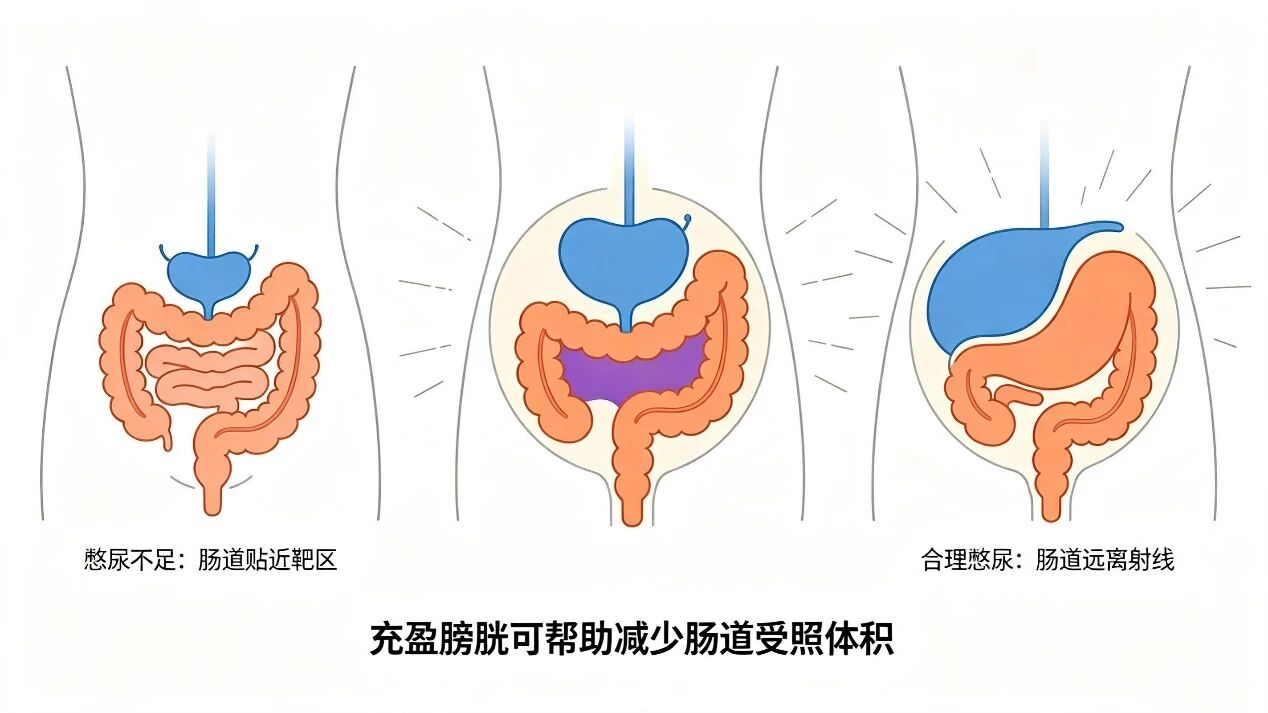
The pelvis is a tight space, packed with the rectum, the bladder, and the prostate or uterus. When your bladder is empty, it collapses like a deflated balloon and presses right up against the front of the tumour — whether that's prostate, cervical or rectal cancer.
To destroy the tumour in that situation, the photon or heavy-ion beam has to pass through a meaningful volume of bladder or bowel first. Worse still, an empty bladder changes shape dramatically from day to day. The gap between the tumour and the bowel might be 5 mm today and only 2 mm tomorrow.
2. How One Full Bladder Does Two Jobs at Once
① It pushes the small bowel out of the way, creating a "water buffer"
As the bladder fills and expands, it pushes upward on the small intestine and lifts most of it clear of the high-dose zone. Studies show that a comfortably full bladder can cut the volume of small bowel receiving radiation by 40–60%, substantially lowering the risk of radiation-induced bowel injury.
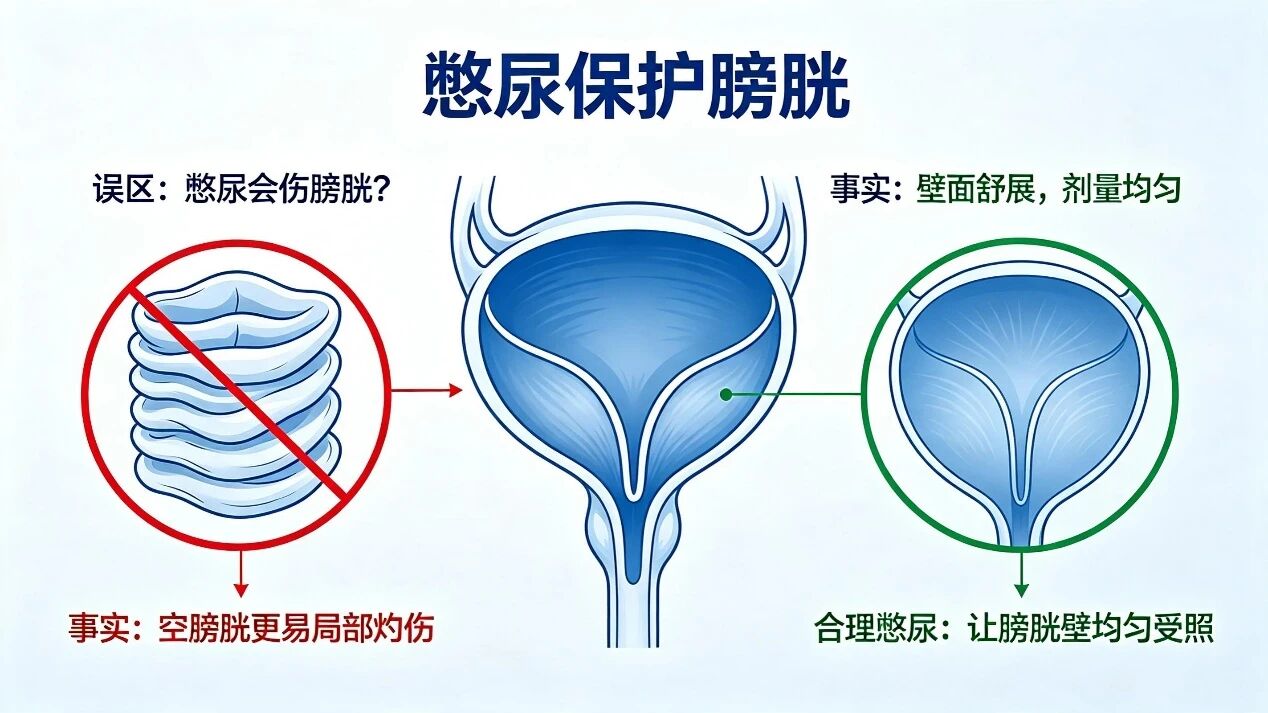
② It stabilises the bladder itself, reducing the dose it receives
When the bladder is full, its wall thins out and its shape becomes predictable. That allows the treatment plan to spare the back wall and concentrate the high-dose region on the tumour, while non-target areas such as the front wall receive very little. You treat the tumour and protect the bladder.
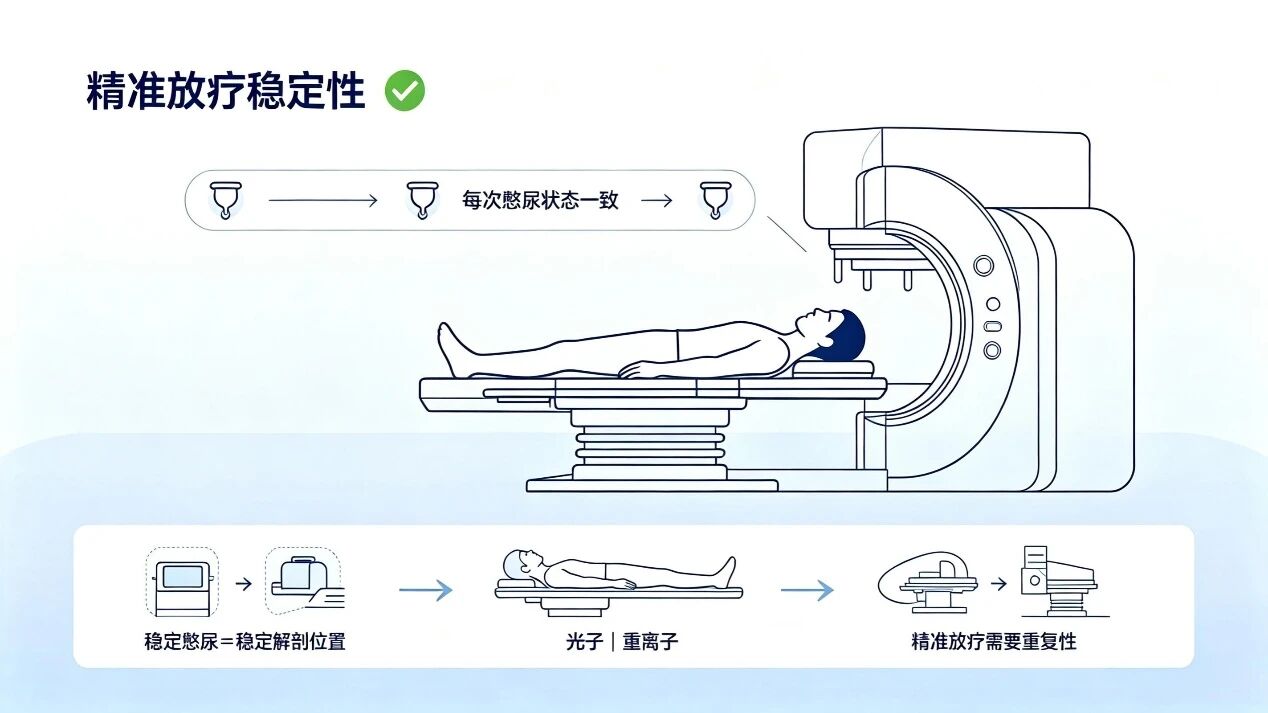
③ It creates a stable coordinate system for a precise hit
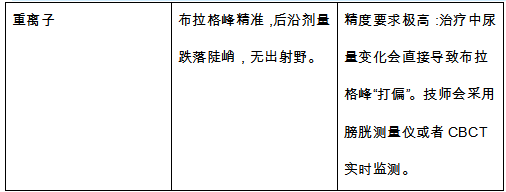
This matters most in heavy-ion therapy, where the Bragg peak must land with millimetre accuracy. Only if your bladder is filled to the same degree every day will the tumour sit in the same place. Otherwise, the peak that was meant for the tumour can land in the bowel — with potentially serious consequences.
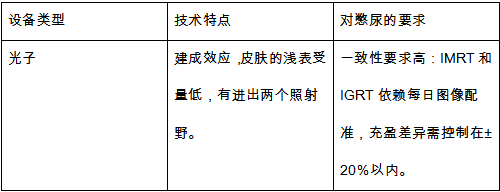
3. Photon vs. Heavy Ion: How Do the Requirements Differ?
4. What Counts as "Just Right"?
The word just right is the whole point: too little urine does nothing, and too much can actually interfere with positioning.
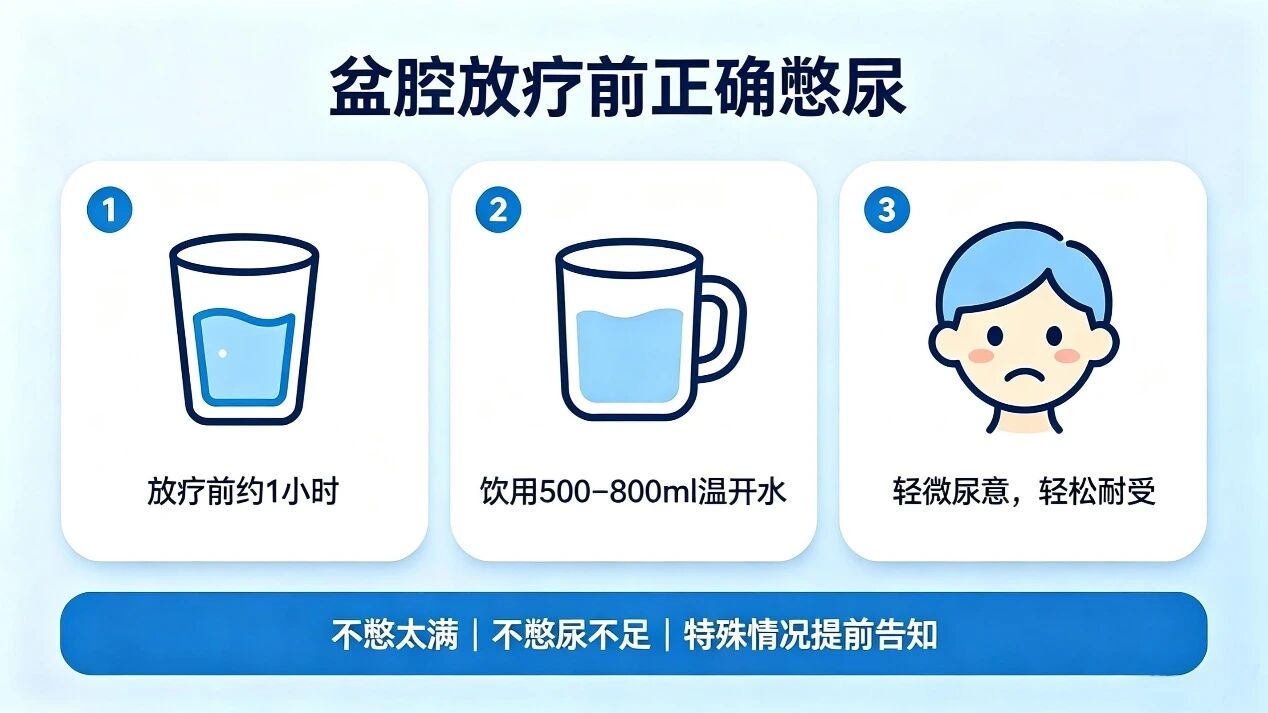
The golden rule: a strong urge to urinate that you can comfortably hold for 3–5 minutes (roughly 300–500 ml).
How to do it:
- Empty your bowels first — this matters even more than the urine. Stool has a bigger impact than urine does.
- One hour before treatment, empty your bladder, then drink 500–800 ml in several sips. Warm water is best; skip carbonated drinks and strong tea.
- Wait until you have a clear urge to urinate, then get on the treatment couch.
- Tip: Try to keep the interval between drinking and treatment consistent every day. Your planning CT is the moment to find your optimal level of fullness — then simply reproduce it, session after session.
5. A Word From Your Care Team
We understand that holding your bladder is uncomfortable. But please believe this: the extra few minutes you endure today may be what keeps you free from bleeding, chronic diarrhoea and urinary frequency for decades to come.
With photon therapy's image guidance and heavy-ion beams accurate to the millimetre, every time you cooperate, you are completing a perfect "shot" together with your physicists and radiation therapists.
Let's use the wisdom of one full bladder to protect the body's waterway and its food route.
Writer: Xu Jinjing
First review: Liu Qiong
Second review: Guo Yishan
Final review: Cai Qinghua