How should patients maintain position immobilization during radiotherapy?
How should patients maintain position immobilization during radiotherapy?
Heavy ion therapy for tumors is currently recognized internationally as one of the most advanced radiotherapy techniques, enabling increasingly precise targeting of tumor lesions. The prerequisite for achieving precise treatment is the patient's stable positioning, with different radiotherapy devices requiring distinct positioning fixation devices. This aims to enhance the accuracy of the radiation target area, reduce the dose to surrounding normal tissues, improve patient comfort and treatment reproducibility, and minimize setup errors during the treatment process. Therefore, effective positioning fixation is key to the successful implementation of the therapy.
Positioning Fixation
Positioning fixation involves securing the patient using specialized positioning devices to ensure the accuracy and reproducibility of their posture during future treatments. It is a critical component in the planning and execution of radiotherapy for tumors and remains essential throughout the entire radiotherapy process.

Why is position immobilization necessary during radiotherapy?
Positioning fixation is an effective method to achieve accuracy and reproducibility in radiotherapy.
Selecting appropriate positioning fixation devices can:
• Reduce daily patient setup time;
• Minimize target movement caused by respiratory motion;
• Decrease setup errors.
Thus, positioning fixation is one of the key steps to ensure the accurate delivery of radiotherapy.
Studies have shown that inter-fraction positional displacement with positioning fixation is <1 mm, whereas without it, the displacement exceeds 3 mm.
If positional deviation results in a 200 cGy reduction in CTV dose (4% of the prescribed 5000 cGy), tumor control rates may decrease by 5%–8%.
As radiotherapy equipment becomes more advanced and tumor targeting more precise, high-precision radiotherapy relies on equally precise positioning fixation. Positioning fixation directly impacts treatment outcomes. Under such highly accurate radiotherapy conditions, significant setup errors not only reduce local tumor control rates but also expose surrounding normal tissues to potentially damaging high-dose radiation.
Immobilization Devices in Radiotherapy
● Thermoplastic Mask
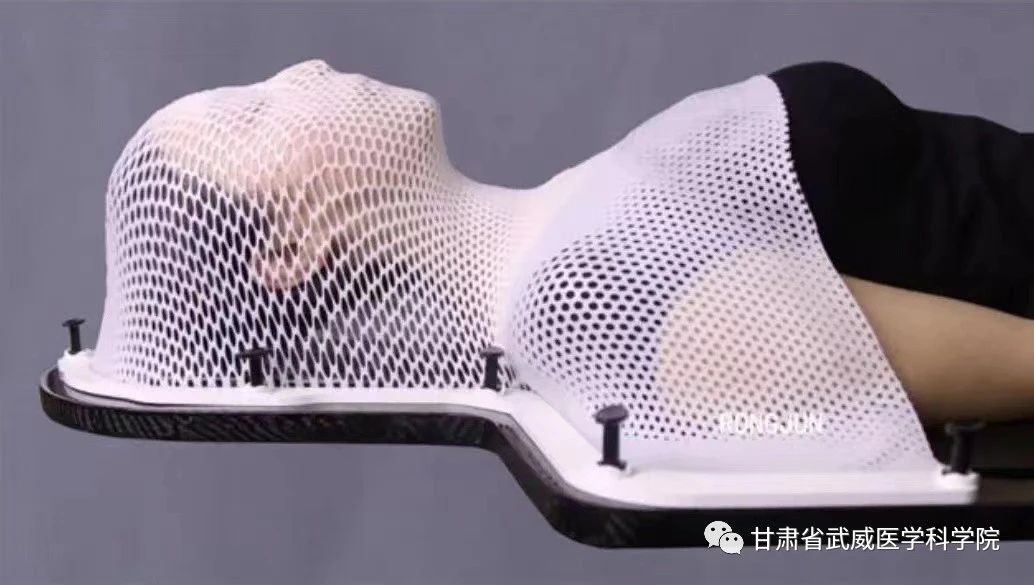
Made from thermoplastic sheets, it is widely used as an auxiliary positioning and fixation device in radiotherapy for tumor patients. It helps reduce unnecessary damage to normal tissues caused by patient movement, thereby improving local tumor control rates.
During radiotherapy, the thermoplastic positioning mask is softened by heat, placed on the corresponding area of the patient, and then hardened upon cooling to securely fix the patient's position.
●Vacuum Immobilization Cushion

It is primarily used for immobilizing tumors in the body. The device is molded according to each patient's individual body shape, ensuring high patient comfort and excellent treatment positioning reproducibility (specific outcomes may vary depending on the patient's physique).
Common Immobilization Positions in Radiotherapy
The most common patient positions are generally divided into the following two types.
1.Standard Positioning
The standard supine or prone position is used, applicable for tumors in the head, neck, thorax, and abdomen. During fixation, the patient should be positioned as comfortably as possible while ensuring ease of immobilization, thereby improving the reproducibility of subsequent treatment setups.
2.Special Positions
Special positions are commonly used for patients with extremity or trunk tumors (e.g., lipomas). During positioning fixation for these patients, their actual clinical symptoms must be considered.
For instance, factors such as the extent of tumor invasion, the patient’s pain level, and the feasibility of achieving proper fixation during the positioning process must be evaluated. Additionally, treatment-related considerations—including positioning reproducibility, the feasibility of radiation field setup in the treatment plan, and patient comfort—must all be taken into account.
For example, breast cancer patients undergoing radiotherapy after either breast-conserving surgery or modified radical mastectomy require the use of a breast board to secure their position. This improves both patient comfort and reproducibility, thereby enhancing treatment efficacy.
Whether using standard or special positions, positional accuracy must be ensured while prioritizing patient comfort.
In summary, before radiotherapy, the simulation room’s radiation therapists will select appropriate immobilization devices and patient positions based on the tumor location. Before fixation, technicians must comprehensively evaluate various factors, make repeated adjustments to the patient’s position, and ultimately choose the optimal and most comfortable fixation posture.
Patient Instructions
1. Patients must avoid tension during positioning fixation, as it may affect reproducibility; meanwhile, radiation therapists must clearly explain the details of the process to patients to alleviate their anxiety.
2. During mold forming, patients should pay attention to whether their breathing is smooth and whether they experience pain, pressure, or other discomforts, and promptly inform the radiation therapist. For patients with head and neck tumors, they should also watch for symptoms such as dizziness, nausea, or facial cyanosis to prevent choking incidents.
3. For breast cancer patients, if the target area includes the axilla, their arms should be opened as wide as possible to fully expose the axillary lymph nodes.
At this time, the radiation therapist must also carefully record the scale markings of the patient’s hand positions to ensure consistency and reproducibility of arm placement during radiotherapy.
4. For some bone tumor patients, during positioning fixation, it is essential to minimize movement when adjusting the upper and lower simulation couches to avoid iatrogenic fractures.
5. For thoracic and abdominal tumor patients, when using a vacuum bag for positioning, care must be taken not to touch the air valve of the vacuum bag when entering or exiting. Additionally, the patient’s hip position should remain as aligned as possible with the vacuum bag, and the body must not tilt to prevent damage to the negative pressure bag, which could affect subsequent treatment.
With the continuous advancement of radiotherapy technology, treatment outcomes for tumors will further improve. Through the joint efforts of radiation oncologists, medical physicists, and radiation therapists, patients can achieve more comfortable treatment positions, significantly enhancing tumor treatment efficacy, reducing damage to normal tissues, and ultimately enabling patients to benefit more from the therapy.