
Thrombosis in the Leg: Only Surgery or Medication? Interventional Therapy Offers a Solution
Thrombosis in the Leg: Only Surgery or Medication? Interventional Therapy Offers a Solution
Deep vein thrombosis (DVT) is a condition caused by abnormal blood clotting in the deep veins of the lower limbs, leading to swelling, pain, and even life-threatening pulmonary embolism (PE) due to dislodged clots.

1. Inferior Vena Cava (IVC) Filter Placement:
A "Protective Umbrella" to Block Deadly Clots
The critical first step in interventional therapy. Through femoral vein puncture, a filter resembling an umbrella frame is implanted into the inferior vena cava (the body's largest vein) to intercept dislodged clots from the lower limbs, preventing them from reaching the pulmonary artery and causing PE.
- Applicable Scenarios: Extensive DVT (involving the thigh and calf), contraindications to anticoagulation or ineffective anticoagulation therapy, high-risk PE patients (e.g., those with cancer or prolonged bed rest).
- High Efficacy: Mechanical thrombectomy can rapidly remove clots, and combined with thrombolytic drugs, it significantly shortens the treatment course (some patients see swelling subside within 2 days post-surgery).
- Safety: The success rate of clot interception by filters exceeds 95%, greatly reducing PE mortality.
- Minimally Invasive: The procedure requires only local anesthesia, leaves tiny incisions (needle-sized), and can be completed in under 30 minutes, allowing early post-operative mobility.
2. Thrombectomy:
Directly "Clearing" the Blood Vessels
- Mechanical Thrombectomy/Fragmentation: A catheter is used to break up and aspirate clots (e.g., high-speed rotating catheters to shred clots), suitable for larger, fresh thrombi.
- Catheter-Directed Thrombolysis (CDT): A thrombolytic catheter is placed directly into the clot, and drugs like urokinase are injected locally to dissolve it. Compared to systemic thrombolysis, this method uses lower drug doses, has fewer side effects, and is more effective.
3. Combined Therapy:
Multi-Pronged Approach for Enhanced Efficacy
Clinically, filter placement is often combined with thrombectomy. For example, a filter is first placed to prevent PE, followed by thrombolysis or thrombectomy to clear the clot, addressing the root cause of blood flow obstruction.
02 Case Study
Patient: Female, 73 years old, presented with left lower limb swelling for 3 days prior to admission, accompanied by soreness and coldness. The patient did not seek medical attention initially. The swelling progressively worsened, significantly limiting mobility.
External Hospital Ultrasound Findings: Thrombosis in the left external iliac, common femoral, deep femoral (branching segment), proximal and mid-superficial femoral, and intermuscular veins.
Admission Date: February 12, 2025, for "1. DVT 2. May-Thurner Syndrome" to the Cardiovascular and Interventional Department.
Treatment: "IVC filter placement + lower limb venous catheter-directed thrombolysis." Post-operatively, "heparin sodium injection" was administered for anticoagulation, and "urokinase (400,000 IU) intravenous pump, twice daily" for thrombolysis.
Follow-Up: Post-thrombolysis venography showed significant reduction in thrombus burden, followed by iliac vein stent placement. The patient continued rivaroxaban for anticoagulation.

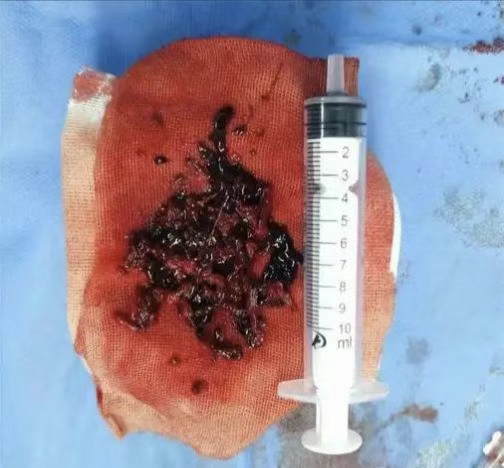
Lower Limb Venography Intraoperative Thrombus Extraction
One-Month Post-Op Ultrasound: Thrombosis in one left intermuscular vein; no significant abnormalities in the left external iliac, common femoral, deep/superficial femoral, popliteal, or posterior tibial veins.
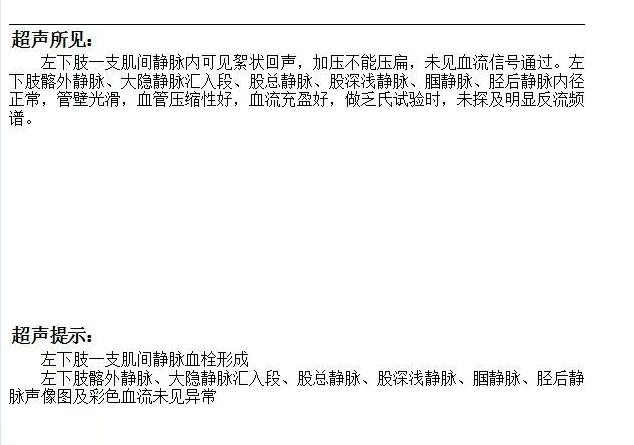
Post-Op Venous Ultrasound Results
03 Expert Reminders
Golden Treatment Window: Intervention within 48–72 hours of symptom onset yields the best outcomes, significantly reducing sequelae.
High-Risk Groups: Those with prolonged bed rest, cancer, or pregnancy should watch for unilateral leg swelling, skin warmth, etc., and seek prompt medical attention.
Avoid Misconceptions: Refrain from non-standard treatments like bloodletting, which may worsen vascular damage or trigger thrombosis.
Interventional therapy offers an efficient, safe, and minimally invasive solution for DVT patients. Early symptom recognition and timely medical care are key.

Director Yang Wangsheng
Key Minimally Invasive Procedures in Cardiovascular and Interventional Departments:
(1) Heart and Major Vessels:
- Catheter closure for congenital heart defects (ASD/VSD/PDA); coronary artery interventional therapy (PCI); pacemaker implantation for bradyarrhythmia; radiofrequency ablation for tachyarrhythmia.
- Endovascular stent graft for aortic dissection/aneurysm; endovascular stent graft for abdominal aortic aneurysm; stent placement for aortic ulcers/intramural hematoma.
(2) Peripheral Vascular Minimally Invasive Procedures:
Balloon angioplasty/stent placement for lower limb arteriosclerosis obliterans; renal artery stenosis angioplasty/stent placement; subclavian artery stenosis stent placement; thrombolysis/thrombectomy for DVT; IVC filter placement/removal; radiofrequency ablation/foam sclerotherapy for varicose veins; acute arterial embolectomy/thrombolysis; acute PE thrombus aspiration/catheter-directed thrombolysis; visceral artery aneurysm embolization.
(3) Tumor Minimally Invasive and Other Procedures:
Interventional embolization for massive hemoptysis, gastrointestinal bleeding, or gynecological bleeding; interventional therapy for benign/malignant tumors (liver cancer, hemangioma, uterine fibroids, cervical cancer, soft tissue tumors, etc.); arterial infusion chemotherapy for advanced tumors; interventional diagnosis/treatment for arterial/venous angiomas; port placement/removal for tumor patients.
Address: 1st Floor, Building 1, Heavy Ion Campus, Gansu Wuwei Cancer Hospital

