
Lung Talk : Things You Should Know About Lung Cancer
Lung Talk : Things You Should Know About Lung Cancer
Lung cancer, known as the world's "number one cancer killer," is far more severe than we imagine. According to 2024 data released by the National Cancer Center, China sees over 820,000 new lung cancer cases annually, with deaths exceeding 700,000—both figures ranking first globally. Behind these numbers are vibrant lives and families enduring immense suffering.
Common clinical symptoms of lung cancer include: The manifestations of lung cancer are complex and diverse, like an elaborately designed "disguise game" that requires our close attention: Symptoms caused by the primary tumor are often the most deceptive: progressively worsening cough, blood in sputum, chest tightness, shortness of breath, and chest pain can easily be mistaken for a common cold or bronchitis. However, if these symptoms persist or do not respond to conventional treatment, it’s crucial to be vigilant. When the tumor begins to invade locally, it exhibits more characteristic symptoms: hoarseness may indicate tumor invasion of the recurrent laryngeal nerve; difficulty swallowing could result from tumor compression of the esophagus; and superior vena cava syndrome, presenting as swelling of the face, neck, and upper limbs, requires emergency treatment. Even more noteworthy, lung cancer may sometimes first manifest as "extrapulmonary symptoms": unexplained clubbed fingers, joint pain, endocrine disorders, and even abnormalities in the skin or nervous system could be signs of lung cancer "creating a diversion."

Early Screening: A Critical Line of Defense for Life
It is worth noting that although lung cancer is aggressive, it is not unpreventable. Early screening and timely diagnosis are key to reducing mortality and prolonging patients' lives. The widespread use of low-dose spiral CT screening has significantly improved the detection rate of early-stage lung cancer, buying precious treatment time for patients. Particularly, long-term smokers, those with a family history of lung cancer, individuals with chronic lung diseases, and those long time exposed to kitchen fumes or dusty environments should prioritize regular screening.
Preventing Lung Cancer Starts with Lifestyle Details
Beyond vigilance, proactive prevention is equally important. Quitting smoking is the most effective preventive measure, while avoiding secondhand smoke exposure is also critical. Strengthening occupational protection, reducing inhalation of kitchen fumes, maintaining indoor air circulation, and exercising appropriately to boost immunity are all essential methods for preventing lung cancer.
Diagnosed with Lung Cancer: How Is It Treated?
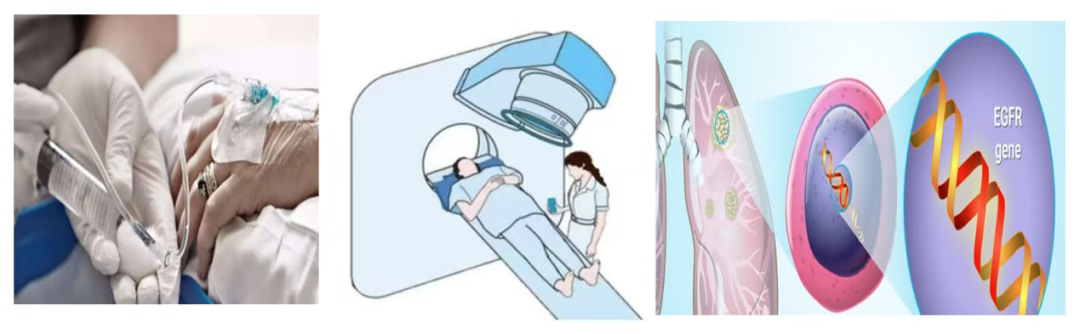
① Surgical Treatment: Surgical resection is the best method for curing lung cancer. However, a comprehensive evaluation of the patient's condition, tumor stage, and physical tolerance is required before deciding whether surgery is suitable.
② Radiation Therapy: As one of the "three pillars" of cancer treatment, radiation therapy uses rays emitted by accelerators, cobalt machines, heavy ion devices, and other radiotherapy equipment to kill tumor cells. It is a non-invasive, precise "invisible scalpel" that preserves lung function and is a vital option for patients who cannot undergo surgery.
③ Drug Therapy: This is a systemic anti-tumor treatment method, primarily including chemotherapy drugs, immunotherapy drugs, and targeted therapy drugs.
④ Traditional Chinese Medicine (TCM) Treatment: Lung cancer is viewed in TCM as a deficiency of the lung and spleen, leading to impaired lung functions of dispersion and purification, fluid metabolism dysfunction, phlegm accumulation, and the formation of masses. Thus, the TCM treatment principle for lung cancer is to strengthen the spleen and nourish the lungs, resolve phlegm and remove stasis, detoxify, and disperse masses.
Steps for Lung Cancer Patients Undergoing Radiotherapy
Radiotherapy is like performing a "precision invisible surgery" on the tumor, with the entire process interconnected to maximize effectiveness and minimize harm. We can simplify it into five key steps:
Draw the Map → Finalize the Plan → Take the "Final Shot" → Daily Sniper → Full Support
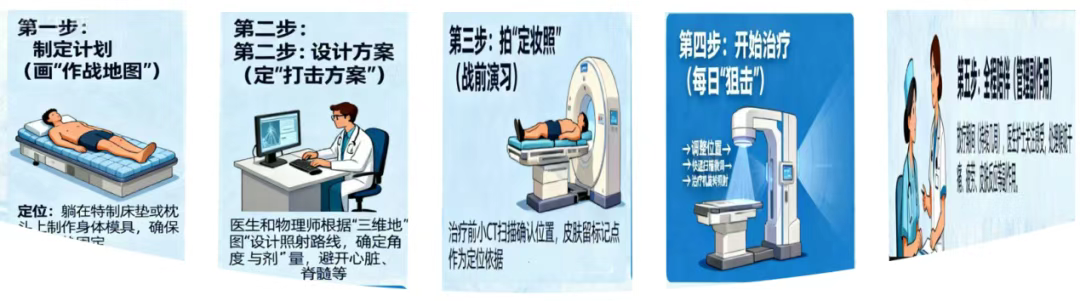
Step 1: Planning (Drawing the "Battle Map")
Positioning: You will lie on a specialized mattress or pillow to create a body mold, ensuring your position remains unchanged during each treatment.
Scanning: Similar to a CT scan, a specialized scanner will take detailed "3D maps" of your chest. On these maps, doctors will mark the "targets" (tumors) to be attacked and the "allies" (normal organs) to be protected.
Step 2: Designing the Plan (Finalizing the "Strike Plan")
Doctors and physicists, like military strategists, will meticulously design the irradiation routes on computers based on your "3D maps." They will determine the angles and "firepower" (dose) to ensure energy is precisely focused on the tumor while perfectly avoiding critical tissues like the heart and spinal cord.
Step 3: Taking the "Final Shot" (Pre-Battle Rehearsal)
Before actual treatment begins, a "dress rehearsal" is conducted. You will lie on the treatment bed, and technicians will use the treatment machine's onboard CT for a quick scan to ensure your position matches the original "map." Tiny marker points may be placed on your skin as reference for each treatment.
Step 4: Starting Treatment (Daily "Sniper")
Each Treatment Session: You simply lie comfortably while technicians adjust your position accurately.
precise Targeting: Before treatment, the machine quickly scans for final "micro-adjustments."
Painless Irradiation: The machine then rotates around you, irradiating the tumor from different angles. You will feel no pain, and the entire process typically takes about 10 minutes.
Step 5: Full Support (Managing Side Effects)
During radiotherapy (usually lasting several weeks), doctors and nurses will monitor your well-being, promptly addressing potential side effects such as dry/sore throat, fatigue, or skin reactions.
Department Introduction
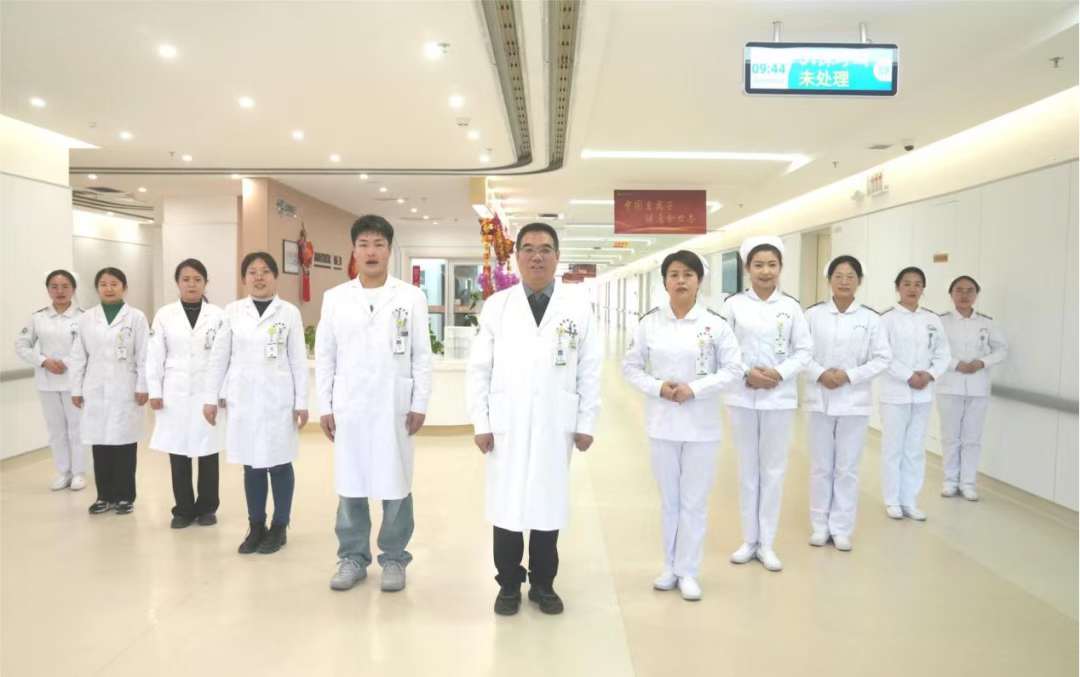
The Department of Heavy Ion Therapy for Thoracic Tumors, Bone and Soft Tissue Tumors (Radiotherapy Department II) specializes in heavy ion and photon radiotherapy for lung cancer, esophageal cancer, thymic cancer, breast cancer, bone tumors, soft tissue tumors, and more. The department currently has 16 staff, including 2 chief physicians and 1 associate chief physician.
The discipline leader, Chen Dongji, Chief Physician, is the Vice President and Chairman of the Labor Union of Gansu Heavy Ion Hospital, and Director of the Department of Heavy Ion Therapy for Thoracic Tumors, Bone and Soft Tissue Tumors (Radiotherapy Department II). With over 30 years of experience in radiotherapy, he previously studied at the Munich Proton Therapy Center in Germany. He currently holds positions including Secretary of the Bone and Soft Tissue Tumor Group of the Chinese Medical Association, Member of the Ion Therapy Group of the Chinese Anti-Cancer Association Radiotherapy Committee, and Member of the Gansu Provincial Anti-Cancer Association Radiotherapy Committee.
The department operates under the guidance of Professor Jorg Hauffe from the Munich Proton Heavy Ion Center in Germany, Professor Hirohiko Tsujii ("the world’s first pioneer in heavy ion tumor therapy"), Professor Ren Yimin from Taiwan, China, and Professor Wu Jiaming, who provide ongoing clinical, research, and teaching guidance. The department has won 3 provincial-level scientific progress second prizes and 7 municipal-level first and second prizes, and has published over 30 academic papers. Department staff have pursued advanced training at renowned oncology hospitals domestically and abroad, including the German RPTC Center, Cancer Hospital of the Chinese Academy of Medical Sciences, Shanghai Proton and Heavy Ion Center, Beijing 301 Hospital, Peking University Third Hospital, Sichuan Cancer Hospital, and Zhejiang Cancer Hospital.
The department currently offers advanced radiotherapy technologies including heavy ion therapy, spatial fractionation radiotherapy, stereotactic radiotherapy (SRS/SABR/SBRT), rotational/static intensity-modulated conformal radiotherapy, image-guided radiotherapy, 3D conformal radiotherapy, 3D brachytherapy, and hyperthermia. These are combined with surgical treatment, immunotherapy, targeted therapy, chemotherapy, and traditional Chinese medicine to provide standardized, individualized comprehensive treatment for cancer patients.
Contact Us
Address: Department of Heavy Ion Therapy for Thoracic Tumors, Bone and Soft Tissue Tumors, 2nd Floor, Building 4, Heavy Ion Campus, Gansu Wuwei Medical Science Academy Cancer Hospital