
Chemotherapy-Induced Diarrhea: An Issue Not to Be Ignored
Chemotherapy-Induced Diarrhea: An Issue Not to Be Ignored
Diarrhea, commonly known as "running stomach," is a frequent discomfort in our daily lives. But do you know what "Chemotherapy-Induced Diarrhea" is? Are you aware of the harm it can cause and how to prevent and treat it?
Chemotherapy-Induced Diarrhea
Refers to one of the unavoidable adverse gastrointestinal reactions in cancer patients during chemotherapy. When symptoms are mild, it may only present as painless diarrhea or mild abdominal pain accompanied by projectile watery stools. In severe cases, it can lead to bloody diarrhea, infectious diarrhea, electrolyte imbalances, dehydration, and even life-threatening consequences such as shock.
Harms of Chemotherapy-Induced Diarrhea
Common harms include impaired nutrient absorption, water-electrolyte imbalances, intestinal function and local damage, and reduced quality of life.
Treatment of Chemotherapy-Induced Diarrhea
Western Medical Treatment: Avoid spicy, irritating, greasy, raw, and cold foods; oral antidiarrheal medications; regulate intestinal flora, improve intestinal function, and alleviate diarrhea; select appropriate antibiotics for anti-infection treatment when necessary.
Traditional Chinese Medicine (TCM) Treatment:
(1) Oral Chinese Herbal Medicine:
① Syndrome of Internal Abundance of Cold-Dampness: Select Huoxiang Zhengqi Powder.
② Syndrome of Dampness-Heat Injuring the Middle: Select Gegen Qinlian Decoction.
③ Syndrome of Food Stagnation in Stomach and Intestines: Select Baohe Pill.
④ Syndrome of Liver Qi Overacting on Spleen: Select Tongxie Yaofang.
⑤ Syndrome of Spleen and Stomach Deficiency: Select Shenling Baizhu Powder.
⑥ Syndrome of Kidney Yang Deficiency: Select Sishen Pill.
(2) External TCM Treatments:
① Herbal Application: Grind herbs like Rougui, Wuzhuyu, and Dingxiang into powder, mix with vinegar, and apply to acupoints such as Zusanli (ST36), Shenque (RN8), Tianshu (ST25), and Shangjuxu (ST37).
② Herbal Enema: Based on the patient's specific symptoms, select formulations like Baitouweng Decoction, Sanhuang Decoction, or Guifu Xixin Decoction for retention enema.
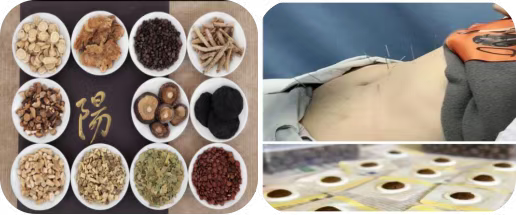
③ Common Acupuncture: Select acupoints such as Tianshu (ST25), Zhongwan (RN12), and Shangjuxu (ST37). Method: Acupuncture, retain needles for 20-30 minutes, once daily. The above acupoints can be modified or substituted based on patient symptoms.
④ Moxibustion: Apply moxibustion to acupoints such as Baihui (DU20), Tianshu (ST25), Pishu (BL20), Zhongwan (RN12), Guanyuan (RN4), Shenshu (BL23), Dachangshu (BL25), Shenque (RN8), etc. For Shenque (RN8), ginger-partition moxibustion or salt-partition moxibustion can be used.
Introduction to Integrated Traditional Chinese and Western Medicine Department / TCM Oncology Specialty
The Integrated Traditional Chinese and Western Medicine Department of Gansu Wuwei Tumor Hospital is a key TCM specialty and an advantageous TCM specialty in Wuwei City. The TCM Oncology Specialty is the largest TCM oncology specialty in Wuwei City. The department has 5 TCM characteristic outpatient clinics and 1 inpatient ward. The department currently has 20 medical staff, including 1 Chief Physician, 2 Associate Chief Physicians, 4 Attending Physicians, 1 Resident Physician, 3 Master's degree holders, 1 Famous TCM Physician of Wuwei City, and 8 direct disciples of Professor Pei Zhengxue, a renowned integrated Chinese and Western medicine expert and nationally famous veteran TCM practitioner; plus 12 nursing staff. The department focuses on the integrated Chinese and Western medicine treatment of tumors, spleen and stomach diseases, rheumatic immune diseases, skin diseases, and neck, shoulder, back, and leg pain. Adhering to the concept of integrated Chinese and Western medicine in cancer treatment, the department applies the systematic health management system of "Comprehensive and Full Life Cycle Rehabilitation Management for Cancer Patients." It utilizes the advantages of TCM in reducing toxicity and enhancing efficacy throughout the entire treatment process, including pre- and post-surgery, heavy ion therapy, radiotherapy, chemotherapy, targeted therapy, and immunotherapy, to maximize patient quality of life, prolong survival, and reduce the risk of recurrence and metastasis. The TCM appropriate techniques carried out by the department include acupuncture, electroacupuncture, wax therapy, moxibustion, long-snake moxibustion, indirect moxibustion, herbal fumigation and washing, cupping, guasha, external high-frequency hyperthermia, cervical and lumbar traction, tuina massage, acupoint catgut embedding, acupoint application, acupoint injection, ear apex bloodletting, auricular plaster therapy, block therapy, foot baths, bloodletting therapy, dog-day acupoint patches, and mid-winter acupoint patches.
For the convenience of patients, our department's outpatient and inpatient services are available year-round without closure. If you experience any discomfort, you are welcome to visit our department.
Location: Room 306, Outpatient Building, Gansu Wuwei Tumor Hospital (Central Campus) or 2nd Floor of the TCM Building.