Swollen Lymph Nodes Are the Body's Cry for Help! These Disease Warnings Must Not Be Ignored!
Swollen Lymph Nodes Are the Body's Cry for Help! These Disease Warnings Must Not Be Ignored!
Swollen Lymph Nodes Are the Body's Cry for Help!
These Disease Warnings Must Not Be Ignored!
I wonder if you have ever had such an experience: when you have a cold, fever, sore throat, or toothache, you might feel "small bumps" the size of soybeans in your neck, under your chin, or behind your ears that are movable and slightly painful when pressed? In fact, these are our body's loyal "guards"—the lymph nodes—speaking up (inflamed)!
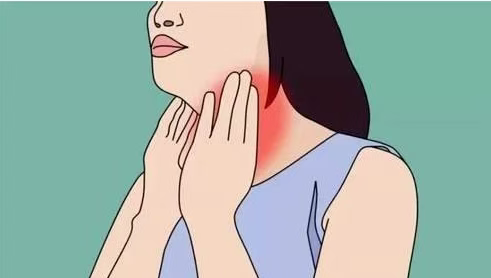
01 Correct Understanding of Lymph Nodes
Lymph nodes are important immune organs in the human body. Normally, a person has 500-600 lymph nodes, which can be divided into superficial lymph nodes (head and neck: including preauricular, postauricular, occipital, submandibular, submental, anterior cervical, posterior cervical, and supraclavicular lymph nodes; upper limbs: including axillary and epitrochlear lymph nodes; lower limbs: including inguinal and popliteal lymph nodes) and deep lymph nodes (near the hilum of internal organs: such as the pulmonary hilum, hepatic hilum, splenic hilum, and mesentery; around large blood vessels: such as para-aortic lymph nodes; around deep body cavity organs: such as the mediastinum, abdominal cavity, and retroperitoneum). Normal lymph nodes are typically 0.2-0.5 cm in diameter, often distributed in groups, with a soft texture, smooth surface, no tenderness, and mobility. Except for the occasional palpation of 1-2 lymph nodes in the submandibular, inguinal, or axillary areas, most lymph nodes are not easily felt.
02 Why Do Lymph Nodes Swell?
Lymph nodes are a crucial part of the human immune system, acting like the body's "border outposts." When nearby areas face "foreign invasions" (such as viral or bacterial infections) or "internal rebellions" (such as tumor cells), they activate their defense mechanisms. The lymphocytes inside rapidly proliferate, causing the lymph nodes to swell. Therefore, "swollen lymph nodes" are the body's cry for help, signaling a disease "warning," and must not be ignored!
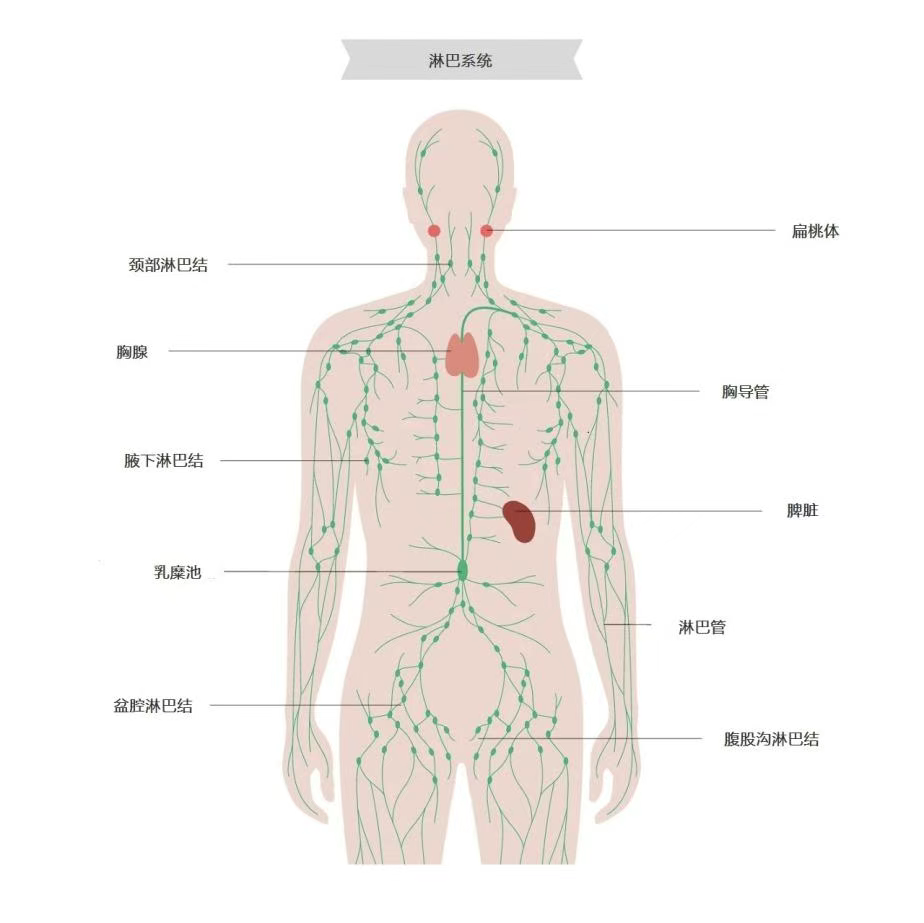
03 Causes of Swollen Lymph Nodes
01 Infectious Factors
Infection is the most common cause of swollen lymph nodes. When the body is invaded by pathogens such as bacteria, tuberculosis bacteria, viruses, or parasites, the lymph nodes initiate a stress immune response to eliminate these "invaders." For example, throat infections may cause cervical lymph nodes to swell; hand infections may cause axillary lymph nodes to swell; and foot infections may cause inguinal lymph nodes to swell.
02 Immune Reactions
Certain autoimmune diseases, such as rheumatoid arthritis, Behçet's syndrome, and systemic lupus erythematosus, can also cause lymph node swelling.
03 Tumor Factors
Tumor cells can invade lymph nodes, causing them to swell. For example, lymphoma is a malignant tumor originating from the lymphatic system, and its main manifestation is painless lymph node swelling. Additionally, malignant tumors from other parts of the body can metastasize to lymph nodes through the lymphatic system, causing swelling. In some cases, early-stage solid tumors, such as lung or stomach cancer, may first present as swollen lymph nodes in the supraclavicular fossa.
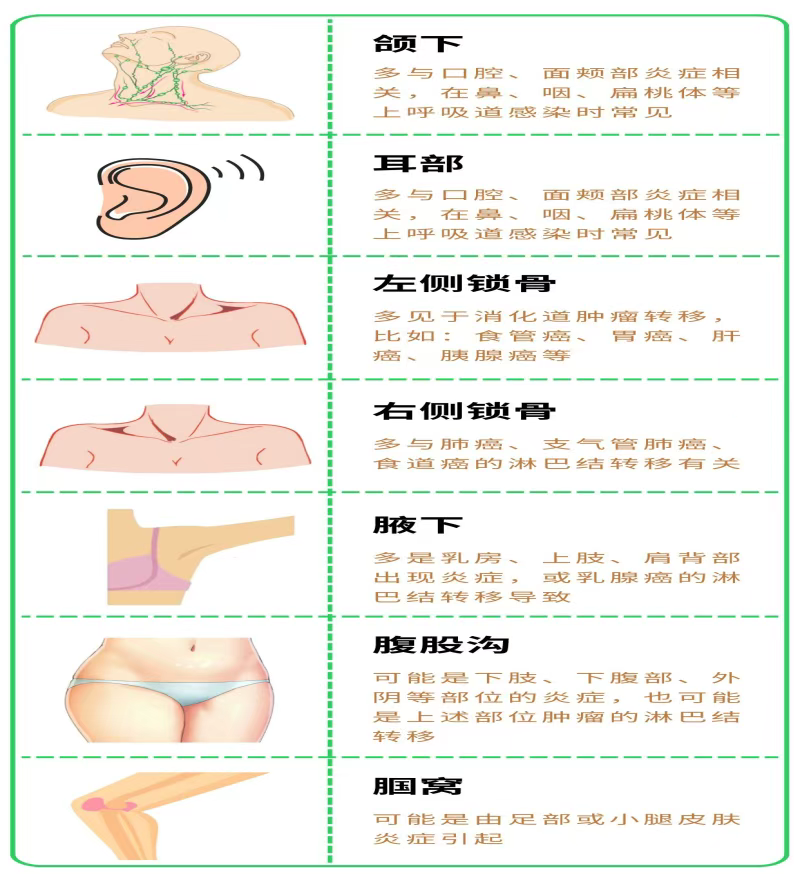
04 What Should I Do If I Have Swollen Lymph Nodes?
01 Don’t Panic
Most cases of swollen lymph nodes are caused by common infections.
02 Learn Preliminary Self-Examination
- Pay attention to size: Is the diameter larger than 1-1.5 cm?
- Pay attention to quantity: Is it a single node? Multiple nodes? In one location? Multiple locations? Bead-like? Fused together?
- Touch and feel: Is the surface smooth? Is the texture hard? Is it fixed in place?
03 Seek Medical Attention Promptly
If you notice the following "danger signals," see a doctor immediately:
- Painless, progressive enlargement of lymph nodes;
- Diameter larger than 1.5 cm, hard texture, fixed and immobile (adhered to surrounding tissues);
- Accompanied by fever, night sweats, or unexplained weight loss;
- Accompanied by generalized skin itching and progressive weight loss;
- Accompanied by fever and significant bone pain;
- Lymph node swelling persists for more than 2 weeks without signs of subsiding.
05 What Are the Common Diseases Associated with Swollen Lymph Nodes?
- Lymphadenitis (most commonly caused by bacterial or viral infections)
- Reactive lymph node hyperplasia
- Tuberculosis, lymph node tuberculosis
- Necrotizing lymphadenitis (Kikuchi-Fujimoto disease, KFD)
- Malignant lymphoma (Hodgkin's lymphoma [HL], non-Hodgkin's lymphoma [NHL])
- Solid tumors
- Lymph node metastasis of tumors
- Rare diseases: Castleman disease, Langerhans cell histiocytosis, etc.
06 Important Considerations for Hospital Visits and Examinations
If you discover swollen lymph nodes, it is crucial to undergo relevant necessary examinations to obtain a clear diagnosis before treatment!
- Visit a formal hospital and make an appointment with the hematology department, rheumatology and immunology department, or oncology department. Leave professional matters to professionals. Finding the right specialist can save you from unnecessary detours!
- Routine examinations include hematological laboratory tests, color ultrasound, and X-rays.
- Further imaging examinations include CT, MRI, and PET/CT.
- Lymph node pathological biopsy is a confirmatory examination.
- Bone marrow aspiration and bone marrow tissue pathological biopsy are confirmatory examinations for detecting tumor cell infiltration into the bone marrow (performed by hematology department specialists).
- Obtaining a clear diagnosis and targeted treatment to avoid delaying the condition is essential!
- Do not fear bone marrow aspiration and biopsy. Hematology department specialists are skilled, safe, and perform the procedure without risks! After the procedure, patients can immediately resume normal activities without any functional restrictions or mobility impacts.
- Do not believe in folk remedies, unverified prescriptions, or unscientific methods for treating swollen lymph nodes. Delaying proper treatment can cause endless harm!
Daily Lymph Node Care
- Pay attention to avoiding bacterial and viral infections in daily life. Maintain personal hygiene and avoid skin breaks and inflammation.
- Avoid frequently pressing or massaging lymph nodes, as repeated stimulation can cause swelling.
- Avoid exposure to harmful substances such as hair dyes, pesticides,building materials, and secondhand smoke, which can damage the immune system and cause immune dysfunction, leading to abnormal lymph node swelling.
- Maintain a good mood, avoid holding in anger, ensure adequate rest, breathe fresh air, and eat fresh fruits to enhance the body's immunity, which is beneficial for lymph nodes.
Oncology Department/Hematology Department
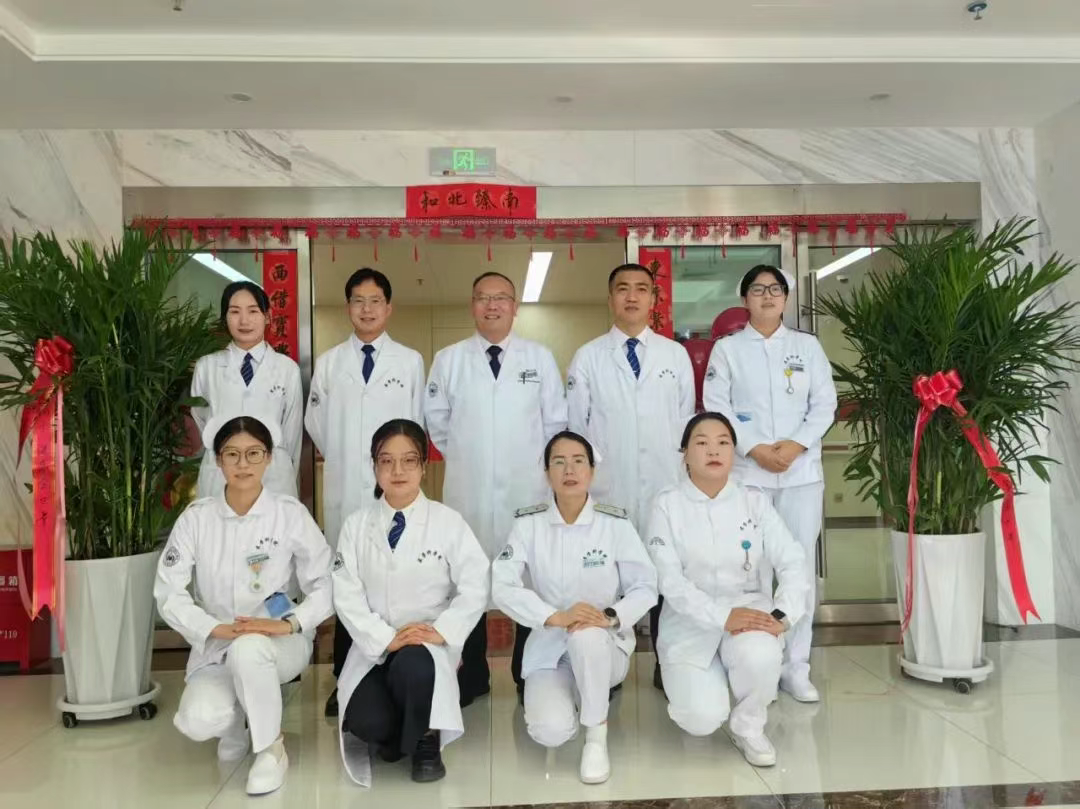
Professional Team
The department has a team of elite medical professionals. Among the medical team, specially appointed experts Professor Bai Hai and Professor Pan Ming are both first-chief physicians who enjoy high reputations in the industry, possessing profound academic achievements and rich clinical experience, providing solid assurance for the department's diagnostic and treatment capabilities. At the same time, the department has a complete and rational talent team and continuously improves its talent training mechanism to ensure high-quality, multi-level medical services for patients. The nursing team, with a high sense of responsibility and professional nursing skills, provides comprehensive and meticulous care for patients, ensuring their comfort and safety during treatment.
Diagnostic and Treatment Scope
The department focuses on the precise diagnosis and treatment of various benign and malignant diseases of the hematopoietic system and solid tumors. It has significant advantages in handling refractory and relapsed hematological diseases and solid tumor diseases. Key areas include hematological diseases such as leukemia, lymphoma, multiple myeloma, and various types of anemia, as well as common solid tumor diseases such as lung cancer, stomach cancer, colorectal cancer, and breast cancer. Whether for common diseases or疑难病症, the department can provide accurate diagnosis and effective treatment plans based on professional medical technology and rich clinical experience.
Diagnostic and Treatment Techniques
Diversified Treatment Methods: The department adopts internationally advanced treatment concepts and methods, including chemotherapy, targeted therapy, immunotherapy, endocrine therapy, supportive therapy, cell therapy, and integrated traditional Chinese and Western medicine treatments. Based on the patient's condition and physical condition, personalized comprehensive treatment plans are developed to achieve the best treatment outcomes.
Precise Diagnostic Techniques: Relying on the advanced marrow morphology,marrow pathology, flow cytometry, gene testing, and other MICM typing technologies of the hematology center laboratory, the department can accurately diagnose and classify hematological diseases, providing a scientific basis for developing personalized treatment plans. Through these advanced technologies, the patient's condition can be understood more accurately, enabling precise treatment and improving treatment outcomes.
Laminar Flow Ward: The department is equipped with laminar flow wards, providing a safe and comfortable treatment environment for patients undergoing high-dose chemotherapy, hematopoietic stem cell transplantation, and other treatments requiring strict infection control. The laminar flow wards use advanced air purification technology to effectively reduce the risk of infection, providing strong support for patient treatment.
Preliminary Review: Ma Shuqian
Final Review: Liu Wenyu