Department of Radiation Oncology Ⅲ: Specialized Heavy-Ion Therapy for Abdominal and Pelvic Tumors
Radiotherapy Department Ⅲ, Gansu Wuwei Cancer Hospital
(Pancreatic Cancer Heavy Ion Specialist Department, Specialized Heavy Ion Therapy for Abdominopelvic Tumors)
I. Department Overview
Department Ⅲ is specializing in heavy ion radiotherapy for pancreatic cancer, as well as heavy ion and photon radiotherapy for abdominopelvic tumors including liver cancer, colorectal cancer, and prostate cancer. Since the department began operations, pancreatic cancer patients from across the country have sought treatment here, benefiting from precise eradication of pancreatic cancer cells without pain, surgery, or collateral damage. To date, we have treated dozens of pancreatic cancer patients from various regions nationwide, achieving a 1-year local control rate as high as 96% and extending the median overall survival from the conventional 11 months to 22 months. With proven efficacy and a positive treatment experience, our outcomes have received widespread recognition from both renowned experts at home and abroad and the patients we serve.

II. Talent Team and Academic Structure
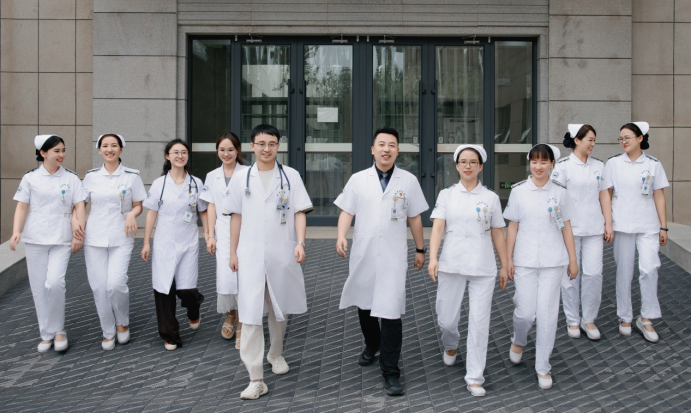
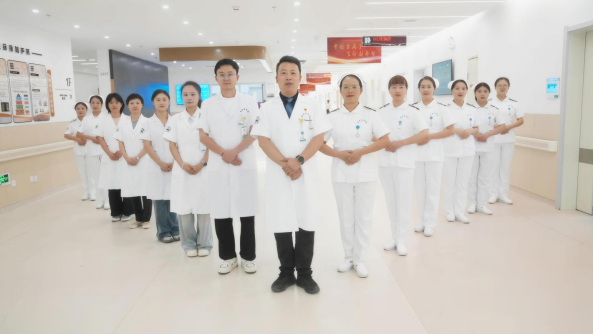
The department currently has 13 staff members, including 6 physicians (1 Associate Chief Physician, 2 Attending Physicians, 3 Resident Physicians) and 7 nurses (2 Senior Nurses, 1 Nurse Practitioner, 4 Nurses). It is a professional technical team with rich knowledge reserves and vibrant dynamism. In talent team building, the department emphasizes the cultivation of young and middle-aged physicians, having trained and introduced 4 postgraduates. Department members have studied at renowned domestic and international cancer centers such as Singapore General Hospital, Shanghai Proton and Heavy Ion Center, Peking University Third Hospital, and Sichuan Cancer Hospital, possessing extensive experience in heavy ion therapy. They are capable of formulating scientific and reasonable treatment plans and providing professional, humanized, and precise services for patients.
The department long-term employs several internationally renowned experts as consultants, including Professor Jorg Hauffe from the Munich Proton and Heavy Ion Center in Germany, Professor Hirohiko Tsujii, a "pioneer in world heavy ion therapy," Professor Ren Yimin and Professor Wu Jiaming, authorities in radiotherapy from Taiwan, China, who regularly participate in clinical rounds, consultations, and difficult case discussions. Additionally, Professor Fan Ruitai, Chairman of Radiotherapy in Henan Province, is appointed as a guiding expert to support the department's discipline construction and quality improvement. The department has thus far won 1 provincial-level Science and Technology Progress Award, 1 municipal-level Science and Technology First Prize, 2 Second Prizes, and published over 30 academic papers, demonstrating strong clinical research capabilities.
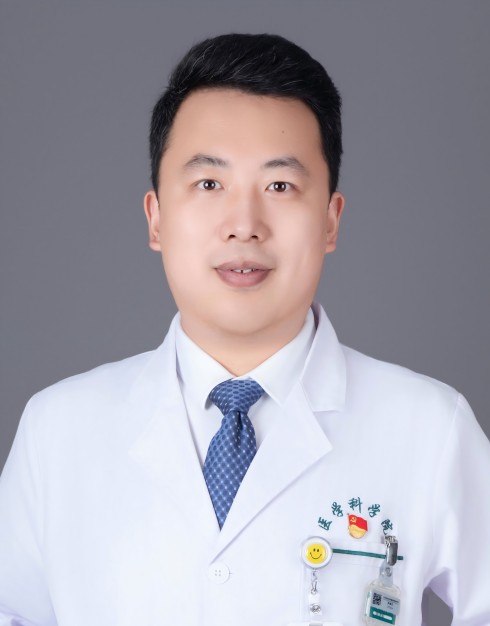
The department leader, Chen Weizuo, Associate Chief Physician, Master of Oncology, Deputy Secretary of the Radiotherapy Department Party Branch, is a "Gansu Provincial Longyuan Youth Elite." He holds positions including: Director of the Close-Range Therapy and Intelligent Radiotherapy Society of the Chinese Nuclear Society; Member of the Ion Radiotherapy Branch of the China Medical Equipment Association; Member of the Oncology Branch of the National Health Industry Enterprise Management Association; Member of the Youth Branch of the Western Radiotherapy Association; Member of the CRTOG Radioimmunology IR Youth Committee; Youth Committee Member of the Gansu Provincial Anti-Cancer Association Gastric Cancer/Colorectal Cancer Professional Committee; Member of the Wuwei Medical Association Radiotherapy Professional Committee. He leads 1 project under the Chinese Academy of Sciences "West Light" Talent Training Program and 2 "Longyuan Youth Innovation and Entrepreneurship" talent projects from the Gansu Provincial Party Committee Organization Department. His projects have won the "Gansu Provincial Science and Technology Progress Award" Third Prize. He has published 12 SCI papers and 6 Chinese core journal papers. He holds 2 national invention patents and 3 utility model patents. His invention patents won the Gold Award at the "National Invention Exhibition" and the Second Prize of the National "Invention Entrepreneurship Award" Project Award. As the core figure of the team, he not only has rich clinical experience but also a solid academic background, having conducted research at centers including Shanghai Proton and Heavy Ion Center, Peking University Third Hospital, and Sichuan Cancer Hospital. He specializes in radiotherapy and comprehensive treatment for abdominopelvic tumors, with extensive experience in advanced radiotherapy techniques such as heavy ion therapy and stereotactic body radiotherapy.
III. Scope of Diagnosis and Treatment & Technical Features
The department primarily focuses on heavy ion therapy for pancreatic cancer, while also conducting heavy ion and photon therapy for abdominopelvic tumors such as liver cancer, cholangiocarcinoma, colorectal cancer, gastric cancer, renal cancer, prostate cancer, and bladder cancer. It provides professional radiotherapy and personalized comprehensive tumor treatment services for patients.
As a benchmark department in the field of domestic precision radiotherapy for tumors, Department Ⅲ focuses on international cutting-edge treatment methods, building a comprehensive technical system characterized by heavy ion therapy and the coordinated development of multi-modal precision radiotherapy technologies. This provides personalized, high-efficacy solutions for refractory tumors and complex cases. The department fully implements multiple internationally mainstream radiotherapy technologies, including heavy ion radiotherapy, spatial fractionated radiotherapy (Lattice Radiotherapy), stereotactic radiosurgery (SRS) and stereotactic ablative body radiotherapy (SABR/SBRT), volumetric modulated arc therapy (VMAT) and intensity-modulated radiotherapy (IMRT), image-guided radiotherapy (IGRT), 3D conformal radiotherapy (3D-CRT), 3D brachytherapy, deep hyperthermia, and external hyperthermia. The department emphasizes the concept of "comprehensive treatment, individualized strategies," organically combining radiotherapy with surgery, immunotherapy, targeted drugs, chemotherapy, and traditional Chinese medicine treatment to develop standardized, full-course management treatment plans for patients. The department has completed hundreds of heavy ion treatments and cumulatively admitted over 1,500 cases of various tumors, with significant efficacy widely recognized by patients and their families.
Department Specialty Technologies:
1、Heavy Ion Radiotherapy:
Heavy ion therapy possesses the dual core advantages of "precise killing + efficient anti-cancer." Its characteristics are mainly reflected in three aspects: First, high biological effectiveness (high RBE), capable of precisely destroying tumor cell DNA double strands, with more significant killing effects on refractory tumors insensitive to traditional radiotherapy (such as pancreatic cancer, cholangiocarcinoma, sarcoma, etc.). Second, precise dose distribution, utilizing the "Bragg Peak" physical characteristic to concentrate high dose within the tumor lesion, minimizing radiation damage to surrounding normal tissues (such as blood vessels, internal organs). Third, short treatment cycle; compared to traditional photon radiotherapy, carbon ion therapy delivers higher single doses and requires fewer total treatment sessions (typically around ten days), significantly shortening the patient's treatment cycle and reducing the physical burden during treatment.
Case Presentation 1: Malignant Tumor of Pancreatic Body
Malignant tumor of the pancreatic body (5.1*4.1cm), lesion encasing the main portal vein, celiac trunk, and superior mesenteric artery, with compressed and narrowed celiac trunk, leading to occlusion of the portal vein and splenic vein with collateral circulation formation, accompanied by metastasis to lymph nodes left of the portal vein and retroperitoneum. Pathological diagnosis (Pathology E2025-00115): Adenocarcinoma. Treatment plan: Carbon ion radiotherapy (2025-06-12) Total dose: PTV: 55.2Gy(RBE)/12Fx. Concurrent chemotherapy: Gemcitabine monotherapy, days 1, 8, 15 Q4W.
Imaging Comparison
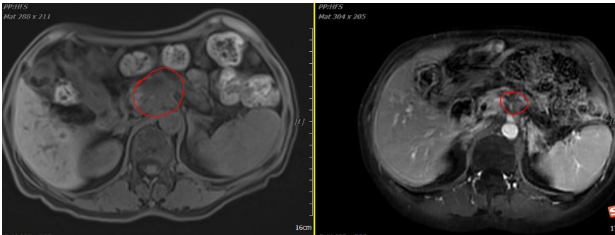
2025-05-30 2025-10-16
Case Presentation 2: Malignant Tumor of Pancreatic Head
Metabolically active focus in the pancreatic head, consistent with pancreatic cancer presentation; accompanied by metastasis to lymph nodes around the abdominal aorta. Invasion of the portal vein and superior mesenteric vein, accompanied by pancreatic duct and common bile duct dilation. Pathological diagnosis: Adenocarcinoma. cT3N1M1 Stage IV, KPS score: 80. Treatment plan: Carbon ion radiotherapy: Total dose 58.5Gy (RBE)/14Fx. Concurrent chemotherapy: Gemcitabine + Albumin-bound Paclitaxel.
Imaging Comparison
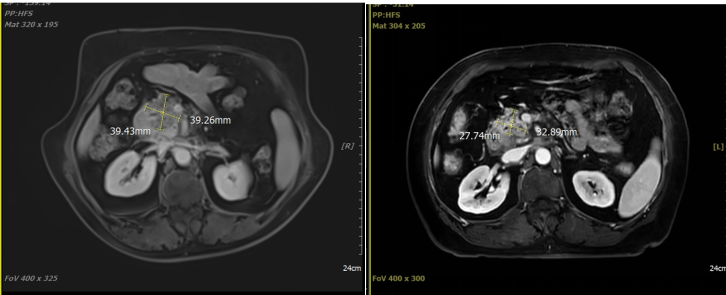
Pre-treatment (2025-3-5) Post-treatment review (2025-4-10)
2)Innovative Heavy Ion Treatment Technology: Heavy Ion Radiotherapy with Surgically Implanted Spacer between Abdominopelvic Tumor Mass and Organs at Risk
Heavy ion radiotherapy is globally recognized as a cutting-edge tumor radiation therapy technology, especially suitable for refractory tumors where surgery, conventional chemotherapy, and traditional radiotherapy are ineffective or prone to recurrence. In clinical practice, heavy ion therapy, due to its unique physical and biological effects, can effectively kill various tumors. However, for cases where the boundary between the tumor and normal tissue is unclear, it is difficult to achieve curative goals due to concerns about damage to normal tissues.
For this subset of refractory tumors, our department has innovated an overall solution. The first course delivers a baseline treatment dose. The second course involves surgically placing a spacer gauze pad between the tumor mass and the organ at risk. On the same day, positioning, target delineation, plan creation, verification, resetting, and treatment are completed, followed by the removal of the gauze pad. This allows the patient to receive a second course of single high-dose radical heavy ion radiotherapy, ensuring the patient safely receives radical high-dose radiation therapy with significant efficacy. The entire process involves multidisciplinary collaboration among radiotherapy, surgery, anesthesiology, radiotherapy physics, radiotherapy technology, imaging, operations personnel, and transport personnel to safeguard the patient.
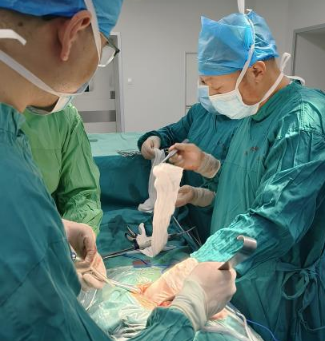

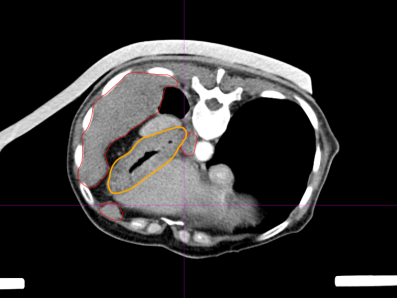
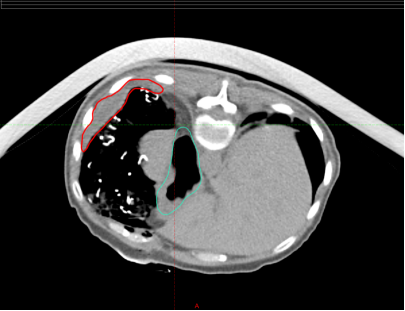
Before gauze placement After gauze placement
2、Stereotactic Body Radiotherapy/Radiosurgery with Respiratory Gating (SBRT/SRS):
Submillimeter Precision "Radiosurgery" Alternative
Relying on multi-modal image fusion technology (CT anatomical localization + MRI functional imaging + PET-CT metabolic imaging), SBRT uses intelligent algorithms to achieve three-dimensional visualization reconstruction of the tumor target volume (GTV) and organs at risk (OARs), with positioning accuracy reaching the submillimeter level (error <1mm). Treatment adopts a "hypofractionated, high-dose" model (single dose 5-12Gy, total sessions 2-10), delivering a lethal dose to the tumor in a short time through focused high-energy beam delivery. Its biologically effective dose (BED) far exceeds that of conventional radiotherapy, with local control effects comparable to surgical resection.
Technical highlights include: ① Non-invasiveness: Achieves radical tumor ablation without surgery; ② High efficiency: Single treatment can significantly reduce tumor volume, suitable for early-stage lung cancer, liver cancer, prostate cancer, and oligometastases (e.g., brain metastases, bone metastases); ③ Safety: Through dynamic respiratory gating, adaptive plan optimization, and other technologies, cumulative damage to normal tissues is minimized, and patients recover quickly post-treatment (most can resume normal activities the next day).
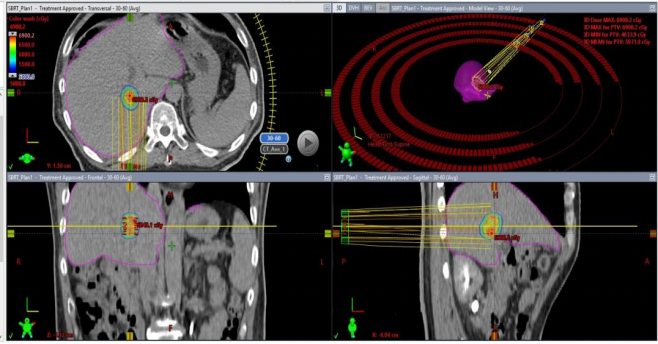
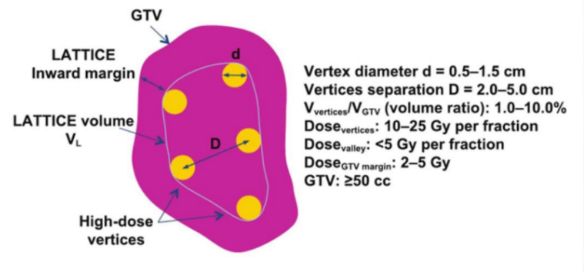
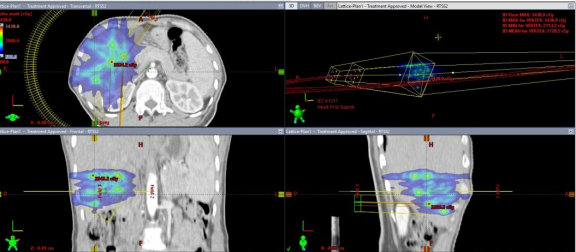
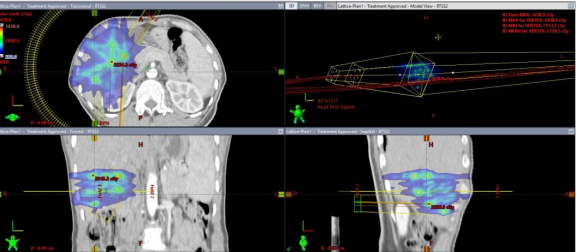
3、Lattice Radiotherapy for Large Tumors: Innovative Dose Distribution Mode for Precise Protection Strategy
As an emerging spatial fractionated radiotherapy technology, Lattice Radiotherapy, through three-dimensional grid-based dose design, overturns the traditional uniform irradiation mode, constructing a stereoscopic structure of alternating "high-dose peak - low-dose valley" within the tumor:
Tumor Core Area: Densely distributed high-dose "lattice points" (dose up to 150%-200% of the prescription dose) form potent killing zones, directly targeting tumor stem cells and proliferatively active cell populations.
Peripheral Transition Zone: Low-dose areas (approximately 20%-50% of the prescription dose) maintain suppression of infiltrating foci at the tumor edge while effectively protecting adjacent critical organs (e.g., brainstem, spinal cord, optic nerves, etc.), keeping the dose to normal tissues within tolerance thresholds.
The technology is particularly suitable for large-volume tumors adjacent to important functional structures (e.g., sellar region tumors, central lung cancer, etc.), significantly reducing the risk of severe complications such as radiation encephalopathy and pulmonary fibrosis while ensuring tumor regression rates.
4、Image-Guided Radiotherapy (IGRT):Real-time Dynamic Monitoring Precision Execution System
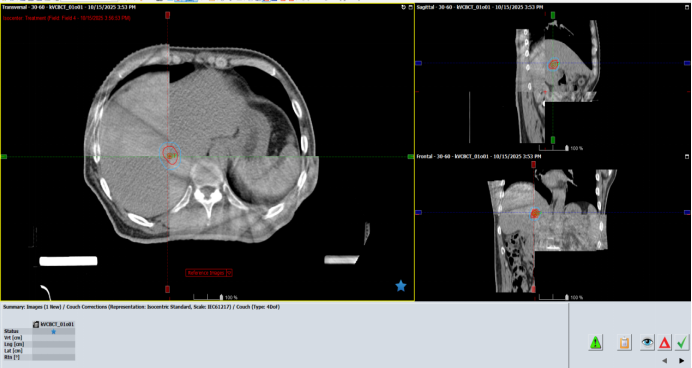
IGRT integrates optical surface tracking, real-time ultrasound imaging, cone-beam CT (CBCT)/diagnostic-grade CT, and MRI multi-modal imaging equipment to acquire real-time data on tumor position, shape, and respiratory motion before/during treatment, dynamically correcting setup errors (accuracy 1-2mm). For cases with significant tumor displacement (e.g., lung cancer moving with respiration, liver cancer affected by diaphragm movement), IGRT can synchronously adjust gantry angles and dose distribution, ensuring rays accurately hit the target. For recurrent tumors (e.g., locally recurrent nasopharyngeal carcinoma) or patients with anatomical variations, its rapid response capability allows timely correction of treatment plans, avoiding "misses" or excessive irradiation of normal tissues.
This technology is especially suitable for tumors with unstable positions (e.g., thoracic and abdominal tumors), easily changing shapes (e.g., cystic-solid tumors), and complex cases requiring high-precision assurance. It is a key quality control link for achieving "precision radiotherapy."
5、Intensity-Modulated (Volumetric Arc) Conformal Radiotherapy (IMRT/VMAT): Multi-dimensional Dose Sculpting Precision Conformal Technology
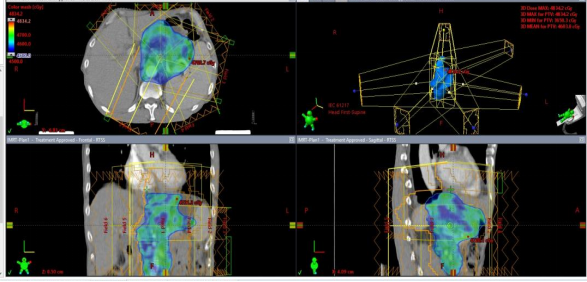
IMRT/VMAT is an upgraded version of traditional conformal radiotherapy, achieving two core breakthroughs through dynamic modulation of the multi-leaf collimator (MLC) and computer inverse optimization algorithms:
Shape Conformity: The irradiation field shape strictly matches the three-dimensional contour of the tumor (e.g., irregular masses, luminal tumors), avoiding "over-irradiation" of healthy tissues.
Intensity Modulation: Based on the internal heterogeneity of the tumor (e.g., necrotic areas, infiltrating borders) and the sensitivity thresholds of surrounding critical organs (e.g., spinal cord, intestines, lens), differentially assign dose intensities to each beam, achieving the dual goals of uniform dose distribution within the tumor (±3%-5%) and minimized dose to organs at risk.
This technology is widely used for head and neck tumors (nasopharyngeal carcinoma, laryngeal cancer), pelvic tumors (rectal cancer, cervical cancer), and adjuvant radiotherapy after breast-conserving surgery for breast cancer, significantly reducing the incidence of complications such as dry mouth, radiation enteritis, and cardiotoxicity.

IV. Hardware Facilities
In terms of equipment configuration, the department has introduced multiple internationally advanced large medical instruments, including: GE Discovery MI large-scale iterative PET-CT, Siemens MAGNETOM Skyra 3.0T superconducting magnetic resonance simulation positioning system, Siemens Somatom Confidence 64-slice simulation CT, Varian VitalBeam linear accelerator, Varian Clinac iX linear accelerator, Elekta Infinity four-dimensional image-guided linear accelerator, etc. These devices together form a complete high-precision radiotherapy platform, providing a solid foundation for clinical treatment.
V. Service Philosophy and Patient Care
The medical team led by Dr. Chen Weizuo will utilize cutting-edge heavy ion radiotherapy technology combined with personalized comprehensive treatment plans to provide precise and efficient medical services for each patient. Our strengths include:
- Advanced medical equipment and technology
- Close collaboration of multidisciplinary experts
- Experienced expert team
- Comprehensive and humanized management
- Warm and comfortable medical environment
- Whole-process considerate patient care
VI. Contact Information
Inpatient Department Address: Radiotherapy Department Ⅲ, Building 5, 1st Floor, Heavy Ion Campus, Wuwei Medical Science Academy Cancer Hospital
Phone: 0935-6988055 Director Chen Weizuo: 13519351968 (Same as WeChat ID)